
ILM Level 5 management units span a broad range of assessment territory: financial management, project management, people development, marketing strategy, and operational performance. The common thread running through all of them is the requirement for critical analysis grounded in real workplace evidence. Financial data must be analysed causally, not summarised descriptively. Project documentation must demonstrate stakeholder management and risk evaluation, not just process compliance. Performance management evidence must show the candidate understanding WHY team performance trends are occurring, not just reporting that they are. At Level 5, the assessor is evaluating whether the candidate can think as a manager, whether they are asking the right analytical questions about the data in front of them and connecting their findings to theoretical frameworks that explain why things happen in organisations. The most common reason for referral across Level 5 management units is not missing evidence (most working managers have substantial evidence of management activity); it is evidence that is presented descriptively rather than analysed critically. A variance analysis that reports "costs were 15% above budget in Q3" is description; a variance analysis that identifies the causal drivers of the variance, maps them to controllable and uncontrollable factors, evaluates the management decisions that contributed to them, and proposes corrective actions with a rationale drawn from Kaplan and Norton or relevant management theory is the analytical standard Level 5 assessors require. This guide provides criterion-level guidance for the most commonly assessed management units at Level 5.
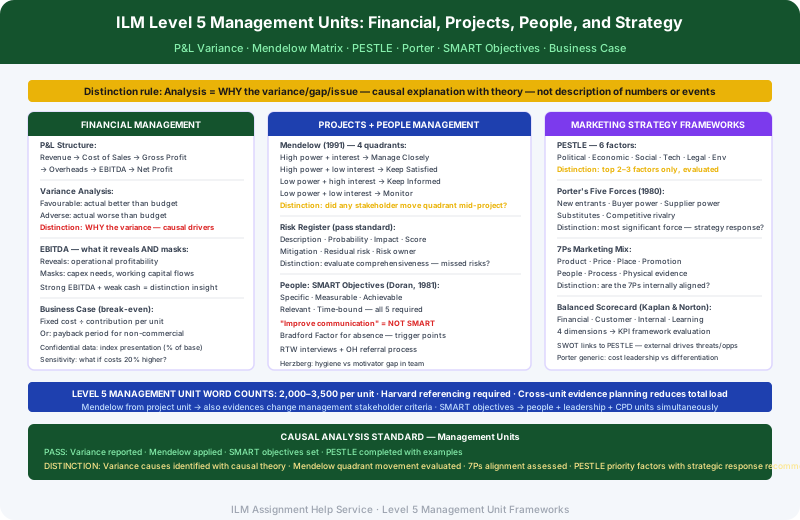
Level 5 Management Units Overview: Which Evidence for Which Unit
ILM Level 5 Certificate and Diploma programmes include a range of management units that address different aspects of middle management practice. The most commonly assessed management-focused units (as distinct from leadership-focused units covered in the companion guide) include: Managing Financial Resources (understanding financial statements, budget management, variance analysis, cost-benefit analysis); Managing Projects in the Organisation (project planning, stakeholder management, risk management, monitoring and evaluation); Managing and Developing People (performance management, objective setting, absence management, development planning); Understanding Marketing for Managers (market analysis, customer segmentation, competitive analysis, marketing planning); and Writing a Business Case (financial justification, stakeholder analysis, cost-benefit and break-even analysis, risk assessment). Each unit has its own assessment criteria, but they share the common analytical requirement: evidence of management practice analysed with theoretical frameworks and evaluated for effectiveness.
Evidence selection by unit: Financial Management units require P&L statements, budget reports, variance analyses, and financial monitoring evidence from the candidate's actual management role, anonymised to protect commercial confidentiality. Candidates who do not have direct budget responsibility should discuss this constraint with their ILM centre before beginning the unit, as the work-based evidence requirement may be met through financial data analysis even where the candidate does not have budget authority. Project Management units require project planning documents (initiation documents, risk registers, stakeholder maps, work breakdown structures), progress monitoring evidence, and post-project evaluation. People Management units require performance review evidence, objective-setting records, absence management documentation, and development plan evidence. Marketing units require market analysis documentation, competitor analysis evidence, customer data, and marketing planning evidence. These units are most relevant to candidates in commercial, sales, or marketing management roles. Business Case writing units often permit the case to be written specifically for the assessment, provided it addresses a real organisational need in the candidate's actual workplace context.
Financial Management: P&L, Variance Analysis, and EBITDA Causal Analysis
Financial management is one of the most technically demanding assessment areas for Level 5 candidates who do not come from a finance background, and one of the most commonly misunderstood. The ILM Level 5 financial management criterion does not require candidates to be qualified accountants. It requires them to demonstrate that they can read financial information, understand what it reveals about organisational performance, identify the management decisions that have influenced the financial outcomes, and propose informed responses. The distinction between reading financial data and analysing it is the fundamental criterion divide: reading is descriptive (the numbers are X), analysing is evaluative (the numbers are X because of Y, and the implication for management decision Z is...).
P&L (Profit and Loss) analysis at Level 5 requires the candidate to understand the structure of a P&L statement: Revenue, Cost of Sales (leading to Gross Profit), Overheads (leading to EBITDA, Earnings Before Interest, Tax, Depreciation, and Amortisation), Interest and Tax (leading to Net Profit). The candidate must be able to identify which line items are within their management influence, which are not, and what the trends in those line items reveal about management effectiveness. Variance analysis (the comparison of actual financial performance against budget) requires the candidate to identify favourable variances (actual better than budget), adverse variances (actual worse than budget), and to explain causally why each significant variance has occurred. "Labour costs were 12% above budget in Q2 due to increased agency spend driven by higher-than-projected absence rates" is a causal explanation. "Labour costs exceeded budget in Q2" is description without causal analysis.
EBITDA is the financial metric most commonly featured in Level 5 management assignments because it is the profitability measure most directly influenced by operational management decisions (as distinct from financing decisions, which affect interest payments, and accounting policy decisions, which affect depreciation). Distinction-level EBITDA analysis at Level 5 requires the candidate to evaluate both what EBITDA reveals (operational profitability relative to revenue, gross margin improvement or deterioration, overhead efficiency) and what it masks: EBITDA excludes capital expenditure and working capital movements, meaning it can overstate the cash generation position of a business and obscure the long-term investment needs. A candidate who notes that their organisation's strong EBITDA performance co-exists with deteriorating cash flow due to capital investment requirements is demonstrating the level of financial literacy that distinction criteria at Level 5 require.
Project Management: Mendelow's Matrix, Risk Registers, and WBS
ILM Level 5 project management units require candidates to demonstrate the full project management lifecycle (from initiation and planning through execution, monitoring, and closure) with evidence of specific project management tools applied to a real workplace project. The three most commonly assessed tools are Mendelow's stakeholder matrix, the project risk register, and the work breakdown structure (WBS).
Mendelow's matrix (1991) classifies stakeholders by two dimensions: their level of power (influence over the project's success or failure) and their level of interest (the extent to which the project's outcomes affect them). The four resulting quadrants produce four management strategies: high power, high interest (Manage Closely: frequent engagement, co-creation of decisions, regular communication, active relationship management), high power, low interest (Keep Satisfied: periodic updates, emphasis on impact on their interests, involvement in key decisions but not routine management), low power, high interest (Keep Informed: regular communication about progress and decisions that affect them, but not active co-creation of project decisions), low power, low interest (Monitor: minimal active management, monitor for changes in position). The distinction-level application of Mendelow requires the candidate to evaluate whether their initial stakeholder classification was accurate: did any stakeholder move between quadrants during the project, and what were the management implications of that movement? A project sponsor classified as "high power, high interest" who became disengaged (effectively becoming "high power, low interest") mid-project represents a stakeholder management failure that should be evaluated, not concealed.
Risk registers at Level 5 pass standard: a table listing identified risks, their probability (high/medium/low), their potential impact (high/medium/low), a risk score, the mitigation action, the residual risk after mitigation, and the risk owner. At distinction standard: evaluation of whether the risk identification process was comprehensive, assessment of whether mitigation actions were effective in practice, and reflection on whether any risks that materialised were foreseeable but missed in the initial risk assessment. WBS (Work Breakdown Structure) at Level 5: decomposing the project deliverables into tasks, sub-tasks, and work packages with resource allocation and timeline. At distinction standard: evaluation of whether the WBS was an effective planning tool: were there tasks that were not captured, dependencies that were not identified, or resource assumptions that proved incorrect?
Managing and Developing People: Performance Management, SMART Objectives, and Absence
The Managing and Developing People unit at Level 5 requires candidates to demonstrate that they can set performance objectives, manage performance against those objectives, address absence and conduct issues through appropriate management processes, and develop individual team members through coaching, development planning, and performance review. The assessment criteria span the full people management lifecycle (from objective setting through to underperformance management and development planning) and the evidence must demonstrate that the candidate manages the whole cycle, not just the comfortable middle portion.
SMART objectives (Doran, 1981) at Level 5 pass standard: the candidate sets objectives for team members that meet all five SMART criteria. At distinction standard: the candidate evaluates the quality of their objective-setting practice: were the objectives genuinely SMART in practice, or were they nominally SMART but actually vague, unmeasurable, or not genuinely connected to team and organisational performance goals? The distinction between objectives that are formatted as SMART and objectives that are functionally SMART requires critical self-evaluation: "Improve customer satisfaction scores" is not SMART; "Increase the team's average customer satisfaction score from 3.7/5 to 4.2/5 by end of Q3 2026, measured by the quarterly Customer Feedback Survey, through structured training on complaint resolution techniques delivered in February 2026" is SMART. Performance management evidence at distinction level includes both the formal performance review documentation and the analytical reflection on whether the performance management process was effective: whether objectives were appropriate to the individual's capability and context, whether feedback was specific enough to drive improvement, and whether the process overall developed the individual's performance or merely monitored it.
Absence management at Level 5 requires the candidate to demonstrate that they manage absence systematically and fairly: using recognised tools such as the Bradford Factor (which calculates the disruptiveness of absence patterns by weighting frequency relative to total duration), return-to-work interview processes, absence trigger point procedures, and occupational health referral where appropriate. The ethical dimension of absence management (balancing the organisation's legitimate interest in attendance with the individual's health needs and legal protections) should be explicitly addressed in any Level 5 people management assignment, connecting to employment law awareness and the duty of care obligations that managers carry.
Marketing Strategy: PESTLE, Porter's Five Forces, and 7Ps for Commercial Managers
The ILM Level 5 Understanding Marketing for Managers unit is most relevant to candidates in commercial, sales, operations, or general management roles where external market analysis is a genuine management responsibility. The unit requires the candidate to analyse their organisation's marketing environment using established strategic analysis frameworks, identify strategic options, and evaluate marketing planning decisions with evidence from their own management context. The three most commonly expected frameworks are PESTLE (Political, Economic, Social, Technological, Legal, and Environmental factors), Porter's Five Forces (competitive intensity analysis), and the 7Ps marketing mix (Product, Price, Place, Promotion, People, Process, Physical evidence).
PESTLE at Level 5 pass standard: a structured analysis of each factor with examples relevant to the candidate's organisation and industry. At distinction standard: identification of the two or three PESTLE factors with the greatest current or near-term impact on the organisation's competitive position, evaluation of how the organisation is currently responding to those factors, and assessment of whether the current strategic response is sufficient or whether additional management action is required. Porter's Five Forces (1980) (Threat of New Entrants, Bargaining Power of Buyers, Bargaining Power of Suppliers, Threat of Substitutes, and Competitive Rivalry) at Level 5 pass standard: analysis of each force with industry evidence. At distinction standard: identification of the forces that are most significant for the organisation's current competitive position, evaluation of how the organisation's strategy is positioned relative to those forces, and assessment of whether the positioning is sustainable given observable trends. The 7Ps at Level 5: application of all seven elements to the candidate's organisation's marketing approach, with evaluation of the consistency and effectiveness of the marketing mix: are the seven elements aligned and mutually reinforcing, or are there internal inconsistencies (e.g., premium pricing with inadequate physical evidence, or a strong digital promotion strategy with weak process support at the point of sale)?
Writing a Business Case: Cost-Benefit Analysis, Break-Even, and Stakeholder Justification
The ILM Level 5 business case writing unit requires candidates to construct a persuasive, evidence-based justification for a proposed management initiative: a capital investment, a new service, a process change, or an organisational development intervention. The business case structure includes: an executive summary, context and problem statement, proposed solution, cost-benefit analysis, break-even analysis, risk assessment, implementation plan, and recommendation. At Level 5 pass standard, each element must be present and accurate. At distinction standard, each element must be analytically sophisticated: the cost-benefit analysis must include sensitivity analysis (what happens if costs are 20% higher than projected, or if benefits are 20% lower?), the break-even analysis must be presented with clear assumptions identified, and the stakeholder justification must apply Mendelow's matrix to identify and address the concerns of high-power stakeholders.
Break-even analysis at Level 5: the point at which total revenue equals total costs, calculated as fixed costs divided by contribution per unit (selling price minus variable cost per unit). In non-commercial contexts, break-even is often reframed as payback period, the time required for the cumulative benefits of the investment to equal the investment cost. Both calculations require the candidate to make assumptions about cost structures, revenue projections, or benefit values, and those assumptions must be stated explicitly and evaluated for their reasonableness rather than treated as facts. A business case that presents break-even figures without identifying the assumptions underlying them, and without acknowledging the scenarios in which those assumptions might not hold, does not reach the analytical standard that distinction criteria at Level 5 require.
Are you finding it difficult to apply financial analysis frameworks to your real workplace data without crossing into commercially sensitive territory?
The most common practical challenge in ILM Level 5 management unit assignments is working with real financial data that is commercially confidential. Most candidates have access to the data their unit requires (P&L statements, budget reports, project cost analyses) but are uncertain about how to present it in an assignment without disclosing information their employer would consider sensitive. The solution is index presentation: presenting financial data as percentages or index numbers relative to a base figure, rather than as absolute monetary values, preserves the analytical structure of the data (trends, variances, proportions, patterns) while removing the specific figures that might identify the organisation's financial performance. This approach is explicitly accepted by ILM quality assurance and is the standard approach used in distinction-level financial management assignments. Our support service helps candidates structure financial analysis presentations that satisfy both the analytical depth requirements of the assessment criteria and the commercial confidentiality requirements of their employer, at the specific criterion level for the management unit they are completing.
Criterion Mapping Across Multiple Level 5 Management Units
ILM Level 5 Certificate and Diploma programmes typically require candidates to complete four to eight units. Evidence produced for one unit often has direct relevance to criteria in other units: Mendelow's stakeholder analysis for a project management unit provides evidence for stakeholder engagement criteria in change management units; absence management evidence for the people management unit contributes to performance management criteria in organisational development units. Planning evidence production with cross-unit relevance in mind from the outset of the programme reduces total evidence production load while increasing criterion coverage density. See also: ILM Level 5 programme structure and unit selection · Level 5 leadership unit assignment help · ILM assignment structure and evidence · Work-based evidence annotation and presentation · Public sector and NHS management unit context
Porter, Kaplan and Norton, and Strategic Management Theory at Level 5
ILM Level 5 management units occasionally require engagement with strategic management theory beyond the immediate operational frameworks: Porter's (1980) generic competitive strategies (cost leadership, differentiation, focus), Porter's (1985) value chain analysis, and Kaplan and Norton's (1996) Balanced Scorecard. The Balanced Scorecard is particularly relevant for Level 5 candidates in organisations that use KPI frameworks, as it provides a theoretical foundation for evaluating whether the organisation's performance measurement system covers all four performance dimensions: Financial (traditional financial metrics), Customer (customer satisfaction, retention, acquisition), Internal Business Processes (operational efficiency, quality), and Learning and Growth (employee capability, innovation, organisational culture). Candidates who connect their financial analysis evidence to the Balanced Scorecard at Level 5 demonstrate the strategic awareness that differentiates distinction-level management analysis from pass-level operational reporting. See also: Level 5 strategic analytical requirements · Strategic frameworks at Level 7
ILM Level 5 Management Unit Assignment Help: Frequently Asked Questions
What financial evidence do I need for the ILM Level 5 financial management unit if I do not have a direct budget?
If you do not have direct budget responsibility in your current role, discuss this with your ILM centre before beginning the financial management unit. Many centres accept a combination of approaches: analysis of financial data relevant to your operational area (even if you do not hold the budget), a business case for a proposed initiative with full cost-benefit analysis, or, in some cases, a hypothetical financial scenario developed from real data in your organisation's sector. The key requirement is that the financial analysis demonstrates your ability to read financial statements, identify variances and their causes, and make management recommendations based on financial evidence; the analytical competence is the assessment target, not the specific financial authority the candidate holds.
How detailed does a risk register need to be for an ILM Level 5 project management unit?
An ILM Level 5 pass-standard risk register should include: risk description, probability rating (high/medium/low or scored 1–5), impact rating (high/medium/low or scored 1–5), overall risk score (probability multiplied by impact), mitigation action, residual risk after mitigation, and risk owner. Typically eight to twelve risks are sufficient for most Level 5 project contexts. At distinction standard, add an evaluation of whether the risk identification process was comprehensive, with a specific example of a risk that materialised despite mitigation, an analysis of why the mitigation was insufficient, and a reflection on what would be done differently in future project risk management. The distinction-level standard is critical reflection on the risk management process, not just completion of the risk register template.
What is the difference between a PESTLE analysis at Level 5 pass and distinction standard?
At Level 5 pass standard, PESTLE analysis presents relevant examples for each factor: Political, Economic, Social, Technological, Legal, and Environmental, with industry-specific evidence. At distinction standard, the candidate selects the two or three factors with the greatest current strategic significance, evaluates the organisation's current response to each, assesses whether the response is sufficient given observed trends, and connects the analysis to a strategic recommendation or management action. The pass/distinction difference is selectivity and evaluation: pass identifies all six factors with examples; distinction prioritises the most significant factors, evaluates the strategic response, and makes a management recommendation based on the analysis.
Common Questions
Is this service specific to ILM qualifications?
Yes. We specialise exclusively in City & Guilds ILM qualifications. Our writers are selected for their specific knowledge of ILM units, marking criteria, and grade descriptors — not generic academic writing.
Will my assignment be plagiarism free?
Every assignment is written from scratch and run through Turnitin before delivery. You receive a copy of the originality report alongside your completed work.
How quickly can you complete my assignment?
Standard turnaround is 5–7 days. For urgent orders we offer 24-hour and 48-hour expedited delivery at an additional cost. Contact us to confirm availability for your deadline.
What if I'm not happy with the work?
We offer unlimited free revisions within 14 days of delivery. If we cannot meet your requirements after multiple revisions, we offer a full refund — no questions asked.