
Work-based evidence is the primary currency of ILM assessment. Unlike traditional academic qualifications, where marks are awarded for essays demonstrating theoretical understanding, ILM qualifications are assessed on the candidate's ability to demonstrate competence in their actual workplace role. Work-based evidence is the means by which that competence is shown to assessors. The evidence principle underpinning all ILM qualifications is that leadership and management capability must be demonstrated in practice, not just described in theory. This creates both the opportunity and the challenge of ILM assessment: candidates with genuine management experience have rich evidence to draw on, but that evidence must be selected, presented, and annotated in ways that satisfy specific assessment criteria. The gap between "I have the evidence" and "my evidence meets the criteria" is the gap where most ILM referrals occur. Understanding what counts as valid work-based evidence, how to annotate it against criteria, what volume and depth assessors require at each level, and what they will and will not accept is the foundational competency for any ILM candidate preparing a portfolio submission. This guide addresses all four of those questions with the specificity that unit specifications demand but rarely provide.
What "Work-Based Evidence" Means in ILM Qualifications
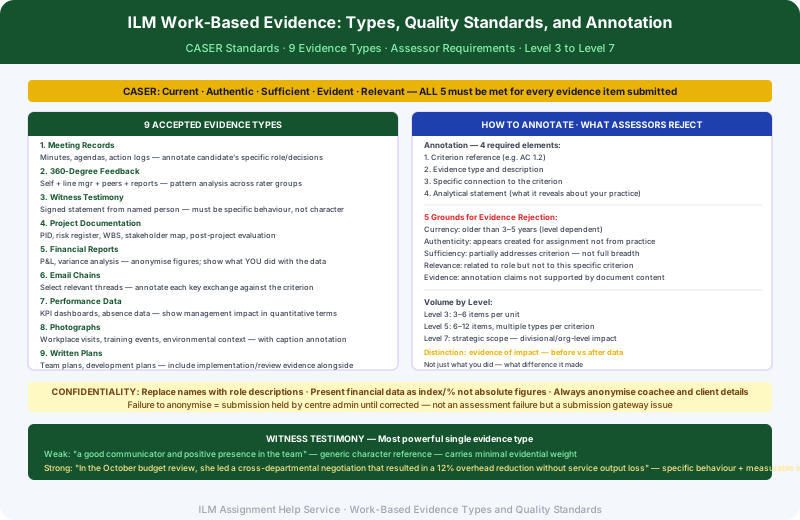
ILM work-based evidence is any documentary or observational evidence of the candidate's management or leadership practice in their actual workplace role. The defining characteristic is authenticity: the evidence must demonstrate something the candidate actually did, decided, managed, or led, not something hypothetical, simulated, or borrowed from another person's practice. City and Guilds (ILM) quality assurance standards require that all work-based evidence be Current (produced within the last three to five years, depending on level and unit), Authentic (genuinely produced by or for the candidate in their workplace role), Sufficient (in enough volume and depth to fully evidence the relevant criteria), Evident (clearly demonstrating what it is claimed to demonstrate), and Relevant (directly related to the specific assessment criterion it is cited for). These five quality standards (often referred to by ILM assessors as CASER) are applied to every piece of work-based evidence submitted, and evidence that fails any one of them will be rejected regardless of its apparent relevance.
The distinction between work-based evidence and assignment text is important: many ILM candidates confuse written assignment text (their own analytical writing describing their management practice) with work-based evidence (actual documentary artefacts from their workplace). Both are required in most ILM units: the written assignment provides the analytical framework that connects evidence to criteria, and the work-based evidence provides the authentic proof that the described practice actually occurred. A written account of how the candidate managed a performance issue is assignment text. It demonstrates analytical ability. The outcome of the performance review meeting, or a witness statement from the candidate's line manager confirming it took place, is work-based evidence. It demonstrates authentic workplace activity. Both are assessed, but they are assessed against different criteria, and substituting one for the other is a common cause of incomplete criterion coverage.
ILM assessors are also trained to identify evidence inflation: padding a portfolio with volume rather than quality, using evidence that is peripheral or tangential to the criterion being evidenced, or presenting administrative documents (standard forms, routine correspondence) as evidence of management capability without the analytical annotation that demonstrates what the candidate did with them and why. An email chain is not evidence of effective stakeholder communication by itself; it is evidence of communication having occurred. The analytical annotation that maps it to a specific criterion, explains what communication approach was used and why, and evaluates the effectiveness of that approach in the specific context is what transforms a document into evidence.
The 9 Evidence Types: What Each Is and When to Use It
ILM qualifications accept nine primary evidence types, each suited to different assessment criteria and different management contexts. Meeting records (minutes, agendas, action logs) evidence decision-making, stakeholder management, planning, and team leadership. To be creditworthy, meeting records must show the candidate's specific contribution or role, not just that a meeting occurred; annotated meeting records that highlight the candidate's agenda items, decisions made, or actions allocated are more useful than unannotated minutes. Witness testimony (written statements from colleagues, line managers, or direct reports confirming specific workplace activities or behaviours) is one of the most powerful evidence types because it provides third-party authentication of claims the candidate makes in written assignments. Effective witness testimony is specific (describing particular behaviours and their impacts, not general character assessments), relevant (addressing the specific assessment criteria identified by the candidate), and signed and dated by a named individual in a named role.
360-degree feedback reports, structured feedback from multiple rater groups (self, line manager, peers, direct reports), are particularly valuable for leadership units because they provide multi-perspectival evidence of leadership behaviour that no single self-report can replicate. At Level 5, assessors expect pattern analysis across rater groups, not just presentation of the feedback data, but analytical examination of where self-perception and other-perception differ, what those gaps reveal about leadership blind spots, and how the candidate plans to address them. Project documentation, project initiation documents, risk registers, work breakdown structures, stakeholder maps, project progress reports, and post-project evaluations, evidences project management competence at Levels 4, 5, and 7. Financial reports, P&L statements, budget variance reports, cost-benefit analyses, evidence financial management capability but must be anonymised to protect organisational confidentiality and annotated to show what the candidate did with the financial data, not just that they had access to it.
Email chains evidence communication, stakeholder management, and decision-making but require careful selection: relevant threads that demonstrate specific management competencies, with irrelevant exchanges removed and key exchanges annotated to identify the management decision or communication approach being evidenced. Performance data, KPI dashboards, team performance reports, absence data, productivity metrics, evidence the candidate's management impact in quantitative terms and are particularly valuable for demonstrating that management actions produced measurable outcomes. Photographs evidence physical activities, workplace visits, training events, and environmental factors relevant to management practice. Written plans, team plans, operational plans, communication plans, development plans, evidence planning capability and are most useful when they include evidence of implementation or review alongside the plan itself, showing that planning was not just an exercise but a genuine management tool.
How to Annotate Evidence to Map to Assessment Criteria
Evidence annotation is the process of explicitly connecting a piece of work-based evidence to the specific assessment criterion it evidences, explaining what the evidence demonstrates and why it meets the criterion. Without annotation, assessors must make their own inference about which criterion a piece of evidence is intended to address. They are not obliged to make that inference charitably. Evidence that is presented without annotation will often be logged as "noted" and may not be credited against any criterion, even if the assessor can see its relevance. Annotation prevents this by making the connection explicit and criterion-specific.
Effective evidence annotation includes four elements: the criterion reference (e.g., "AC 1.2: Evaluate the impact of leadership style on team performance"), the evidence type and description ("360-degree feedback report, September 2024"), the specific connection to the criterion ("This report provides multi-source feedback data from four rater groups that evidences the impact of my transformational leadership approach on team engagement, as required by AC 1.2"), and the analytical statement that maps the evidence to the criterion ("The gap between my self-assessment (3.8/5) and my direct reports' assessment (4.4/5) indicates that my impact on team engagement is greater than I perceive, an observation consistent with Bass's (1985) finding that transformational leaders often underestimate the inspirational dimension of their leadership impact"). That last element (the analytical statement) is what distinguishes evidence annotation that reaches distinction standard from annotation that merely labels the evidence.
Physical evidence annotation: where evidence is a physical document (a meeting record, a financial report, an email chain), annotation should appear either as a typed cover page for each evidence item or as highlighted sections within the document with marginal annotations identifying the criterion each section evidences. ILM centres vary in their preferred format: some require a formal evidence portfolio index with numbered evidence items and cross-references to criteria; others accept inline annotation within the assignment text. The unit specification and centre guidelines will specify the required format; where they do not, a formal portfolio index with annotated cross-references is the safest approach.
What Assessors Reject: Evidence Failures Causing Referrals
Assessors reject evidence on one of five grounds. Currency failure: evidence that is more than three to five years old (depending on the level) is presumed to reflect outdated practice and will not be credited unless the candidate explicitly justifies its ongoing relevance. Evidence of a management action taken seven years ago does not demonstrate current management capability regardless of its intrinsic quality. Authenticity failure: evidence that appears to have been created specifically for the assignment rather than arising naturally from workplace practice raises authenticity concerns. A witness statement written in the same corporate voice as the candidate's assignment text, a meeting record with an unusual level of detail about the candidate's specific leadership behaviours, or performance data that perfectly matches every criterion are all flags that assessors are trained to examine carefully.
Sufficiency failure: evidence that partially addresses a criterion but does not fully meet it. A single email exchange evidencing one instance of stakeholder communication does not sufficiently evidence a criterion that requires "sustained and effective stakeholder engagement across a project lifecycle." Sufficiency is assessed against the full breadth of the criterion, not just its surface. Relevance failure: evidence that relates to the candidate's role or organisation but does not directly address the specific criterion being claimed. A team away-day agenda evidences that an event occurred but may not evidence the planning, team development, or communication criteria that the candidate has claimed it against. Evidence failure: evidence that, when examined, does not demonstrate what the candidate's annotation claims. A witness statement that describes the candidate as "a good communicator and positive presence in the team" does not evidence that the candidate "can analyse stakeholder needs and adapt communication strategies accordingly." The language of the statement must match the language of the criterion.
Evidence Portfolios vs Written Assignments: Understanding the Difference
ILM assessment typically combines two submission components: a written assignment (the candidate's own analytical writing applying management theory to their practice and connecting it to assessment criteria) and an evidence portfolio (the documentary and observational evidence from the workplace that corroborates and substantiates what the assignment claims). Some units are entirely assignment-based; others are portfolio-based with minimal written commentary; most are hybrid. Understanding the distinction matters because the marking criteria for each component are different: written assignments are marked on analytical depth, theoretical application, and criterion coverage in the text; evidence portfolios are marked on the currency, authenticity, sufficiency, relevance, and evidential clarity of the documents submitted.
A common error is candidates submitting an evidence portfolio that duplicates what the written assignment has already established analytically, rather than corroborating it with authentic workplace artefacts. If the written assignment provides a detailed analytical account of how the candidate managed a change programme, the evidence portfolio should contain the documents that prove the change programme occurred and that the candidate managed it: the project plan, the stakeholder communication, the risk register, the outcome data, not a restatement of the analytical account in a different format. Conversely, submitting an evidence portfolio without sufficient written analytical context leaves assessors unable to connect the documents to specific criteria; they need both the evidence and the analysis that maps it.
Volume and Depth Expectations by ILM Level
ILM Level 3 evidence portfolios: typically three to six pieces of work-based evidence per unit, with each piece supported by a brief annotation connecting it to the relevant criterion. The volume requirement is relatively low, but the authenticity requirement is the same at all levels: real workplace documents, not student-created simulations. Witness testimony is particularly valuable at Level 3 because it provides third-party authentication for candidates whose workplace evidence may be relatively thin (team leaders whose management role is limited in scope). Level 3 assessors are looking for evidence that the candidate is applying leadership and management concepts in their immediate team context, not evidence of strategic management at organisational level.
ILM Level 5 evidence portfolios: typically six to twelve pieces of evidence per unit, with more sophisticated annotation that demonstrates analytical depth rather than just criterion identification. At Level 5, assessors expect to see multiple evidence types for each criterion, not just one document that partially addresses it, but a combination of types that together build a complete evidential case. Financial reports, project documentation, 360-degree feedback, and witness testimony from multiple sources are expected components of a Level 5 portfolio. Distinction-level portfolios at Level 5 include evidence of impact, not just what the candidate did, but what difference it made, demonstrated through outcome data, improved performance metrics, or comparative before-and-after evidence. ILM Level 7 evidence portfolios: strategically complex, multi-source, and demonstrating senior leadership scope. Evidence should reflect the candidate's organisational leadership: strategic planning documents, board-level communications, cross-departmental project outcomes, organisational performance data. Assessors at Level 7 expect evidence of leadership impact at organisational or divisional level, not team-level management actions.
Do you have the workplace evidence but struggle to present it in the way ILM assessors require?
The most common evidence challenge for ILM candidates is not having insufficient evidence, most working managers have extensive documentation of their practice, it is knowing which evidence to select for each criterion, how to annotate it to demonstrate its relevance, and how to combine multiple evidence types into a coherent criterion-level case. Selecting the wrong evidence type (descriptive rather than evaluative), failing to annotate (leaving assessors to infer relevance rather than seeing it stated), and providing volume without depth (ten peripheral documents instead of three well-annotated primary ones) are the three most common portfolio errors. Our support service helps candidates audit their existing evidence against specific assessment criteria, identify the critical gaps, and structure annotations that make the evidential connection explicit and criterion-specific, at the analytical standard required for their ILM level. Work-based evidence guidance is provided for units at all levels, including unit specifications that do not clearly describe what evidence is required.
Connecting Work-Based Evidence to Reflective Accounts
Work-based evidence and reflective accounts are complementary submission components: the evidence proves that the practice occurred, and the reflective account demonstrates that the candidate has learned from and developed through the experience. The two must connect explicitly: the reflective account should reference specific evidence items by type (not by confidential detail), and the evidence should corroborate the specific situations and outcomes that the reflective account analyses. A reflective account that analyses a performance management conversation should be supported by evidence of that conversation (an anonymised file note, an outcome record, a witness statement from the candidate's line manager); a reflective account that evaluates the impact of a communication strategy should be supported by evidence of the communication (an email chain, a meeting record, feedback data). See also: ILM assessment structure and evidence standards · Level 3 evidence requirements · Level 5 evidence and portfolio standards · Reflective account writing and evidence integration · How ILM assessment works end to end
Confidentiality and Anonymisation in Work-Based Evidence
All work-based evidence submitted for ILM assessment must be anonymised to protect the confidentiality of the people and organisations involved. Individual names should be replaced with role descriptions (e.g., "the Finance Manager" or "Team Member A"); organisation names that are not already publicly known in the context of the submission should be replaced with a description (e.g., "a mid-sized financial services organisation in the North West of England"); financial data should be presented in index format rather than absolute figures where absolute figures would identify the organisation's financial performance. ILM assessors and external quality verifiers are bound by confidentiality agreements but candidates remain responsible for obtaining any necessary consent from their employers and for ensuring that sensitive or commercially confidential information is appropriately protected. Failure to anonymise adequately is not a marking failure; it will be flagged by the centre administrator and the submission held until the anonymisation is completed. See also: ILM assignment submission standards · Level 5 portfolio confidentiality requirements
ILM Work-Based Evidence Guide: Frequently Asked Questions
What is the most powerful type of work-based evidence for an ILM portfolio?
Witness testimony from a line manager or senior colleague is typically the most powerful single evidence type because it provides third-party authentication of claims the candidate makes in their written assignment. To be fully creditworthy, witness testimony must be specific, describing particular behaviours and their observable impacts, signed by a named individual in a named role, and directly addressing the assessment criterion it is cited for. Vague character references ("a good communicator") carry very little evidential weight. Specific behavioural statements ("In the October budget review, she led a cross-departmental negotiation that resulted in a 12% reduction in overhead costs without any reduction in service output") are the standard assessors look for.
How old can work-based evidence be for an ILM portfolio?
ILM quality assurance standards generally require work-based evidence to be current, typically within the last three years for Level 3 and Level 5, and within the last five years for some Level 7 units where strategic evidence by definition reflects longer-term leadership impact. Evidence older than these timeframes should be used only where the candidate can demonstrate its continued relevance to their current practice, and it should be supported by more recent corroborating evidence. Where a candidate has limited recent evidence due to role changes or organisational restructuring, witness testimony confirming that the described practices are representative of ongoing capability can help bridge the currency gap.
Can I create documents specifically for my ILM portfolio, or does everything have to pre-exist?
ILM assessment requires authentic work-based evidence: documents that arise naturally from workplace practice rather than being created specifically for the portfolio. However, certain evidence types are legitimately produced as part of the assessment process: reflective accounts, personal development plans, self-assessments, and criterion-mapping documents are assessment tools, not work-based evidence. Some units also permit the candidate to produce specific management plans or analyses as part of the assessment itself. Where a document appears to have been created solely to satisfy an assessment criterion, particularly if it uses assessment language rather than management language, assessors may query its authenticity. The test is whether the document could plausibly have been produced as a normal management tool in the candidate's role.
Common Questions
Is this service specific to ILM qualifications?
Yes. We specialise exclusively in City & Guilds ILM qualifications. Our writers are selected for their specific knowledge of ILM units, marking criteria, and grade descriptors — not generic academic writing.
Will my assignment be plagiarism free?
Every assignment is written from scratch and run through Turnitin before delivery. You receive a copy of the originality report alongside your completed work.
How quickly can you complete my assignment?
Standard turnaround is 5–7 days. For urgent orders we offer 24-hour and 48-hour expedited delivery at an additional cost. Contact us to confirm availability for your deadline.
What if I'm not happy with the work?
We offer unlimited free revisions within 14 days of delivery. If we cannot meet your requirements after multiple revisions, we offer a full refund — no questions asked.