ILM (the Institute of Leadership and Management) is an Ofqual-regulated leadership qualification body and a City & Guilds Group company. All ILM qualifications are assessed entirely through work-based written evidence with no exams: candidates must provide evidence from their own workplace that addresses every assessment criterion in every unit, and missing any one criterion results in a referral regardless of the quality of the rest of the submission. This service provides expert guidance on structuring that evidence correctly, at Level 3 for team leaders and supervisors, Level 5 for middle managers and operations managers, and Level 7 for senior leaders and directors.
What Is an ILM Qualification? Levels, Types, and Assessment Format
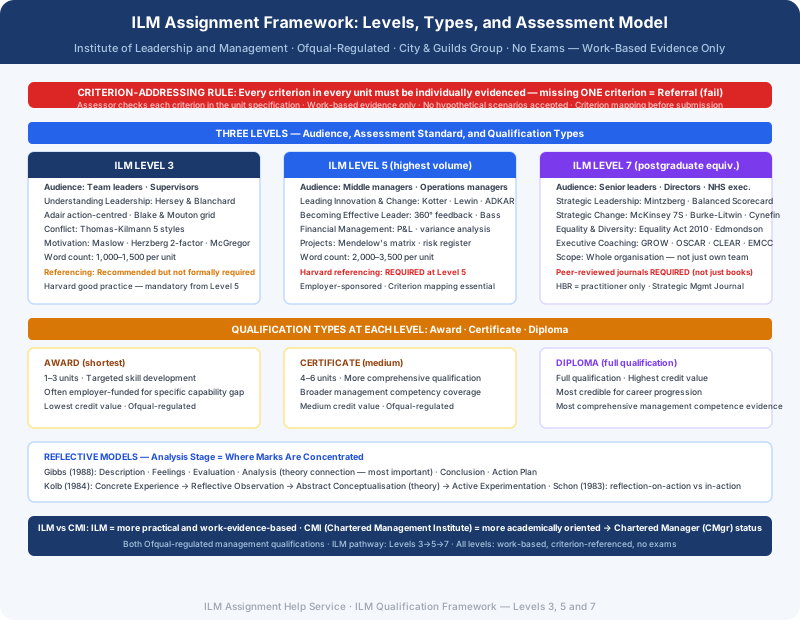
ILM qualifications are available at Levels 2, 3, 5, and 7, aligned to the Regulated Qualifications Framework (RQF). The most widely enrolled levels are Level 3 (team leader and supervisor entry-level management), Level 5 (middle manager and operations manager, the highest-search-volume ILM level), and Level 7 (senior leader and director, postgraduate equivalent). At each level, qualifications are offered in three types: Award (1–3 units, the shortest commitment, often employer-funded for a specific management capability gap), Certificate (4–6 units, a more comprehensive qualification at the given level), and Diploma (the full qualification, the most comprehensive evidence of management competence and the most credible route for career progression applications).
The fundamental characteristic of all ILM qualifications is the assessment format: entirely work-based, with no unseen examinations. Candidates evidence their leadership and management activities from their own workplace, real management decisions, real team leadership activities, real organisational change. ILM does not accept hypothetical scenarios or simulated evidence. Two primary pathways are available at Levels 3, 5, and 7: Leadership and Management (the main pathway, covering leading teams, managing performance, financial management, innovation, and strategic leadership depending on level) and Coaching and Mentoring (specialist pathway, covering coaching skills, mentoring practice, coaching models, and professional development planning).
ILM is often compared with CMI (Chartered Management Institute). ILM is perceived as more practical and work-evidence-based; CMI is more academically oriented and leads toward Chartered Manager (CMgr) status. Both are credible management qualifications, but ILM's purely work-based assessment model makes it particularly suited to working professionals who want to evidence management competence directly from their practice rather than through academic examination.
How ILM Assignments Are Assessed: Work-Based Evidence and the Criterion-Addressing Rule
All ILM assignments are assessed criterion by criterion. The assessor works through each assessment criterion listed in the unit specification and marks whether the candidate's submission provides sufficient evidence for each one. This makes the criterion-addressing rule the most operationally critical aspect of ILM assessment: every criterion must be individually addressed in the assignment. Missing one criterion results in a referral (a fail) regardless of how well every other criterion has been covered. A submission that is analytically excellent but fails to address one assessment criterion from the unit specification will be referred at the same outcome level as a submission that misses it because of poor planning.
Criterion mapping (annotating the draft assignment against each criterion from the unit specification before submission) is the most effective practical technique for ensuring no criterion is missed. Download the unit specification, list every criterion, and annotate each section of the draft with the criterion number it evidences. Any criterion left unannotated identifies a gap before submission rather than after referral.
Work-based evidence types that count in ILM assignments include: written analytical reports describing and reflecting on own management practice; management plans (action plans, project plans, business cases); meeting agendas and minutes as supporting documents; 360-degree feedback results with analytical commentary; witness statements from line managers or senior colleagues corroborating management activity; coaching session logs (for the Coaching and Mentoring pathway). The assessor is looking for evidence that each criterion has been met, not assessing the quality of the management described. A well-evidenced analysis of a difficult team situation that did not go perfectly will pass. A brief description of a successful outcome without criterion-specific evidence will be referred.
ILM Level 3 Assignment Help: Team Leaders, Supervisors, and Entry-Level Management
ILM Level 3 is the entry point for formal management qualification, designed for team leaders, supervisors, and people moving into their first management role. Assignments are typically 1,000–1,500 words per unit, shorter than Level 5, but requiring the same criterion-by-criterion evidence coverage from real team leader practice. Popular Level 3 units include: Understanding Leadership (applying Hersey and Blanchard's situational leadership, Adair's action-centred leadership, and Blake and Mouton's managerial grid to own team leader experience); Managing Workplace Projects at team level (project plan, stakeholder communication, risk register from a real workplace project); Understanding Conflict Management in the Workplace (Thomas-Kilmann five conflict management styles applied to a real conflict situation); and Motivating People in the Workplace (Maslow's hierarchy of needs, Herzberg's two-factor theory, McGregor's Theory X/Y applied to own team motivation approach).
At Level 3, many candidates are writing work-based academic evidence for the first time since school. The key challenge is translating team leader experience, which candidates have in abundance, into structured written evidence that addresses specific assessment criteria rather than a narrative of daily management activities. Harvard referencing is not formally required at Level 3 but citing the management theorists applied (Hersey and Blanchard, Herzberg, Thomas-Kilmann) strengthens the assignment and establishes good academic practice ahead of Level 5. Completing ILM Level 3 provides the recognised formal management qualification base and the academic evidence-writing foundation for progression to Level 5.
ILM Level 5 Assignment Help: Middle Managers, Operations Managers, and Work-Based Evidence
ILM Level 5 is the most widely enrolled ILM qualification level, designed for middle managers, operations managers, and project managers with team and budget responsibility. Assignments are typically 2,000–3,500 words per unit, requiring work-based written evidence and Harvard referencing of management theory. Popular Level 5 units include: Leading Innovation and Change (applying Kotter's 8-step model, Lewin's force field analysis, or Prosci's ADKAR model to a real organisational change initiative); Becoming an Effective Leader (360-degree feedback analysis connected to transformational leadership theory, Bass (1985), and situational leadership, producing a specific SMART development plan); Understanding Financial Management (P&L interpretation, variance analysis, evidence of own budget management responsibilities); Managing Workplace Projects at Level 5 (Mendelow's power/interest matrix, risk register, project evaluation); and Developing a Marketing Strategy (PESTLE, Porter's Five Forces, 7Ps, for commercial management candidates).
Many ILM Level 5 candidates are employer-sponsored: their organisation funds the qualification and expects professional-quality written evidence of management competence. Harvard referencing is required at Level 5: key management theory citations include Kotter (1996) Leading Change, Hersey and Blanchard (1969) Management of Organizational Behavior, Bass (1985) Leadership and Performance Beyond Expectations, and Gibbs (1988) Learning by Doing. Distinction at Level 5 requires assignments that are analytically critical (acknowledging the limitations of the management approach used), theory-connected (referencing appropriate management theories and evaluating their explanatory power), and forward-looking (planning specific development actions from the reflective analysis, not just describing outcomes).
ILM Level 7 Assignment Help: Senior Leaders, Strategic Analysis, and Postgraduate Standard
ILM Level 7 is a postgraduate-equivalent qualification designed for senior leaders, directors, NHS executives, and HR professionals. Level 7 assignments require strategic-level analysis spanning the whole organisation, not just the candidate's immediate team, with academic writing quality equivalent to a postgraduate management programme and Harvard referencing from peer-reviewed academic journals. Popular Level 7 units include: Developing Strategic Leadership (Mintzberg's schools of strategy, Kaplan and Norton's Balanced Scorecard four perspectives, Heifetz's adaptive leadership model); Leading Organisational Equality and Diversity (Equality Act 2010 nine protected characteristics, Edmondson's psychological safety, Bourke and Titus inclusive leadership model); Understanding Strategic Change (McKinsey 7S, Burke-Litwin causal model, Cynefin complexity domains); and Executive Coaching (GROW, OSCAR, CLEAR models, EMCC and ICF professional competency frameworks, coaching supervision).
At Level 7, the distinction between peer-reviewed academic journals and practitioner publications is assessed. Peer-reviewed sources (Strategic Management Journal, Leadership Quarterly, Journal of Applied Psychology) are expected as primary academic foundations. The Harvard Business Review is a practitioner publication (not peer-reviewed) and can supplement academic sources for current examples but cannot replace them. 360-degree feedback analysis at Level 7 requires critical evaluation across rater groups, assessing what patterns across board-level, peer, and direct-report perspectives reveal about strategic leadership impact, not just reporting numerical scores. Level 7 assignments are assessed at a standard equivalent to a Master's level management module.
Which is your primary challenge: structuring work-based evidence for all unit criteria, writing an analytical reflective account, or producing the strategic-level analysis required at Level 7?
ILM assignment challenges differ by level. At Level 3, the most common difficulty is translating team leader experience into criterion-addressed academic evidence for the first time. At Level 5, the most common challenges are applying change management models analytically to a real organisational initiative and structuring 360-degree feedback data into a critical reflective account with a SMART development plan. At Level 7, the challenge is producing postgraduate-equivalent strategic analysis, with appropriate academic referencing, that covers the whole organisation rather than a specific team function. Each of the level pages below covers the specific unit requirements, evidence types, and Distinction criteria for that level.
Reflective Writing for ILM Assignments: Gibbs, Kolb, and Schon in Practice
Three reflective frameworks are used across ILM levels. Gibbs' Reflective Cycle (1988), the most commonly used model at Level 3 and Level 5, has six stages: Description (what happened), Feelings (emotional response), Evaluation (what went well and what did not), Analysis (what theory explains it, this is the stage where management theory must be connected to practice), Conclusion (what else could have been done), and Action Plan (what will be done differently). The Analysis stage is where marks are concentrated: an assignment that covers Description and Evaluation in detail but reaches Analysis only briefly will not access Merit or Distinction criteria. Kolb's Experiential Learning Cycle (1984), with four stages (Concrete Experience, Reflective Observation, Abstract Conceptualisation as theory connection, Active Experimentation as practice change), is particularly useful at Level 5 for leadership development plans because it explicitly connects experience to theory and back to changed practice. Schon's reflection-on-action and reflection-in-action (1983, 1987), distinguishing between reflecting after an event and adjusting practice during an event in real time, is most useful at Level 7 for executive coaching assignments. Across all models, the unifying principle is moving beyond description (what happened) to analysis (what theory explains it) and forward planning (what will specifically change).
See also: ILM Level 3 reflective writing · ILM Level 5 management reflective accounts · ILM Level 7 strategic leadership reflection · ILM coaching reflective practice
ILM Qualification Types: Award, Certificate, and Diploma Explained
At each ILM level, qualifications are available in three types that differ in scope, credit value, and commitment. The Award comprises 1–3 units and carries the lowest credit value. Designed for targeted skill development, it is the most frequently employer-funded type when an organisation wants to address a specific management capability gap quickly. The Certificate comprises 4–6 units and provides a more rounded qualification at the given level. The Diploma is the full qualification: the highest credit value, covering the broadest range of management competencies at the level, and providing the most comprehensive evidence portfolio for career progression applications and professional development portfolios. All three types are Ofqual-regulated, RQF-aligned, and use the same work-based, criterion-referenced assessment model. The Award is not a shorter version of the Diploma with less content. It is a qualification for a specific development purpose and carries its own full professional recognition at the given level.
See also: ILM Level 5 qualification types and units · ILM Level 7 qualification options
ILM Assignment Help: Frequently Asked Questions
What is ILM and how are its qualifications assessed?
ILM (Institute of Leadership and Management) is an Ofqual-regulated leadership qualification body and a City & Guilds Group company. All ILM qualifications are assessed entirely through work-based written evidence; there are no exams. Candidates must provide evidence from their own workplace that addresses every assessment criterion in each unit. Evidence types include written analytical reports, management plans, reflective accounts, meeting minutes, 360-degree feedback analysis, and witness statements. Missing any one criterion in a unit results in a referral regardless of the overall quality of the submission.
Which ILM levels does this service cover?
The service covers ILM qualifications at Level 3 (team leaders and supervisors: Understanding Leadership, Conflict Management, Motivating People), Level 5 (middle managers and operations managers: Leading Innovation and Change, Becoming an Effective Leader, Financial Management), and Level 7 (senior leaders: Developing Strategic Leadership, Strategic Change, Executive Coaching). Guidance is also available for the ILM Coaching and Mentoring pathway at Levels 3, 5, and 7. Unit-specific guidance addresses the exact assessment criteria for each unit at each level.
Do ILM assignments require Harvard referencing?
Harvard referencing is required at ILM Level 5 and Level 7. At Level 5, management theory must be cited with in-text references (Author, Year) and a full reference list. At Level 7, academic source quality is assessed; peer-reviewed management journals (Strategic Management Journal, Leadership Quarterly, Journal of Applied Psychology) are expected alongside academic textbooks. At Level 3, Harvard referencing is not formally required but using academic references to support management theory citations demonstrates academic rigour and strengthens the assignment.
What is the difference between an ILM Award, Certificate, and Diploma?
ILM qualifications at each level are available in three types: Award (shortest: 1–3 units, targeted skill development, often employer-funded for a specific management capability), Certificate (medium: 4–6 units, more comprehensive qualification), and Diploma (full qualification: highest credit value, most comprehensive evidence of management competence at the given level). All three types are Ofqual-regulated. The Diploma provides the most credible qualification for career progression applications and professional development portfolios.
Submit Your ILM Assignment Brief
Provide your ILM level, qualification type (Award, Certificate, or Diploma), pathway (Leadership and Management or Coaching and Mentoring), specific unit name, and assignment brief or unit specification. Unit-specific guidance addresses every assessment criterion listed in the unit specification and covers work-based evidence structuring, reflective writing, Harvard referencing (Level 5 and Level 7), and criterion mapping before submission.
Common Questions
Is this service specific to ILM qualifications?
Yes. We specialise exclusively in City & Guilds ILM qualifications. Our writers are selected for their specific knowledge of ILM units, marking criteria, and grade descriptors — not generic academic writing.
Will my assignment be plagiarism free?
Every assignment is written from scratch and run through Turnitin before delivery. You receive a copy of the originality report alongside your completed work.
How quickly can you complete my assignment?
Standard turnaround is 5–7 days. For urgent orders we offer 24-hour and 48-hour expedited delivery at an additional cost. Contact us to confirm availability for your deadline.
What if I'm not happy with the work?
We offer unlimited free revisions within 14 days of delivery. If we cannot meet your requirements after multiple revisions, we offer a full refund — no questions asked.