ILM Level 3 is the entry-level formal management qualification, designed for team leaders, supervisors, and people stepping into their first management role. All assessment is work-based: candidates must evidence their leadership and management activities from their own team leader role, with no unseen exams and no hypothetical scenarios accepted. Every unit has specific assessment criteria that must each be individually addressed in the submitted assignment: missing any one criterion results in a referral regardless of the quality of everything else. This service provides unit-specific guidance on structuring evidence from real team leader practice in a way that addresses every ILM Level 3 assessment criterion.
ILM Level 3 Work-Based Evidence: What Team Leaders Need to Provide
All ILM Level 3 assignments are criterion-referenced and work-based. The assessor checks each assessment criterion listed in the unit specification and marks whether the submission provides evidence for each one. This criterion-by-criterion marking model means precision is more important than length: every paragraph should address a specific criterion or connect experience to theory. Word count at Level 3 is typically 1,000–1,500 words per unit, shorter than Level 5, which makes padding with general management commentary particularly costly in terms of available evidence space.
Evidence types at Level 3 include the primary written report (1,000–1,500 words describing and reflecting on own team leader practice) and supporting documents that can be submitted as appendices: team meeting agendas or minutes, action plans produced in the team leader role, email communications about a project or conflict situation, or a witness statement from a line manager corroborating the management activity described. Supporting evidence is not a substitute for analytical writing; it supplements it. The written report must connect the evidence to the assessment criteria and to the relevant management theory.
Many ILM Level 3 candidates are writing work-based academic evidence for the first time since school. The key challenge is translating team leader experience, which most candidates have in substantial quantity, into structured written evidence. A reflective account of a team shift, a rota dispute, or a new starter induction written without connecting to assessment criteria and management theory will not pass the criterion-referenced marking. The same experience, structured around criterion-specific sections with theory connection, will pass and potentially achieve Merit or Distinction depending on analytical depth.
ILM Understanding Leadership Assignment: Hersey and Blanchard, Adair, and Theory Application
Understanding Leadership is the foundational ILM Level 3 unit. It requires candidates to describe one or more leadership theories and reflect on how their own team leader experience relates to those theories. The assessment criteria typically require: accurate description of at least one leadership theory, identification of how the candidate's own leadership style compares to the theory, and critical reflection on leadership effectiveness in the specific team context.
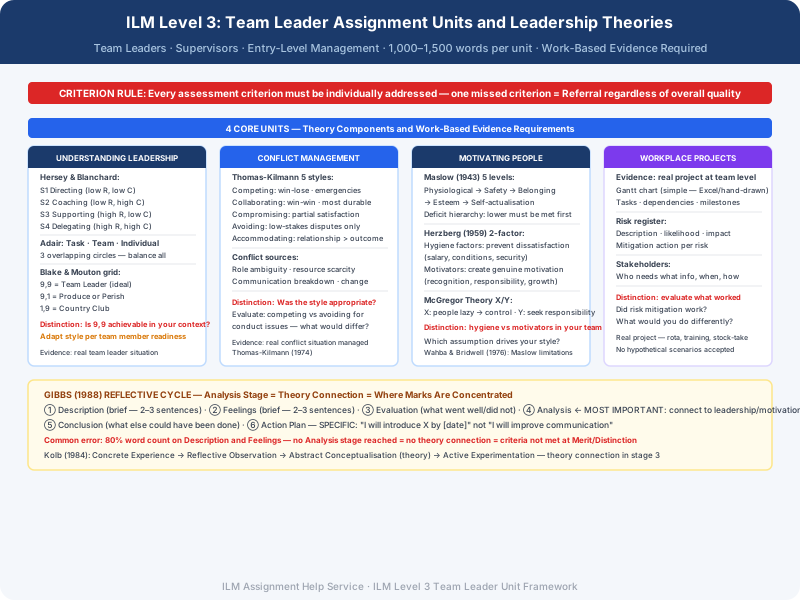
Hersey and Blanchard's situational leadership model identifies four leadership styles: S1 Directing (high task, low relationship: appropriate for team members with low competence and low commitment), S2 Coaching (high task, high relationship: appropriate for team members with low competence but high commitment), S3 Supporting (low task, high relationship: appropriate for team members with high competence but variable commitment), S4 Delegating (low task, low relationship: appropriate for high competence and high commitment), matched to four follower readiness levels (R1 through R4). The key insight is that effective team leaders adapt their style per team member rather than applying one fixed approach. Pass criteria require describing the model and identifying own leadership style. Distinction criteria require critically reflecting on whether the candidate genuinely adapts their style per team member or defaults to one style regardless of readiness level, and what the implications are for team performance and development.
Adair's action-centred leadership represents team leader responsibilities as three overlapping circles: Task (achieving the objective), Team (maintaining team cohesion and motivation), and Individual (meeting individual team member development and welfare needs). The three circles overlap because neglecting any one area affects the others: a task-only focus produces burnout; a team-cohesion focus without task achievement fails the organisation's objectives; neglecting individual needs leads to disengagement. Distinction requires evaluating which circle the candidate over-focuses on and what changes would improve leadership balance. Blake and Mouton's managerial grid maps concern for production (1–9 scale) against concern for people (1–9 scale), producing five characteristic styles: Impoverished (1,1), Country Club (1,9), Produce-or-Perish (9,1), Middle-of-the-Road (5,5), and Team Leader (9,9, high concern for both). Distinction requires critical reflection on whether the 9,9 Team Leader style is achievable in the candidate's specific team and organisational context, or whether structural constraints make it idealistic.
ILM Managing Workplace Projects at Level 3: Team-Level Project Evidence
Managing Workplace Projects at Level 3 focuses on managing or contributing to a project at team level, not strategic organisational projects, but real initiatives within the candidate's area of responsibility: a new rota system, a team training event, a stock-take, a process improvement initiative. The project must be real; the assessor is evaluating work-based evidence of project management practice, not a hypothetical plan. Assessment criteria typically require: a project plan with timeline and milestones, stakeholder identification, a risk assessment, evidence of monitoring project progress, and evaluation of project outcomes.
Project planning at Level 3 does not require complex project management software. A simple Gantt chart (Excel or hand-drawn) showing tasks, dependencies, and milestones is sufficient as supporting evidence. The analytical value comes from the written commentary: why were those milestones identified? What were the critical dependencies? How was the timeline adjusted when circumstances changed? A simple risk register, describing each identified risk, its likelihood (high/medium/low), its potential impact, and the planned mitigation action, demonstrates structured risk thinking appropriate to Level 3. Pass criteria require identifying risks and initial mitigation actions. Distinction criteria require evaluating the effectiveness of the risk mitigation actions for any risks that materialised: did the mitigation work? What would have been done differently in hindsight?
Stakeholder communication at Level 3 means identifying who needed to know what, when, and through which channel: the team members directly involved, the line manager, perhaps other departments affected by the project. Distinction requires evaluating whether the stakeholder communication approach was effective: was anyone who should have been informed left out of the loop? Did the communication frequency and format match what different stakeholders actually needed?
ILM Understanding Conflict Management Assignment: Thomas-Kilmann and Real Conflict Evidence
Understanding Conflict Management in the Workplace at Level 3 requires candidates to evidence handling a real conflict situation in their team leader role, not describing what they would theoretically do, but what they did. Assessment criteria typically require: description of sources of workplace conflict, application of a conflict management approach, evidence of managing a real conflict situation, and evaluation of the outcome.
The Thomas-Kilmann Conflict Mode Instrument describes five conflict management styles defined on two dimensions: assertiveness (concern for own needs) and cooperativeness (concern for others' needs). Competing (high assertiveness, low cooperativeness, win-lose; appropriate for emergencies or when a decision must be made immediately to prevent harm); Collaborating (high assertiveness, high cooperativeness, win-win; time-intensive but produces the most durable resolution for significant conflicts); Compromising (medium assertiveness, medium cooperativeness, partial satisfaction for both parties; faster than collaborating but neither party is fully satisfied); Avoiding (low assertiveness, low cooperativeness, neither party addresses the conflict; appropriate for genuinely low-stakes disputes); Accommodating (low assertiveness, high cooperativeness, the candidate yields to the other party; appropriate when the relationship matters more than the outcome).
Pass criteria require describing a real conflict situation and the management style used. Distinction criteria require evaluating whether the style chosen was the most appropriate for the specific conflict type: was Avoiding used for a conflict that needed Competing (a team behaviour issue affecting customers)? Was Competing used where Collaborating would have produced a more sustainable outcome? What would be done differently in a similar situation? The distinction between conflict types matters: a resource allocation dispute between team members may call for Compromising; a team member's repeated breach of a conduct standard requires Competing (decisive management action) regardless of the relationship cost.
ILM Motivating People in the Workplace Assignment: Maslow, Herzberg, and Team Evidence
Motivating People in the Workplace at Level 3 requires candidates to demonstrate understanding of motivation theory and evidence applying it in their own team leader role. Assessment criteria typically require: description of at least one motivation theory, evidence of motivating team members in practice, and evaluation of the effectiveness of the motivation approach used.
Maslow's hierarchy of needs organises human motivation into five levels: physiological needs (basic survival: food, shelter, rest), safety needs (security, stability, freedom from threat), belonging needs (social connection, team membership, acceptance), esteem needs (recognition, achievement, respect), and self-actualisation (growth, fulfilment, realising potential). Maslow's model operates as a deficit hierarchy: lower-level needs must be substantially met before higher-level needs become motivational. The practical team leader application is identifying where team members are on the hierarchy: a team member experiencing job insecurity (safety needs unmet) cannot be motivated by additional responsibility or recognition (esteem needs) until the safety concern is addressed. Distinction requires evidence of recognising different team members' motivational levels and adapting the approach accordingly, not applying a one-size-fits-all motivation strategy.
Herzberg's two-factor theory distinguishes between hygiene factors (salary, working conditions, job security, company policy, supervision quality, which eliminate dissatisfaction when present but do not create genuine motivation) and motivators (achievement, recognition, responsibility, advancement, the work itself, which create genuine intrinsic motivation). A common team leader error is addressing only hygiene factors (better rota, more consistent breaks, salary increase) when the team needs motivators (recognition for good performance, more autonomy, more interesting work). Distinction requires critical evaluation of whether the team leader's approach addressed genuine motivators or only hygiene factors, and what the difference would be in practice. McGregor's Theory X/Y identifies the assumption driving the leader's approach: Theory X (people are inherently lazy and need close supervision and control) produces directive, monitoring management; Theory Y (people seek responsibility and find work intrinsically motivating) produces delegating, developing management. Distinction requires self-reflection on which assumption drives own team leader behaviour and whether that assumption is justified by the specific team context.
Is your biggest challenge structuring the reflective account, connecting your team leader experience to the required leadership theories, or making sure you address every criterion in the unit specification?
ILM Level 3 assignment challenges most commonly fall into one of three categories. First: candidates who have rich team leader experience but are writing work-based academic evidence for the first time and find translating practice into criterion-addressed analytical writing unfamiliar. Second: candidates who understand the leadership theories covered in their ILM programme but do not know how to connect their specific workplace experience to a theory's components in a way that evidences assessment criteria. Third: candidates who write strong reports covering the overall topic but miss specific assessment criteria, often because the criteria are detailed and the report addresses the general subject without covering each criterion individually. The supplementary sections below address reflective writing specifically for Level 3 and the progression pathway from Level 3 to Level 5.
Reflective Writing for ILM Level 3: Using Gibbs' Cycle Without Getting Stuck in Description
Gibbs' Reflective Cycle (1988) has six stages: Description (what happened, factual account of the event), Feelings (emotional response during and after), Evaluation (what went well and what did not), Analysis (what theory explains the experience, this is the stage where management theory must be applied), Conclusion (what else could have been done), and Action Plan (what will be specifically done differently in future). At Level 3, the Assessment stage concentrations are clear: Description and Feelings stages should be brief, two to four sentences establishing factual context; the analytical weight of the assignment belongs in the Analysis stage.
The most common error in Level 3 reflective writing is writing 80% of the word count across Description and Feelings, producing a detailed account of what happened and how it felt but providing no evidence of understanding why it happened or what leadership or management theory explains the pattern. Without the Analysis stage connecting practice to theory (connecting the conflict resolution approach to Thomas-Kilmann's model, connecting the team motivation approach to Herzberg's motivators), the assessment criteria for demonstrating theoretical understanding are not met regardless of how well the Description is written. The Action Plan must be specific: not "I will improve my communication with the team" but "I will introduce a five-minute team brief before every shift, addressing task priorities and inviting questions, to address the Role Ambiguity source of conflict identified in this analysis."
See also: ILM reflective writing models: Gibbs, Kolb, Schon · ILM Coaching and Mentoring at Level 3
ILM Level 3 to Level 5: Progressing Your Management Qualification
ILM Level 3 provides the formal management qualification base for team leaders and supervisors moving into middle management or operations roles, where Level 5 becomes the relevant qualification. Level 5 covers more complex management challenges, strategic change management, financial management, 360-degree leadership effectiveness feedback, and the evidence requirements are substantially more demanding: longer assignments (2,000–3,500 words per unit), Harvard referencing required, and more sophisticated management theories (Kotter's 8-step, Prosci ADKAR, Mendelow's stakeholder matrix). The academic evidence-writing experience gained through ILM Level 3 (structuring criterion-addressed analytical reports, connecting workplace experience to management theory, writing structured reflective accounts) is the direct preparation for Level 5. Candidates who found Level 3 assignment writing challenging because of the academic evidence format typically find Level 5 more manageable once the Level 3 format has become familiar.
See also: ILM Level 5 leadership and management qualification · ILM qualifications across levels · ILM Level 2 introductory leadership award
ILM Level 3 Assignment Help: Frequently Asked Questions
What ILM Level 3 units does this service cover?
All major ILM Level 3 units are covered, including Understanding Leadership (Hersey and Blanchard situational leadership, Adair action-centred leadership, Blake and Mouton managerial grid), Managing Workplace Projects at team level (project planning, stakeholder communication, risk register), Understanding Conflict Management in the Workplace (Thomas-Kilmann five conflict management styles, real conflict evidence), and Motivating People in the Workplace (Maslow's hierarchy, Herzberg's two-factor theory, McGregor Theory X/Y). Guidance is unit-specific and addresses the exact assessment criteria for each unit from the ILM unit specification.
How long are ILM Level 3 assignments and what format do they need?
ILM Level 3 unit assignments are typically 1,000–1,500 words per unit. The format is a structured written report organised around the assessment criteria, not a free-form essay. Each section must provide evidence of specific management or leadership activity from the candidate's real team leader role. Supporting evidence (meeting records, project plans, witness statements) can be included as appendices. Every criterion listed in the unit specification must be individually addressed in the report.
Do ILM Level 3 assignments require Harvard referencing?
Harvard referencing is not formally required at ILM Level 3, but citing the theorists whose models are applied strengthens the assignment, for example referencing Hersey and Blanchard (1969) for situational leadership or Herzberg (1959) for two-factor motivation theory. If the candidate's programme specifies referencing requirements, those should be followed. Harvard referencing is mandatory at Level 5 and Level 7.
How do I use the Thomas-Kilmann conflict styles in an ILM Level 3 assignment?
The Thomas-Kilmann model provides five conflict management styles: Competing (win-lose), Collaborating (win-win, most time-intensive), Compromising (partial satisfaction for both), Avoiding (neither addresses the conflict), and Accommodating (yielding to the other party). In an ILM Level 3 assignment, the candidate describes a real conflict from their team leader role, identifies the style used, and reflects on whether it was appropriate for that conflict type. Distinction criteria require evaluation: was the style chosen the most effective option? Would a different style have produced a better outcome? What would be done differently?
Submit Your ILM Level 3 Assignment Brief
Provide your ILM Level 3 unit name, the assessment criteria from the unit specification, and any assignment brief or evidence you have already gathered from your team leader role. Unit-specific guidance addresses every assessment criterion in your unit specification, covers work-based evidence structuring for your team leader context, and identifies where the Analysis stage of your reflective account requires theory connection to reach Merit and Distinction criteria.
Common Questions
Is this service specific to ILM qualifications?
Yes. We specialise exclusively in City & Guilds ILM qualifications. Our writers are selected for their specific knowledge of ILM units, marking criteria, and grade descriptors — not generic academic writing.
Will my assignment be plagiarism free?
Every assignment is written from scratch and run through Turnitin before delivery. You receive a copy of the originality report alongside your completed work.
How quickly can you complete my assignment?
Standard turnaround is 5–7 days. For urgent orders we offer 24-hour and 48-hour expedited delivery at an additional cost. Contact us to confirm availability for your deadline.
What if I'm not happy with the work?
We offer unlimited free revisions within 14 days of delivery. If we cannot meet your requirements after multiple revisions, we offer a full refund — no questions asked.