ILM reflective accounts are assessed on the depth of analysis they demonstrate, not on the quality of the experience they describe. An assessor marking a Level 5 unit on Becoming an Effective Leader is not evaluating whether the candidate managed an interesting situation — they are evaluating whether the candidate has moved beyond describing events to examining why those events unfolded as they did, what assumptions or beliefs shaped the candidate's responses, and what the analysis reveals about their development as a leader. Gibbs (1988), Kolb (1984), Schön (1983), and Moon (2004) each provide a different architecture for that analytical work, and selecting the right model for the specific unit context is itself an indicator of reflective sophistication. At Level 3, description with some commentary on lessons learned will meet a pass standard. At Level 5, assessors expect the candidate to apply a formal reflective framework and cite it by name, to move from description through analysis to evaluation, and to produce a development action that is specific rather than aspirational. At Level 7, the standard moves further still: candidates must demonstrate critical self-scrutiny, examining the limitations of their own perspective, challenging their own conclusions, and situating personal experience within broader organisational and professional contexts using postgraduate-level language and independent academic research. The difference between a Level 5 pass and a Level 5 distinction in a reflective account is rarely about the length of the account — it is almost always about whether the candidate has genuinely evaluated rather than merely described.
What ILM Assessors Expect: Analysis Not Description
The single most common cause of referral in ILM reflective accounts across all levels is description presented as analysis. A descriptive account tells the assessor what happened. An analytical account tells the assessor what the events reveal — about the candidate's assumptions, values, decision-making processes, relationships, and development needs. The distinction is not subtle: assessors are explicitly trained to identify accounts that describe a sequence of events and attach generic lesson statements at the end ("I learned that communication is important") and to refer them for insufficient analytical depth.
At Level 3, the pass standard for a reflective account requires the candidate to describe a relevant workplace experience, identify what they learned from it, and state what they would do differently as a result. That is a three-part structure: experience, learning, development. A Level 3 reflective account that provides only the first element — a detailed description of what happened — will not meet the learning outcome criterion and will be referred. The development element must be specific to be creditworthy: "I will attend a communication training course" is not a specific development action; "I will request monthly one-to-one meetings with each member of my team to provide individual performance feedback, beginning in the current quarter" is specific.
At Level 5, assessors apply a more demanding standard: the reflective account must demonstrate that the candidate has used a theoretical framework to structure and deepen their reflection, not just describe experience in chronological sequence. The criterion requires candidates to analyse their practice, and analysis means applying concepts — from Gibbs, Kolb, Schön, or other cited theorists — to explain why the experience unfolded as it did, what assumptions the candidate was making, and what the reflective examination reveals about their leadership or management practice. A Level 5 reflective account that describes a change management situation without referencing Kotter (1996) or Lewin (1951), or a leadership reflection that does not cite Bass (1985) or Hersey and Blanchard (1969), is missing the theoretical frame that the criterion expects. Connecting specific theoretical concepts to specific moments in the reflected experience — not just listing models at the end — is what distinguishes an analytical account from a sophisticated description.
At Level 7, the assessment standard requires critical self-evaluation: the candidate must not only examine what happened but challenge their own reflective conclusions. Moon (2004) describes the highest level of reflection as "transformative" — the point at which the candidate not only learns from experience but recognises how their existing assumptions, mental models, or professional identity shaped what they could see and do in the situation. A Level 7 reflective account that presents confident conclusions without acknowledging the limitations of the candidate's own perspective — the biases, gaps, or frames of reference that may have constrained their analysis — will not reach distinction level regardless of how sophisticated the theoretical application is.
Gibbs' Six-Stage Reflective Cycle Applied to ILM Units
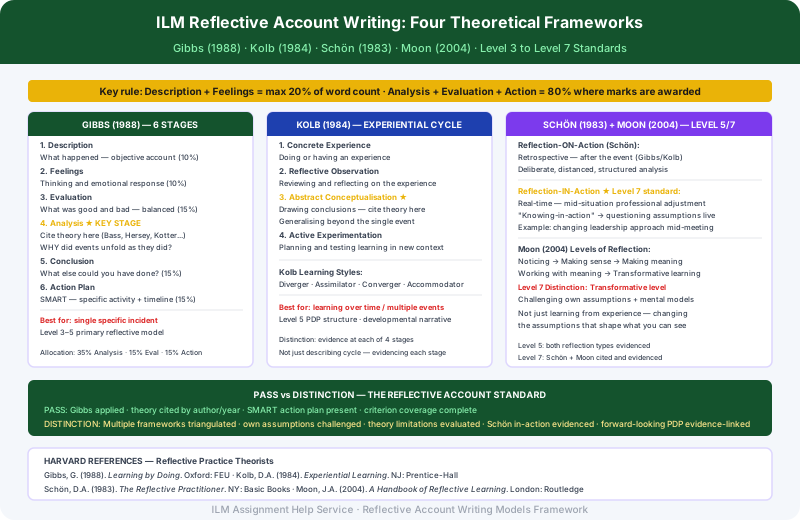
Gibbs' Reflective Cycle (1988), developed from Kolb's earlier work, provides six stages for structuring reflection on a specific experience: Description (what happened — objective account of the event), Feelings (what you were thinking and feeling at the time and why), Evaluation (what was good and bad about the experience — a balanced assessment), Analysis (what sense you can make of the situation — drawing on theory and evidence), Conclusion (what else you could have done — what you learn from the analysis), and Action Plan (what you will do differently if the same situation arises again — specific development intentions).
The critical ILM application point for Gibbs is that stages one and two (Description and Feelings) must remain brief in ILM assignments — typically no more than 20–25% of the total reflective account word count. Assessors do not award marks for detailed descriptions of what happened or how the candidate felt about it. The assessed content is concentrated in stages three through six — Evaluation, Analysis, Conclusion, and Action Plan — and the Analysis stage is where the theoretical connection must occur. An ILM Level 5 assignment that uses Gibbs without a theoretical frame in the Analysis stage has applied Gibbs structurally but not analytically: the form is present, the substance is missing.
A worked example of Gibbs applied at Level 5 to a performance management situation: Description — "I had to address a consistent absence pattern with a member of my team in September" (two sentences). Feelings — "I felt anxious about having the conversation because I had avoided addressing the issue for several weeks and was concerned about the team member's wellbeing" (two to three sentences). Evaluation — "The conversation itself was constructive once started, but I recognised that my six-week delay had created a more difficult situation and reduced the team member's opportunity to address the issue with support." Analysis — "My avoidance behaviour reflects what McGregor (1960) would identify as a Theory Y management assumption taken to an unproductive extreme: I prioritised relationship maintenance over the team member's development need, creating the inverse of what Theory Y management should achieve. Herzberg's (1959) two-factor theory provides a further frame: my delay had allowed an absence pattern to become normalised, which represented a hygiene factor failure rather than a motivational deficit." Conclusion — "I had the authority and the evidence to act sooner and should have done so. My discomfort with potential conflict was the primary constraint." Action Plan — "I will use Bradford Factor monitoring monthly and will initiate absence conversations at the second trigger point rather than the third, beginning this quarter." That is Gibbs applied correctly at Level 5.
Kolb's Experiential Learning Cycle in ILM Evidence
Kolb's Experiential Learning Cycle (1984) describes learning as a four-stage iterative process: Concrete Experience (doing or having an experience), Reflective Observation (reviewing and reflecting on the experience), Abstract Conceptualisation (learning from the experience — drawing conclusions, forming generalisations), and Active Experimentation (planning and trying out what has been learned in a new context). Kolb's cycle is continuous: Active Experimentation generates new Concrete Experience, which begins the cycle again. The central claim of Kolb's theory is that learning does not occur simply through experience — it requires the full cycle. Experience without reflection, reflection without conceptualisation, or conceptualisation without new action are all partial cycles that do not produce genuine learning.
The ILM application of Kolb differs from Gibbs in one important respect: Kolb's cycle is better suited to evidence of learning across a period of time or across multiple experiences, while Gibbs is typically applied to a single specific incident. A Level 5 reflective account using Kolb to structure evidence of leadership development across a six-month period — citing specific experiences at the Concrete Experience stage, reflective diary entries at the Reflective Observation stage, theoretical framework application at the Abstract Conceptualisation stage, and a record of changed practice at the Active Experimentation stage — demonstrates exactly the kind of developmental narrative that ILM assessors award high marks to. The evidence requirement for Kolb's cycle is therefore more complex than for Gibbs: it requires the candidate to present evidence at each stage, not just describe a single experience through four lenses.
Kolb also identified four learning styles — Diverger, Assimilator, Converger, and Accommodator — based on which stages of the cycle an individual prefers. ILM Level 5 assignments that incorporate Kolb's learning styles in a Personal Development Plan do so productively when the candidate identifies their own preferred learning style with evidence (not just self-declaration), evaluates how that preference shapes their approach to professional development, and designs development activities that extend beyond their comfort style. An Assimilator (strong at Abstract Conceptualisation, preferring theoretical frameworks to experiential learning) who designs a PDP consisting entirely of reading and online courses is demonstrating a learning style bias rather than a developmental plan — the Distinction criterion expects the candidate to recognise and address that bias explicitly.
Schön's Reflection-in-Action vs Reflection-on-Action at Level 5 and Level 7
Donald Schön's (1983) distinction between reflection-in-action and reflection-on-action is the most theoretically sophisticated reflective framework used in ILM assignments and is most appropriate — and most required — at Level 5 and Level 7. Reflection-on-action is retrospective: it is the deliberate examination of past experience after the event, using time and distance to analyse what happened. This is the form of reflection that Gibbs and Kolb structure. Reflection-in-action is simultaneous with the experience: it is the real-time thinking that a skilled practitioner does during a complex situation — adjusting, questioning their own assumptions, adapting their approach mid-event in response to what they are observing.
Schön described expert practitioners as operating in a "knowing-in-action" state — drawing on a repertoire of professional knowledge, frameworks, and past experience so fluidly that it appears intuitive. The value of reflection-in-action is that it enables practitioners to step back from "knowing-in-action" in the middle of a situation and ask: "Is what I am doing working? What am I assuming about this situation? What would I do if my current approach is wrong?" In a leadership context, reflection-in-action appears in a senior leader who, mid-way through a difficult team conversation, notices that the conversation is not going as expected and changes their communication approach in real time — not just after the fact. This is a form of professional skill that reflection-on-action, by definition, cannot develop without practice: Schön's argument is that the two forms of reflection are complementary, not equivalent.
The ILM application: at Level 5, candidates are expected to demonstrate both forms of reflection — retrospective analysis of past leadership experiences (reflection-on-action, typically structured using Gibbs or Kolb) and evidence that they are developing the capacity for in-the-moment professional self-awareness (reflection-in-action, demonstrated through narrative evidence of adapting mid-situation). At Level 7, the distinction between the two is an explicit criterion-level requirement in many units: candidates must demonstrate they understand Schön's framework conceptually, apply it to their own practice with specific evidence, and critically evaluate the limitations of their reflective practice — including identifying where their capacity for reflection-in-action is underdeveloped and what they are doing to address it.
Common Mistakes Causing Referrals in Reflective Accounts
Six mistakes account for the majority of referrals in ILM reflective accounts across all levels. First: excessive description in the Description and Feelings stages. A common pattern is candidates spending 60–70% of their word count on what happened and how they felt, leaving insufficient space for the analytical stages where marks are awarded. The structural fix is to set a strict word count allocation before writing: Description 10%, Feelings 10%, Evaluation 15%, Analysis 35%, Conclusion 15%, Action Plan 15%.
Second: missing or superficial theory application. The Analysis stage must cite specific theoretical frameworks by author and year, apply specific concepts from those frameworks to specific moments in the described experience, and explain — not just state — what the theoretical lens reveals about the experience. "Kotter's model shows that change is difficult" is not theory application. "Step 3 of Kotter's (1996) model — communicating the change vision — was the critical failure in this project: the vision was communicated to senior leaders but not cascaded to frontline staff, which Kotter identifies as the most common point of failure in organisational change initiatives" is theory application at Level 5 pass standard.
Third: action plans that are generic or aspirational. "Improve my communication skills" is not an action plan. An assessable action plan specifies: what the candidate will do (specific activity), by when (concrete timeline), how progress will be measured (success indicator), and why this addresses the specific gap identified in the analysis. Fourth: no connection between the analysis and the action plan — the candidate describes a leadership failure, analyses it using theory, and then proposes development actions that do not address the specific failure identified. Fifth: reflective accounts that evaluate the situation rather than the candidate's own practice — the focus must be on the candidate's decisions, assumptions, and behaviour, not on the behaviour of others or the fairness of the situation. Sixth: failure to use first-person analytical language — passive constructions and institutional language distance the candidate from the experience and signal descriptive rather than reflective writing.
Word Count and Format Requirements by Level
ILM Level 3 reflective accounts: typically 750–1,500 words per unit, depending on the specific unit specification. The format is usually a written account without formal subheadings, although referencing a reflective model (Gibbs or Kolb) and structuring the account according to its stages — even if not using them as section headers — is expected. Harvard referencing is not typically required at Level 3, but citations to any theoretical models used should appear in parentheses (Author, Year) to demonstrate academic awareness. Two to three models are sufficient — one primary reflective model, one management or leadership theory applied in the Analysis stage.
ILM Level 5 reflective accounts: typically 1,500–2,500 words per unit, with some units specifying up to 3,500 words. Full Harvard referencing is required — both in-text citations and a reference list. The analytical standard requires explicit framework application with citations, pass vs distinction determined primarily by the depth of the Analysis stage. Multiple theoretical frames applied to the same experience (Gibbs as the structural model, Bass or Hersey and Blanchard applied within the Analysis stage) are expected at distinction standard. Subheadings aligned to the reflective model stages are acceptable and often aid assessor navigation.
ILM Level 7 reflective accounts: typically 2,500–4,000 words, with some units requiring longer accounts as part of a portfolio. The standard requires postgraduate-level critical reflection — Schön's framework applied as a primary analytical lens, Moon's levels of reflection used explicitly to evaluate the depth of the candidate's reflective practice, independent academic research cited beyond core management texts (peer-reviewed journal articles from leadership journals, coaching journals, or management research journals). The action plan must be integrated with a Personal Development Plan that connects to the candidate's strategic professional objectives rather than operational skill development.
Criterion Mapping for Reflective Accounts
Before submitting a reflective account, candidates should annotate their draft against the specific assessment criteria in the unit specification. Each criterion — typically four to eight per unit — should be identifiable in the completed account: if a criterion requires the candidate to "evaluate the impact of leadership style on team performance," there must be a specific passage in the account that evaluates (not describes) the impact of the candidate's specific leadership behaviour on observable team outcomes, with evaluation meaning a balanced judgment about both what worked and what did not. Criterion mapping is not optional — it is the diagnostic tool that identifies gaps before submission rather than after referral.
A common criterion mapping error is treating word count as a proxy for criterion coverage. An account that has 2,500 words but addresses only three of six criteria will not pass — the remaining three criteria will each be marked as "not evidenced" and the account will be referred. The structural solution is to work through each criterion in order before drafting, identify the specific passage in the account that evidences it, and note any criterion for which no passage exists — then write that passage before submission. This criterion-first approach to drafting, rather than the narrative-first approach that most candidates default to, is the single most reliable structural technique for avoiding referrals in reflective accounts at any level.
Is your reflective account being referred because it is too descriptive, or because the theory application is missing the assessment criteria?
Most referrals in ILM reflective accounts trace back to one of two specific problems. The first is structural: the account is predominantly descriptive, with the analytical stages (Evaluation, Analysis, and Action Plan in Gibbs' terms) either absent or underdeveloped. Fixing this requires a structural reallocation — the description must be cut and the analysis must be extended, with specific theoretical frameworks applied to specific moments in the described experience. The second problem is criterion-level: the account has analysis, but the analysis does not map to the specific assessment criteria in the unit specification. The candidate may have applied Gibbs correctly and cited Bass and Hersey competently, but the specific criterion that requires evaluation of the impact on team outcomes, or the criterion that requires a SMART development plan, has not been explicitly evidenced. Our support service addresses both problems through criterion-mapped revision guidance that connects your existing account to the specific pass and distinction descriptors for your unit, identifies the specific passages that need to be rewritten, and provides the analytical frameworks and citation structures that assessors expect to see. Both the reflective framework application and the criterion mapping are specific to your ILM level and unit — generic guidance on reflective writing will not reliably address ILM-specific assessment requirements.
Criterion Mapping Across Reflective Practice and Leadership Units
Reflective accounts do not exist in isolation within an ILM programme — they are typically one of several evidence types required for a unit, and the reflective evidence must map to specific criteria that other evidence types (work-based evidence, witness testimony, 360-degree feedback) also contribute to. Understanding which criteria the reflective account is responsible for evidencing — and which are covered by other evidence types — prevents both under-evidencing (criteria missed entirely) and over-coverage (lengthy reflective accounts that duplicate evidence already provided in other forms). The unit specification assessment criteria grid is the primary planning tool: each criterion should have at least one identified evidence source before submission planning begins. See also: ILM assignment structure and criterion coverage · Level 3 reflective practice requirements · Level 5 analytical depth standards · Level 7 critical reflection and Schön · Coaching and mentoring reflective accounts
Referencing Reflective Practice Theorists: Gibbs, Kolb, Schön, and Moon
Harvard referencing for the four core reflective practice theorists used in ILM assignments follows the standard author-date format. Gibbs, G. (1988). Learning by Doing: A Guide to Teaching and Learning Methods. Oxford: Further Education Unit. Kolb, D.A. (1984). Experiential Learning: Experience as the Source of Learning and Development. Englewood Cliffs, NJ: Prentice-Hall. Schön, D.A. (1983). The Reflective Practitioner: How Professionals Think in Action. New York: Basic Books. Moon, J.A. (2004). A Handbook of Reflective and Experiential Learning: Theory and Practice. London: RoutledgeFalmer. In-text citations should follow the author-date format: (Gibbs, 1988) or Gibbs (1988) describes the six stages as... When paraphrasing, use the in-text citation without page numbers; when using a direct quotation, include the page number: (Schön, 1983: 54). At Level 5, ILM assessors expect to see at least two reflective practice theorists cited correctly; at Level 7, additional peer-reviewed journal sources should supplement these foundational texts. See also: ILM referencing standards · Level 5 Harvard referencing requirements
ILM Reflective Account Writing Help: Frequently Asked Questions
Which reflective model should I use for my ILM assignment — Gibbs or Kolb?
Gibbs (1988) is better suited to reflecting on a single specific incident — a difficult conversation, a performance issue, a change management event. Use Gibbs when your unit asks you to reflect on a specific experience. Kolb (1984) is better suited to reflecting on learning over a period of time or across multiple experiences. Use Kolb when your unit asks you to evidence how you have developed in a particular area. At Level 5 and Level 7, using both frameworks — Gibbs for incident analysis and Kolb to show learning progression — demonstrates greater reflective sophistication and is more likely to reach distinction. Schön (1983) should be added at Level 7 to evidence reflection-in-action as a distinct capability.
How do I avoid being too descriptive in an ILM reflective account?
Set a strict word count allocation before you write: limit Description and Feelings to 20% of your total word count combined. The remaining 80% should be Evaluation, Analysis (with theory cited by author and year applied to specific moments), Conclusion, and Action Plan. After drafting, highlight every sentence that reports what happened — if those sentences exceed 20% of your total, cut them and expand the Analysis section. Every analytical paragraph should contain a theoretical citation and an explanation of what that theory reveals about your specific situation, not just what the theory says in general.
What does Distinction look like in an ILM Level 5 reflective account?
A Level 5 distinction reflective account demonstrates four things: first, multiple theoretical frameworks applied and compared rather than a single model described; second, critical evaluation of the candidate's own assumptions and decision-making — including acknowledging where their approach was limited or wrong; third, an action plan that is SMART (specific, measurable, achievable, relevant, time-bound) and directly connected to the specific gaps identified in the Analysis stage; and fourth, Schön's (1983) concepts of reflection-in-action and reflection-on-action applied to demonstrate that the candidate understands both retrospective and in-the-moment reflective practice as distinct capabilities.
Common Questions
Is this service specific to ILM qualifications?
Yes. We specialise exclusively in City & Guilds ILM qualifications. Our writers are selected for their specific knowledge of ILM units, marking criteria, and grade descriptors — not generic academic writing.
Will my assignment be plagiarism free?
Every assignment is written from scratch and run through Turnitin before delivery. You receive a copy of the originality report alongside your completed work.
How quickly can you complete my assignment?
Standard turnaround is 5–7 days. For urgent orders we offer 24-hour and 48-hour expedited delivery at an additional cost. Contact us to confirm availability for your deadline.
What if I'm not happy with the work?
We offer unlimited free revisions within 14 days of delivery. If we cannot meet your requirements after multiple revisions, we offer a full refund — no questions asked.