ILM Level 7 is a postgraduate-equivalent qualification aligned to postgraduate level on the RQF: designed for senior leaders, directors, NHS executives (Band 8 and above), HR directors, and senior learning and development professionals. Level 7 assignments require strategic-level analysis spanning the whole organisation, critical evaluation of strategic leadership frameworks at postgraduate depth, and academic writing quality equivalent to a Master's level management module, with Harvard referencing from peer-reviewed academic sources, not management books alone. This service provides unit-specific guidance on structuring Level 7 strategic analysis, applying frameworks at postgraduate standard, and meeting the academic referencing requirements that are assessed at this level in a way they are not at Level 5.
The Postgraduate-Equivalent Standard at ILM Level 7: What It Requires
The distinction between ILM Level 5 and Level 7 is not primarily about more or longer content. It is a categorical difference in analytical scope and writing standard. Level 5 requires management competence in a team and function context with evidence from a middle management role. Level 7 requires strategic leadership analysis of the whole organisation: the candidate's decisions and leadership are evaluated in terms of their effect on organisational culture, strategic direction, and systemic performance, not team-level outcomes.
The written analytical standard at Level 7 must match postgraduate expectations: structured argument building from evidence through analysis to conclusion, critical evaluation of competing theoretical perspectives rather than application of a single framework, synthesis of multiple analytical frameworks into a coherent strategic assessment, and explicit acknowledgement of complexity, uncertainty, and the limitations of the analytical approach taken. At Level 5, applying Kotter's 8-step model to describe a change is Pass to Merit standard. At Level 7, the same model application without critical evaluation of its limitations, comparison to alternative frameworks, and assessment of its fit to the organisational context would not reach the expected standard.
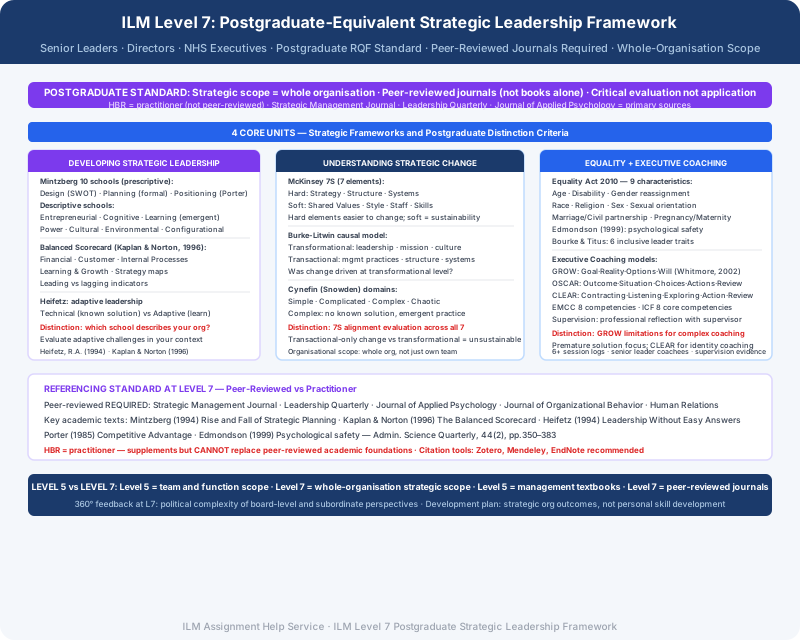
Harvard referencing at Level 7: peer-reviewed academic management journals are the primary academic source: Strategic Management Journal, Leadership Quarterly, Journal of Applied Psychology, Journal of Organizational Behavior, Human Relations. The Harvard Business Review is a practitioner publication, not peer-reviewed, and can be used for current business examples but cannot substitute for peer-reviewed academic foundations. This distinction (between practitioner journals and peer-reviewed research) is assessed at Level 7 in a way that it is not at Level 5. Academic management textbooks (Mintzberg, Kaplan and Norton, Heifetz, Porter) are appropriate core references. Citation management tools (Zotero, Mendeley, EndNote) are recommended for managing the volume of academic references required at Level 7.
ILM Developing Strategic Leadership: Mintzberg, Balanced Scorecard, and Adaptive Leadership
Developing Strategic Leadership at Level 7 requires the candidate to analyse their own strategic leadership approach and its organisational effectiveness using postgraduate-level strategic management frameworks. Assessment criteria require: evidence of strategic leadership at organisational level, analysis of strategic leadership frameworks and their applicability to the organisational context, critical reflection on strategic leadership effectiveness, and a strategic leadership development plan.
Mintzberg's ten schools of strategy categorise approaches to strategy formation into three prescriptive schools (Design: SWOT-based, explicit strategy formulation by the top team; Planning: formalised analytical processes, Ansoff's influence; Positioning: Porter's competitive advantage, analytical positioning) and seven descriptive schools (Entrepreneurial: strategy as the vision of a single leader; Cognitive: strategy formation as mental models and cognitive biases; Learning: emergent strategy, Lindblom's muddling through, Weick's sense-making; Power: strategy as political negotiation; Cultural: strategy embedded in organisational culture and shared assumptions; Environmental: organisational adaptation to environment; Configurational: organisations as configurations transforming between states). Distinction requires evaluating which school most accurately describes the actual strategy formation process in the candidate's organisation and why: not applying Porter's frameworks generically but assessing what the pattern of strategic decision-making in the specific organisation reveals about its dominant strategic logic.
Kaplan and Norton's Balanced Scorecard (1996) translates strategic objectives into measurable targets across four perspectives: Financial (shareholder value: revenue growth, cost reduction, asset utilisation), Customer (customer value proposition: market share, satisfaction, retention), Internal Business Processes (value-creating processes: innovation, operations, post-sale service), and Learning and Growth (organisational capabilities: employee skills, information systems, organisational climate). Strategy maps show causal relationships between objectives across perspectives: investment in Learning and Growth capabilities drives process improvement, which drives customer satisfaction, which drives financial results. The distinction between leading indicators (inputs and process measures, training investment, employee engagement scores, which predict future performance) and lagging indicators (output measures, financial results, customer satisfaction, which reflect past performance) is critical for evaluating strategic performance management effectiveness. Heifetz's adaptive leadership framework distinguishes technical problems (challenges with known solutions that require expertise) from adaptive challenges (challenges that require people to change values, beliefs, or behaviours, with no known solution, since no expertise can solve them). Distinction requires evaluating which leadership challenges in the candidate's organisation are genuinely adaptive and what this implies for the strategic leadership approach required.
ILM Leading Organisational Equality and Diversity: Legislation, Strategy, and Inclusive Leadership
Leading Organisational Equality and Diversity at Level 7 requires strategic-level analysis of how the candidate leads equality and diversity across the organisation, not just within their immediate team. Assessment criteria require: analysis of the legislative framework, evidence of leading D&I strategy at organisational level, critical evaluation of D&I effectiveness, and strategic recommendations for improvement.
The Equality Act 2010 consolidates previous equality legislation and establishes nine protected characteristics: age, disability, gender reassignment, marriage and civil partnership, pregnancy and maternity, race, religion or belief, sex, and sexual orientation. The Act establishes duties around direct discrimination (treating someone less favourably because of a protected characteristic), indirect discrimination (applying a provision, criterion, or practice that puts people with a protected characteristic at a disadvantage), and reasonable adjustments (the duty to remove barriers faced by disabled people). For NHS, local authority, and other public sector candidates, the Public Sector Equality Duty adds positive duties to have due regard to advancing equality of opportunity and fostering good relations between groups with different characteristics, not just avoiding discrimination. Pass criteria require describing the legislative framework. Distinction criteria require evaluating whether the organisation's D&I strategy goes beyond legal compliance to create genuine inclusion.
Psychological safety (Edmondson, 1999), the shared belief among team and organisational members that it is safe to take interpersonal risks, speak up, challenge authority, admit errors, and propose ideas without fear of punishment, is a critical enabler of inclusive culture and organisational learning. Distinction requires evaluating how senior leaders' behaviour creates or undermines psychological safety at systemic level, not just whether individual team leaders are approachable. Bourke and Titus's Deloitte inclusive leadership model (2016) identifies six signature traits of inclusive leaders: Commitment (explicit priority, accountability), Courage (challenging bias and the status quo), Cognisance of bias (recognising own biases and their impact), Curiosity (open-minded about difference), Cultural Intelligence (awareness of cultural differences), and Collaboration (creating diverse thinking). Distinction requires critical evaluation of whether these traits are present in the organisation's senior leadership collectively and what the evidence reveals about D&I outcome effectiveness.
ILM Understanding Strategic Change: McKinsey 7S, Burke-Litwin, and Complexity Theory
Understanding Strategic Change at Level 7 requires analysis of strategic organisational change, not the operational change management of Level 5 (leading a team through a process change) but the strategic transformation of an organisation's culture, structure, and direction. Assessment criteria require: analysis of a strategic change initiative, application of a strategic change framework, critical evaluation of change effectiveness, and strategic recommendations.
McKinsey 7S framework maps seven interconnected organisational elements: Strategy (the plan for competitive advantage), Structure (how the organisation is organised), Systems (processes and procedures), Shared Values (culture, the central element, connecting all others), Style (leadership behaviour), Staff (the people), and Skills (organisational capabilities). Hard elements (Strategy, Structure, Systems) are more tangible and easier to change; soft elements (Shared Values, Style, Staff, Skills) are harder to change and typically determine whether hard element changes are sustainable. A structural reorganisation (hard element change) that does not address shared values and leadership style (soft element change) will revert to old behaviours within the new structure. Distinction requires evaluating the degree of alignment between all seven elements after the strategic change: a change that altered three elements without addressing the other four has created misalignment that will undermine the change's effectiveness.
Burke-Litwin causal model distinguishes between transformational factors (external environment, mission and strategy, leadership, and organisational culture, which drive fundamental, discontinuous change in response to external environmental pressures) and transactional factors (management practices, structure, systems, work unit climate, task requirements, individual skills, and motivation, which drive incremental improvement within the existing organisational framework). Distinction requires evaluating whether the strategic change was actually driven at the transformational level or whether it addressed only transactional factors while leaving transformational factors unchanged, and what the difference implies for whether the change will be sustained. Cynefin (Snowden) complexity domains: Simple (cause and effect obvious, best practice applies), Complicated (cause and effect discernible with expertise, good practice), Complex (cause and effect only apparent in retrospect, emergent practice, experimentation required), and Chaotic (no cause and effect discernible, novel practice, act first then sense). Distinction requires evaluating which Cynefin domain the strategic change operated in and whether the leadership approach was appropriate for that domain's characteristics: a Complex environment cannot be managed with Simple (best practice) approaches.
ILM Executive Coaching Assignment at Level 7: Coaching Models and Professional Practice Evidence
Executive Coaching at ILM Level 7 requires evidence of conducting real executive coaching conversations with senior leaders as coachees, critical reflection on coaching practice at professional standard, and evidence of professional coaching supervision. Assessment criteria require: coaching session logs evidencing real coaching, critical reflection on coaching practice using a coaching model, evidence of supervision, and evaluation of coaching effectiveness against a professional competency framework.
GROW (Whitmore, 2002: Goal, Reality, Options, Will) is the most widely known coaching model. Pass criteria require applying GROW to a coaching session and describing what happened at each stage. Distinction criteria require critically evaluating GROW's limitations for executive coaching contexts: GROW was designed for performance and skills coaching. It is most effective when the coachee has a clear goal and needs structured support moving from Reality to action. For executive coaching conversations involving leadership identity, organisational politics, or deeply held value conflicts, GROW's linear structure may create premature solution focus ("Options" and "Will") before the systemic Reality has been sufficiently explored. CLEAR (Hawkins and Smith, 2006: Contracting, establishing the coaching relationship, purpose, and success criteria; Listening, coaching presence and reflective listening; Exploring, widening perspective and challenging assumptions; Action; Review) is more appropriate for transformational coaching because it explicitly treats the quality of the coaching relationship (Listening) and the depth of exploratory questioning (Exploring) as primary rather than as pathways to action. OSCAR (McLeod, 2003: Outcome, Situation, Choices, Actions, Review) places the coachee's current Situation before the Outcome, making it more appropriate for complex or systemic presenting issues where the goal cannot be clearly defined before the context is understood.
EMCC (European Mentoring and Coaching Council) competency framework covers eight competencies including self-management, coaching presence, active listening, fostering insight and learning, and outcome and action orientation. ICF (International Coaching Federation) core competencies are organised in four clusters: setting the foundation, co-creating the relationship, communicating effectively, and facilitating learning and results. Distinction requires critical evaluation of own coaching practice against one of these frameworks, identifying specific competency areas for development and connecting them to evidence from supervision discussions and coaching session reflection. Coaching supervision at Level 7: engaging with an experienced coaching supervisor to reflect on coaching practice (different from line management supervision) is a professional requirement for accredited coaches and is evidenced through supervision session records with reflective notes on learning and development implications.
Is your primary challenge the strategic analysis scope of the leadership or change unit, the executive coaching evidence requirements, or producing the postgraduate-equivalent Harvard-referenced writing quality?
Level 7 assignment challenges concentrate in three areas. First: strategic scope. Candidates with strong management experience at team or function level find the requirement to analyse the whole organisation as a strategic system, rather than their own area of responsibility, a significant analytical transition. Second: executive coaching evidence. Candidates who are building a coaching practice find that Level 7 requires critical evaluation of coaching model limitations and professional competency framework assessment, not just session logs that describe applying GROW. Third: referencing standard. Candidates who have worked at Level 5 with management textbook referencing find the shift to peer-reviewed academic journals, and the required distinction between practitioner and academic sources, a material change in research approach. The supplementary sections below address both Harvard referencing at Level 7 standard and 360-degree feedback analysis at senior leader level.
Harvard Referencing at ILM Level 7: Peer-Reviewed Sources and Academic Standard
Peer-reviewed management journals expected at ILM Level 7: Strategic Management Journal (strategy, competitive advantage), Leadership Quarterly (leadership theory and research), Journal of Applied Psychology (organisational behaviour, leadership effectiveness), Journal of Organizational Behavior (work and organisational behaviour), Human Relations (sociology of organisations), International Journal of Human Resource Management (HRM strategy). Key academic management texts at Level 7: Mintzberg, H. (1994). The Rise and Fall of Strategic Planning. Free Press; Kaplan, R.S. and Norton, D.P. (1996). The Balanced Scorecard. Harvard Business School Press; Heifetz, R.A. (1994). Leadership Without Easy Answers. Harvard University Press; Porter, M.E. (1985). Competitive Advantage. Free Press; Edmondson, A.C. (1999). Psychological safety and learning behavior in work teams. Administrative Science Quarterly, 44(2), pp.350–383. The Harvard Business Review is a practitioner publication (not peer-reviewed) and provides current business context but not academic foundation. Referencing management textbooks alongside peer-reviewed journal articles reflects the mixed methodology of strategic management as a discipline; peer-reviewed journals provide the primary research evidence base. See also: ILM Harvard referencing requirements by level · ILM Level 5 as prerequisite context for Level 7
360-Degree Feedback Analysis at Senior Leader Level: ILM Level 7 Reflective Practice
At senior leader level, 360-degree feedback collects perspectives from board-level peers, the senior leader's line manager (often a CEO, CFO, or board member), direct reports who may be themselves senior managers, and the candidate's own self-assessment. The power dynamics and political complexity of this multi-directional feedback are qualitatively different from a middle manager's 360-degree review. Direct reports providing critical feedback about a senior leader are taking an interpersonal risk. This must be acknowledged in the analytical reflection, not treated as straightforward quantitative data. Patterns across rater groups that diverge significantly, particularly where self-assessment is markedly higher than subordinate assessment on specific leadership dimensions, require critical evaluation of what the gap reveals about strategic leadership impact and blind spots, not defensiveness or dismissal.
A strategic leadership development plan at Level 7 is categorically different from a Level 5 personal development plan: the development objectives must be connected to the organisation's strategic direction, not just personal skill development. A development objective to "improve listening skills" is Level 5. A development objective to "increase psychological safety in the executive team to enable more effective adaptive challenge of strategic assumptions, evidenced by independent staff survey results within 18 months" is Level 7 in scope, specificity, and connection to strategic organisational outcomes. See also: ILM Level 7 qualification overview · ILM coaching and mentoring for senior leaders · Careers after ILM Level 7 · ILM Level 6 vs Level 7 comparison
ILM Level 7 Assignment Help: Frequently Asked Questions
What is the difference between ILM Level 5 and ILM Level 7 assignment standards?
ILM Level 5 requires work-based management assignments demonstrating competence in a middle management role, with Harvard referencing of management theory at professional development standard. ILM Level 7 requires postgraduate-equivalent strategic analysis of the whole organisation, with peer-reviewed academic journal referencing. Strategic frameworks at Level 7 (Mintzberg's schools, Balanced Scorecard, McKinsey 7S, Burke-Litwin) are more sophisticated and must be critically evaluated rather than applied. The written analytical standard expected at Level 7 is equivalent to Master's level management study.
Which strategic frameworks are used in ILM Level 7 assignments?
Developing Strategic Leadership uses Mintzberg's ten schools of strategy, Kaplan and Norton's Balanced Scorecard (four perspectives and strategy maps), and Heifetz's adaptive leadership model. Understanding Strategic Change uses McKinsey's 7S framework (seven interconnected elements), Burke-Litwin's causal model (transformational vs transactional factors), and Cynefin complexity domains. Equality and Diversity units use the Equality Act 2010 framework, Edmondson's psychological safety model, and Bourke and Titus's Deloitte inclusive leadership model. All frameworks must be critically evaluated, not just applied.
Does ILM Level 7 require peer-reviewed academic sources or are management books sufficient?
Peer-reviewed academic journals are expected as primary sources at ILM Level 7: Strategic Management Journal, Leadership Quarterly, Journal of Applied Psychology, and Journal of Organizational Behavior. Academic management textbooks (Mintzberg, Kaplan and Norton, Heifetz, Porter) are appropriate core references. The Harvard Business Review is a practitioner journal (not peer-reviewed) and should not form the academic foundation of Level 7 arguments. This distinction between peer-reviewed and practitioner sources is assessed at Level 7 in a way it is not at Level 5.
What coaching models are assessed in the ILM Level 7 Executive Coaching assignment?
The ILM Level 7 Executive Coaching assignment assesses GROW (Whitmore: Goal, Reality, Options, Will), OSCAR (McLeod: Outcome, Situation, Choices, Actions, Review), and CLEAR (Hawkins and Smith: Contracting, Listening, Exploring, Action, Review). Distinction requires critical evaluation of GROW's limitations for complex executive coaching contexts and comparison of at least two models. Professional coaching bodies (EMCC and ICF) competency frameworks are used to evaluate own coaching practice. Evidence of coaching supervision is required at Level 7.
Submit Your ILM Level 7 Assignment Brief
Provide your ILM Level 7 unit name, the assessment criteria from the unit specification, and any strategic context: organisational change initiative, 360-degree feedback data, executive coaching session logs, or strategic leadership development evidence. Unit-specific guidance covers strategic framework application at postgraduate depth, peer-reviewed academic source identification for the key strategic theories, and the postgraduate-equivalent analytical standard required for each Level 7 Distinction criterion.
Common Questions
Is this service specific to ILM qualifications?
Yes. We specialise exclusively in City & Guilds ILM qualifications. Our writers are selected for their specific knowledge of ILM units, marking criteria, and grade descriptors — not generic academic writing.
Will my assignment be plagiarism free?
Every assignment is written from scratch and run through Turnitin before delivery. You receive a copy of the originality report alongside your completed work.
How quickly can you complete my assignment?
Standard turnaround is 5–7 days. For urgent orders we offer 24-hour and 48-hour expedited delivery at an additional cost. Contact us to confirm availability for your deadline.
What if I'm not happy with the work?
We offer unlimited free revisions within 14 days of delivery. If we cannot meet your requirements after multiple revisions, we offer a full refund — no questions asked.