The ILM Coaching and Mentoring pathway is a specialist ILM route available at Levels 3, 5, and 7, assessed entirely through work-based evidence: coaching session logs, reflective accounts, coaching case studies, and coaching philosophy statements. All evidence must come from real coaching conversations with real coachees in the candidate's workplace or professional practice. The fundamental assessment requirement across all levels and all units is demonstrating genuine coaching practice, non-directive questioning and listening through which the coachee generates their own solutions, rather than mentoring (advisory guidance) or management consultation. Conflating coaching and mentoring is the most common fundamental knowledge error in ILM coaching assessments, and it results in a referral because core assessment criteria are not met.
Coaching vs Mentoring: The Foundational Distinction in Every ILM Coaching Assignment
Coaching is a non-directive developmental process: the coach uses questioning, active listening, reflecting back, summarising, and challenging assumptions to raise the coachee's self-awareness and enable them to generate their own solutions. The coach does not provide advice, share personal opinions about what the coachee should do, or direct the conversation toward a predetermined outcome. The coachee's own thinking drives the session; the coach's job is to create the conditions in which that thinking is most productive. Powerful coaching questions widen perspective rather than narrowing it: "What else might be possible?", "What's stopping you from taking that action?", "If you knew you couldn't fail, what would you do?", "What does this situation say about what you value?"
Mentoring is an advisory relationship: the mentor shares their own experience, knowledge, and professional wisdom. The mentor may give direct advice ("In my experience, the most effective approach in this situation is..."), make specific recommendations, suggest specific courses of action, and serve as a role model for the mentee's development. The mentor's expertise and experience are the primary resource in the relationship. There is nothing wrong with mentoring; it is a valid and valuable developmental relationship, but it is not coaching, and ILM Coaching and Mentoring assessments require candidates to demonstrate that they understand the distinction and can apply a genuinely non-directive coaching approach in their sessions.
The most common assessment failure in ILM coaching assignments is coaching session logs that describe the candidate advising, directing, or solving the coachee's problem. A session log that reads "I suggested she speak to her line manager about the issue, which she agreed to do" describes mentoring or management consultation, not coaching. The criterion for demonstrating coaching practice, that the coachee generated their own solutions through the candidate's questioning, is not met. ILM allows assignments that cover both coaching and mentoring as distinct activities, but the candidate must demonstrate clear understanding of which approach is being applied at any point and why the distinction matters in that context.
GROW Model in ILM Coaching Assignments: Application, Evaluation, and Distinction
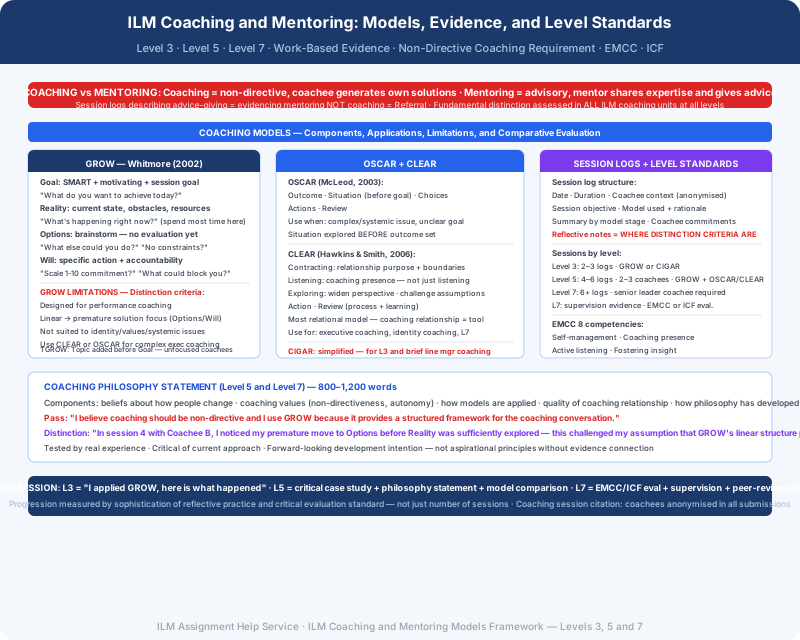
GROW (Whitmore, 2002) is the most widely used coaching model and the starting point for most ILM coaching assignments. Its four stages provide a clear structure for coaching conversations: Goal (what the coachee wants to achieve, both the end goal for the overall development area and the performance goal for this specific session), Reality (the current situation: what is actually happening, what has been tried, what resources are available, what obstacles exist), Options (generating a range of possible approaches without evaluation, brainstorming before filtering), and Will (committing to specific next steps with accountability, timeline, and a follow-up mechanism).
Coaching questions by stage. Goal: "What do you want to achieve from this session today?", "How will you know when you've succeeded?", "How does this session goal connect to your bigger development objective?". Reality: "What's happening right now?", "What have you already tried?", "What is the impact of the current situation on you and on others?", "What resources do you have available?". Options: "What options do you have?", "What else could you do?", "What would you do if there were no constraints at all?", "What has someone else done in a similar situation?". Will: "What will you do?", "When will you do it by?", "What might get in the way of taking that action?", "On a scale of 1–10, how committed are you to taking this step?"
GROW's limitations, the Level 5 and Level 7 Distinction requirement: GROW was designed for performance coaching and skills development. It works best when the coachee has a clear goal and needs structured support to move from their current Reality to specific action. It is less appropriate when the coachee's presenting issue is systemic (involving organisational culture, leadership identity, or values conflicts at the executive level) because the model's linear structure tends to move the conversation toward "Options" and "Will" before the depth of the "Reality" (the coachee's systemic context, underlying assumptions, and habitual patterns) has been adequately explored. Premature solution focus is the most common coaching error in GROW application, and it is most likely to occur in the Options and Will stages when the Reality stage has been treated as information gathering rather than deep exploration. Distinction criteria at Level 5 and Level 7 require critical evaluation of whether GROW was the most appropriate model for the specific coachee and presenting issue, not just whether it was applied correctly.
OSCAR and CLEAR Models: When and How to Apply Alternative Coaching Frameworks
OSCAR (McLeod, 2003): Outcome, Situation, Choices, Actions, Review. The key structural difference from GROW is that OSCAR places Situation before Outcome. The coachee's current context, the full systemic complexity of their situation, including organisational dynamics, relationships, and the history of the issue, is explored before a specific goal or desired outcome is identified. This makes OSCAR more appropriate than GROW when the coachee arrives at the session without a clear goal, when the presenting issue is complex or systemic, or when premature goal-setting would constrain the exploration that is needed before an authentic coaching objective can be identified. Review explicitly addresses how progress will be measured, building accountability into the model in a way that GROW's "Will" stage initiates but does not always structure as a forward-looking review mechanism.
CLEAR (Hawkins and Smith, 2006): Contracting, Listening, Exploring, Action, Review. CLEAR is the most relational of the three primary coaching models, treating the quality of the coaching relationship itself as a primary developmental tool rather than as a vehicle for reaching action. Contracting at the start of a coaching engagement (not just a session) establishes the purpose of the coaching relationship, boundaries, confidentiality parameters, and success criteria for the coaching as a whole, not just the immediate session goal. Listening is a stage in its own right, not a background skill: it describes the quality of coaching presence, the coach's full, non-judgemental attention on the coachee's experience, including what is said, what is not said, body language, and emotional state. Exploring uses systemic and creative questioning to widen the coachee's perspective, challenging assumptions, introducing alternative frames of reference, and working with metaphor and imagery. CLEAR is most appropriate for transformational coaching and executive coaching at Level 7 where the coaching relationship spans multiple sessions, the presenting issues are leadership identity and values-level challenges, and the depth of the Exploring stage is more developmental than any single GROW or OSCAR application.
TGROW (Topic, Goal, Reality, Options, Will) adds a Topic stage before Goal in the standard GROW model. The Topic stage allows the coachee to describe the broad presenting issue before a specific Goal for the session is identified. This reduces the risk of premature goal-narrowing: the coachee arrives with "I want to talk about my relationship with my director" (a Topic) and the TGROW structure allows that broad presenting area to be articulated before a specific coaching goal is agreed. CIGAR (Current, Ideal, Gaps, Actions, Review) is a simplified coaching model particularly suited to Level 3 line manager coaching contexts and brief coaching conversations (10–20 minutes). Its explicit Gaps stage (what is the distance between Current and Ideal) makes it accessible for managers introducing coaching into regular one-to-one conversations without extensive coaching training.
ILM Coaching Session Logs: Structuring Evidence for Assessment Criteria
Coaching session logs are the primary evidence in ILM Coaching and Mentoring assignments: they demonstrate that real coaching conversations have taken place and that the candidate is applying coaching models and skills with genuine non-directive coaching practice. Assessors examine session logs for evidence that the coachee generated their own solutions through the candidate's questioning (not the candidate's advice), that the chosen coaching model was applied systematically, that the quality of coaching questions is consistent with the model stage, and that the candidate's reflective notes demonstrate analytical self-awareness about coaching effectiveness rather than just reporting what the coachee said.
Complete coaching session log structure: (1) Date and duration of session; (2) Coachee context, anonymised (use role descriptions: "a middle manager in a financial services organisation," not the coachee's name); (3) Session objective, what the coachee wanted to achieve from this session; (4) Coaching model applied (GROW, OSCAR, CLEAR) and rationale for model choice; (5) Session summary by model stage, what happened at each stage, what key questions were used, how the coachee responded, what the stage produced; (6) Coachee commitments, specific actions agreed, timeline, accountability measure ("she will email her line manager by next Friday requesting a development conversation"), and agreed review at next session; (7) Candidate reflective notes, what went well in this session, what was challenging, what would be done differently, which specific coaching skills were used effectively (listening, use of silence, powerful questioning), which need development, and connection to the coaching model used.
Evidence volume by level: Level 3 typically requires 2–3 session logs; Level 5 typically requires 4–6 logs across 2–3 different coachees; Level 7 typically requires 6 or more logs including at least one executive coaching engagement with a senior leader coachee. The Distinction-level content in session logs is concentrated in the reflective notes section: it is here that candidates demonstrate critical evaluation of the coaching approach used, comparison to alternative approaches for the specific coachee and context, and specific coaching development actions based on the session's reflection. A session log with detailed Stage summaries but perfunctory reflective notes will not access Distinction criteria regardless of the quality of the coaching described.
ILM Coaching Case Studies and Critical Review of Coaching Models
ILM Level 5 and Level 7 coaching assignments typically include a coaching case study, a detailed analytical account of a coaching engagement (typically 3–6 sessions with one coachee) with critical reflection on the coaching process and outcomes. The case study structure: presenting issue (anonymised coachee context and coaching objective), coaching approach (rationale for model selection for this coachee and context), session-by-session summary (how the coaching developed across sessions, key moments and turning points, how the coachee's thinking evolved), outcomes (what the coachee achieved or learned through the engagement), and critical reflection (evaluation of the coaching approach's effectiveness, what worked and what was limiting, how the candidate's coaching skills developed through this engagement, and what would be done differently with another coachee in a similar situation).
Critical review of coaching models at Level 5 requires candidates to evaluate two or three models against research evidence, not just describe them. Limitations of GROW: designed for performance coaching; limited empirical evidence from peer-reviewed research about coaching outcome effectiveness; the model's linear stage progression may not reflect how coaching conversations actually unfold when coachees circle back; does not explicitly address the coaching relationship quality or the coach's own presence as developmental variables. Limitations of CLEAR: more complex to apply consistently than GROW; requires higher coaching skill to fully utilise the Contracting and Listening stages; practitioner-developed rather than empirically validated through independent research. Research evidence for coaching model critique: the International Journal of Evidence Based Coaching and Mentoring and Coaching: An International Journal of Theory, Research and Practice publish peer-reviewed coaching research and should be cited at Level 5 and Level 7 Distinction criteria for model critiques.
Is your primary challenge writing the critical model comparison for Level 5 or Level 7, structuring the coaching session evidence logs, or producing the coaching philosophy statement?
ILM Coaching and Mentoring assignment challenges concentrate in three distinct areas. First: candidates who have conducted coaching sessions but whose session logs describe advice-giving or direction rather than non-directive coaching. This is the most fundamental issue, because it means the coaching criterion is not met regardless of the quality of the writing. Second: candidates whose session logs have strong session summaries but thin reflective notes. The critical evaluation of coaching practice that accesses Distinction criteria is concentrated in the reflective notes section, and without analytical depth there the assignment will reach Merit at best. Third: candidates who need to produce a coaching philosophy statement or a critical review of coaching models for the first time and do not know how to structure an analytical evaluation of coaching theory rather than a description of it. The supplementary sections below address both the philosophy statement and the level-by-level progression in the coaching assessment standard.
Coaching Philosophy Statement: What It Is and How to Write It
A coaching philosophy statement, typically 800–1,200 words, required at Level 5 and Level 7, is a reflective piece in which the candidate articulates their approach to coaching: the beliefs and values that underpin their coaching practice, how those beliefs have been shaped and tested through real coaching experience, the coaching models they apply and why they have chosen those models over alternatives, and what kind of coaching relationship they seek to create with coachees. It is not a summary of coaching theory or a description of the ILM programme; it is the candidate's personal account of their developing coaching identity.
Distinction-level coaching philosophy statements demonstrate three characteristics: they are tested (the philosophy is connected to specific coaching session evidence, where did a particular belief about how people change get confirmed or challenged in a real coaching conversation?), they are critical (the candidate evaluates the limitations of their current coaching approach and identifies how it is developing, not just what they believe about coaching in the abstract), and they are forward-looking (the statement includes specific development intentions based on the reflective analysis, how will the coaching practice change in response to what has been learned?). A philosophy statement that reads as a series of aspirational principles without connection to real coaching experience will reach Merit at best. See also: ILM work-based evidence and reflective account standards · ILM Level 5 coaching and reflective practice · Executive coaching at ILM Level 7
ILM Coaching and Mentoring at Level 3, Level 5, and Level 7: What Changes
At Level 3, ILM Coaching and Mentoring introduces coaching skills for line managers and team leaders: GROW or CIGAR applied to brief coaching conversations within management one-to-ones, 2–3 session logs, basic reflective accounts describing what happened and what was learned. The assessment standard is introductory: demonstrating that the candidate understands the coaching approach and can apply a simple model correctly. At Level 5, the assessment standard requires application of multiple coaching models across several coachees (4–6 session logs), a coaching case study with critical reflection across a coaching engagement, a coaching philosophy statement, and a critical review of coaching models using research evidence, suitable for HR professionals, L&D professionals, and managers developing a coaching practice. At Level 7, the standard is executive coaching with senior leader coachees, advanced model application with critical evaluation of model fit for complex coaching contexts, evaluation of own practice against EMCC or ICF professional competency frameworks, and coaching supervision evidence, suitable for professional coaches and senior HR executives. The progression is not measured in session count alone but in the sophistication of reflective practice: from "I applied GROW and here is what happened" (Level 3) to "I critically evaluated whether GROW was the most appropriate model for this coachee's systemic presenting issue and compared my coaching approach to CLEAR, finding that..." (Level 7).
See also: ILM Level 3 coaching skills foundation · ILM Level 5 coaching and mentoring qualification · ILM Level 7 executive coaching assignment · ILM coaching supervision documentation · ILM vs CIPD for coaching and HR careers
ILM Coaching and Mentoring Assignment Help: Frequently Asked Questions
What coaching models do ILM Coaching and Mentoring assignments require?
ILM Coaching and Mentoring assignments use: GROW (Whitmore, 2002: Goal, Reality, Options, Will), the most widely used model at all levels; OSCAR (McLeod, 2003: Outcome, Situation, Choices, Actions, Review), preferred for systemic coaching contexts; CLEAR (Hawkins and Smith, 2006: Contracting, Listening, Exploring, Action, Review), for transformational and executive coaching at Level 5 and Level 7; TGROW (GROW with Topic added) and CIGAR (Current, Ideal, Gaps, Actions, Review), simpler variants used at Level 3. Distinction criteria at Level 5 and Level 7 require critical evaluation of model limitations, not just application.
What is the difference between coaching and mentoring in ILM assignments?
Coaching is non-directive: the coach uses questioning and listening to enable the coachee to generate their own solutions, with no advice and no direction. Mentoring is advisory: the mentor shares their experience and wisdom, may give direct advice, and serves as a role model. In ILM Coaching assignments, demonstrating genuinely non-directive coaching practice is a fundamental criterion. Session logs describing advice-giving or problem-solving for the coachee evidence mentoring or management, not coaching, and result in a referral.
How many coaching sessions do I need for an ILM coaching assignment?
ILM Level 3 typically requires 2–3 coaching session logs. ILM Level 5 typically requires 4–6 session logs across 2–3 coachees. ILM Level 7 typically requires 6 or more sessions including at least one executive coaching engagement with a senior leader coachee. All sessions must be with real coachees and all coachee details must be anonymised. The exact requirement is specified in the unit assessment criteria for the specific unit.
What is a coaching philosophy statement and is it required at ILM Level 3?
A coaching philosophy statement (800–1,200 words) articulates the candidate's approach to coaching: beliefs about how people change, coaching values, models applied, and the coaching relationship. It is required at ILM Level 5 and Level 7, not Level 3. Distinction-level statements demonstrate critical reflection on how the philosophy has been tested and refined through real coaching practice, connected to specific session evidence, not a description of coaching theory or aspirational coaching ideals.
Submit Your ILM Coaching and Mentoring Assignment Brief
Provide your ILM Coaching and Mentoring level (3, 5, or 7), unit name, assessment criteria from the unit specification, and your coaching session logs or case study draft. Guidance covers non-directive coaching practice assessment, coaching model application and critical evaluation for Distinction criteria, coaching session log structuring, coaching philosophy statement writing, and Harvard referencing for coaching theory at Level 5 and Level 7.
Common Questions
Is this service specific to ILM qualifications?
Yes. We specialise exclusively in City & Guilds ILM qualifications. Our writers are selected for their specific knowledge of ILM units, marking criteria, and grade descriptors — not generic academic writing.
Will my assignment be plagiarism free?
Every assignment is written from scratch and run through Turnitin before delivery. You receive a copy of the originality report alongside your completed work.
How quickly can you complete my assignment?
Standard turnaround is 5–7 days. For urgent orders we offer 24-hour and 48-hour expedited delivery at an additional cost. Contact us to confirm availability for your deadline.
What if I'm not happy with the work?
We offer unlimited free revisions within 14 days of delivery. If we cannot meet your requirements after multiple revisions, we offer a full refund — no questions asked.