ILM Level 5 is the most widely enrolled ILM qualification level, designed for middle managers, operations managers, and project managers with responsibility for teams and budgets. All assessment is work-based and criterion-referenced (no exams, no hypothetical scenarios) and candidates must structure evidence from their own management practice that addresses every ILM assessment criterion in each unit. This service provides unit-specific guidance for ILM Level 5 assignments covering change management, leadership effectiveness, financial management, project management, and marketing strategy, including Harvard referencing, criterion mapping, and the analytical standard required to reach Distinction.
ILM Level 5 Leading Innovation and Change Assignment: Kotter, Lewin, and ADKAR Evidence
Leading Innovation and Change is one of the most popular ILM Level 5 units. It requires candidates to evidence managing a real change initiative in their organisation, applying a recognised change management model to the analysis and evaluation of that change. Assessment criteria typically require: analysis of the driving and resisting forces for the change, planning or describing the implementation using a change management model, evidence of the implementation, and critical evaluation of the change outcomes and management approach.
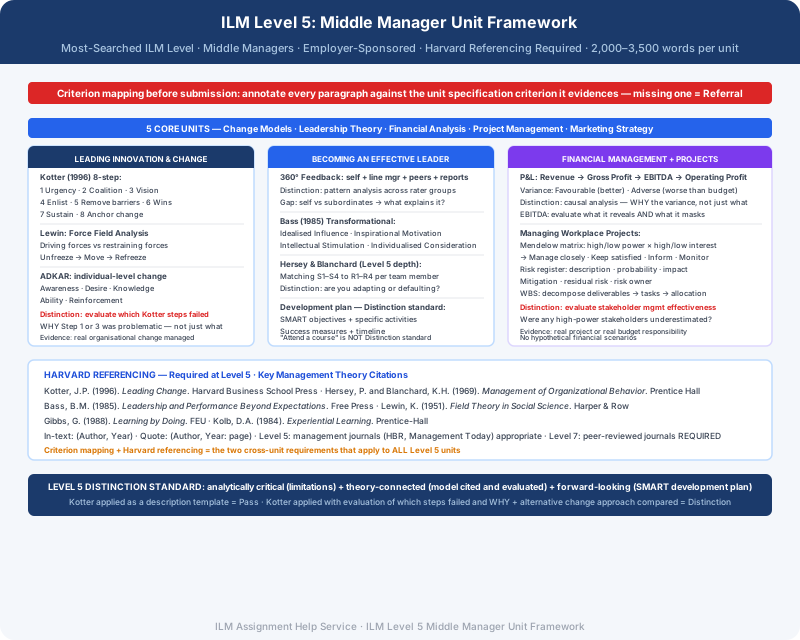
Kotter's 8-step change model (1996) is the most widely used in ILM Level 5 assignments: (1) Establish a sense of urgency, (2) Build a guiding coalition, (3) Form a strategic vision, (4) Enlist a volunteer army, (5) Enable action by removing barriers, (6) Generate short-term wins, (7) Sustain acceleration, (8) Institute the change. Pass criteria require applying Kotter's model to describe the change. Distinction criteria require critically evaluating which steps were most difficult in the actual change and why: Step 1 (genuinely establishing urgency rather than announcing it) and Step 3 (forming a vision that team members actually understand and connect to) are most commonly problematic in real management contexts. The evaluation must address why, not just what was done.
Lewin's force field analysis provides a complementary framework: identifying the driving forces supporting the change and the restraining forces opposing it, then evaluating which forces were most significant. The unfreezing-moving-refreezing model must be applied to the actual change timeline: what unfroze the organisation's prior state? When did moving begin and what characterised it? What actions were taken to refreeze the new state? Prosci's ADKAR model (Awareness of the need for change, Desire to support it, Knowledge of how to change, Ability to implement the new behaviours, Reinforcement to sustain it) is particularly useful for evaluating individual-level change readiness among team members. Distinction requires critical evaluation of where different team members were in the ADKAR model during the change and what this reveals about the change management approach's effectiveness at the individual rather than organisational level.
ILM Becoming an Effective Leader: 360-Degree Feedback Analysis and Leadership Development
Becoming an Effective Leader requires candidates to critically evaluate their own leadership effectiveness using evidence (360-degree feedback data or a validated leadership questionnaire) and produce a personal development plan. Assessment criteria typically require: evidence of leadership style assessment, analysis of leadership strengths and development areas connected to leadership theory, and a personal development plan with SMART objectives.
360-degree feedback collects leadership assessments from line manager, peers, and direct reports, plus a self-assessment, providing a multi-perspective view of leadership effectiveness. Pass criteria require describing the feedback findings and identifying strengths and development areas. Distinction criteria require pattern analysis across rater groups: do direct reports rate the candidate systematically lower on a specific dimension than peers? Is there a significant gap between self-assessment and how others perceive leadership? These patterns reveal specific leadership impact dynamics that a summary of scores does not, and the analysis must explain what causes the pattern, not just describe that it exists.
Leadership theory at Level 5: Hersey and Blanchard's situational leadership (S1 Directing: high task, low relationship; S2 Coaching: high task, high relationship; S3 Supporting: low task, high relationship; S4 Delegating: low task, low relationship) matched to follower readiness levels (R1: low competence, low commitment; R2: low competence, high commitment; R3: high competence, variable commitment; R4: high competence, high commitment) requires the candidate to evaluate whether their own leadership style is matched to the readiness levels of different team members. Transformational leadership (Bass, 1985) has four components: Idealised Influence (role modelling, trust-building), Inspirational Motivation (communicating a compelling vision), Intellectual Stimulation (encouraging innovation and challenge), Individualised Consideration (tailored development for each team member). It provides a framework for evaluating whether leadership is transactional (task completion and rewards) or transformational (developing people toward higher levels of performance). Distinction-level personal development plans include SMART objectives (Specific, Measurable, Achievable, Relevant, Time-bound), defined development activities that are more specific than "attend a leadership course," a timeline, and defined success measures connected to the specific leadership gap identified in the feedback data.
ILM Understanding Financial Management at Level 5: Budget Analysis and Management Evidence
Understanding Financial Management at ILM Level 5 requires candidates to evidence financial management responsibilities (budget management, P&L interpretation, or business case development) and demonstrate analytical commentary on financial data from their own management role. Assessment criteria typically require: evidence of financial management responsibilities, analysis of financial information relevant to the management role, and application of financial concepts to a specific management decision.
P&L (Profit and Loss) account interpretation at management level: revenue (total income), cost of goods sold (direct costs), gross profit (revenue minus direct costs), operating expenses (overheads: salary, rent, marketing), EBITDA (Earnings Before Interest, Taxes, Depreciation and Amortisation, a measure of operational financial performance), and operating profit (gross profit minus operating expenses). Pass criteria require interpreting a P&L account relevant to own area and identifying key lines. Distinction criteria require trend analysis: comparing this period to prior periods and to budget, and evaluating what management actions caused significant movements in key lines, not just identifying the numbers.
Variance analysis: a favourable variance occurs when actual performance is better than budget (lower costs or higher revenue than planned); an adverse variance occurs when actual performance is worse than budget (higher costs or lower revenue). Pass criteria require identifying variances as favourable or adverse. Distinction criteria require causal analysis: a 15% adverse variance on labour costs must be explained in specific management terms (overtime authorisation decisions, agency staff to cover absence, error in the original budget assumption, change in service demand) and the management implications assessed (is this variance controllable? What decision would reduce it in the next period?). EBITDA: a commonly used operational performance metric that excludes depreciation and capital investment. Distinction requires evaluation of what EBITDA reveals about operational efficiency and what it masks (capital-intensive businesses may show strong EBITDA while consuming capital at a rate that is strategically unsustainable). A business case for a financial decision must include quantified cost-benefit analysis with a break-even point.
ILM Managing Workplace Projects at Level 5: Project Evidence and Stakeholder Analysis
Managing Workplace Projects at Level 5 requires candidates to evidence managing or leading a real workplace project, at a more complex scale than Level 3, involving multi-stakeholder management, formal risk assessment, and project evaluation against objectives. Assessment criteria typically require: a project plan using appropriate tools, stakeholder analysis, a risk register, evidence of project monitoring, and an evaluation of project outcomes.
Mendelow's power/interest matrix maps project stakeholders on two dimensions, power (the ability to affect the project's outcome) and interest (the motivation to engage with the project), into four management strategies: high power/high interest (manage closely: regular engagement, two-way communication, involving in key decisions); high power/low interest (keep satisfied: provide timely updates, minimise surprises); low power/high interest (keep informed: regular updates, address concerns without over-engaging); low power/low interest (monitor: minimal effort but do not ignore). Distinction criteria require evaluating whether stakeholder management was actually aligned with the matrix analysis: were high-power stakeholders sufficiently engaged? Were any stakeholders whose power was underestimated a source of project risk?
Risk register at Level 5 records, for each identified risk: description, probability (high/medium/low), impact (high/medium/low), risk score (probability × impact), mitigation action, residual risk after mitigation, risk owner. Pass criteria require producing the risk register. Distinction criteria require evaluating the effectiveness of mitigation actions for risks that materialised: did the planned mitigation prevent the risk from becoming an issue? If a risk did materialise, what was the gap in the mitigation approach? The Work Breakdown Structure (WBS) at Level 5 decomposes the project into deliverable components, providing the basis for task allocation, timeline development, and responsibility assignment.
ILM Developing a Marketing Strategy at Level 5: Commercial Management Evidence
Developing a Marketing Strategy is a Level 5 unit relevant to candidates in commercial management, sales management, or regional management roles with marketing strategy responsibilities. Assessment criteria typically require: external market analysis, marketing objectives, a marketing strategy recommendation, and evidence from the candidate's own commercial management role.
PESTLE analysis at management level (Political, Economic, Social, Technological, Legal, Environmental factors) identifies macro-environmental forces affecting the organisation's market. At Distinction, PESTLE is not a list of factors with brief descriptions: it is an evaluation of which macro-environmental factors are most significant for the organisation's specific competitive position and what the strategic response should be, with evidence from recent trading performance or market data. Porter's Five Forces (supplier bargaining power, buyer bargaining power, competitive rivalry, threat of substitutes, threat of new entrants) evaluates the competitive intensity of the industry and the attractiveness of the market position. Distinction requires synthesising PESTLE and Porter's Five Forces analysis into an integrated strategic assessment: what does the combined external analysis reveal about the strategic options available?
The 7Ps marketing mix at management level (Product, Price, Place, Promotion, People, Process, Physical Evidence) must be grounded in the candidate's own commercial role. Unlike an academic marketing assignment, the ILM version requires evidence from real commercial decisions: what pricing decisions has the candidate made? What promotional activity has been managed? Distinction requires evaluating the effectiveness of current 7Ps execution and recommending specific improvements with measurable success criteria, not just describing the current marketing mix.
Which ILM Level 5 unit is your current priority: the change management assignment, the leadership development reflective account, or the financial management evidence?
ILM Level 5 units each require a specific combination of theoretical framework application and work-based evidence. For Leading Innovation and Change, the challenge is connecting a real organisational change to one or more change models at sufficient analytical depth to reach Distinction, not just applying the model as a description template. For Becoming an Effective Leader, the challenge is conducting pattern analysis across 360-degree feedback rater groups and connecting the findings to specific leadership theory components. For Understanding Financial Management, the challenge is moving from reading financial numbers to causal analysis of variance: explaining why the numbers are what they are, not just what they are. The supplementary sections below cover criterion mapping and Harvard referencing: the two cross-unit requirements that apply across all Level 5 units.
Criterion Mapping for ILM Level 5 Assignments: Ensuring Every Criterion Is Evidenced
Criterion mapping is the practice of annotating a draft ILM assignment against each assessment criterion listed in the unit specification before submission. At Level 5, with longer assignments (2,000–3,500 words), missing a criterion is more likely than at Level 3: a detailed analytical report can cover the general subject matter comprehensively while inadvertently leaving one specific criterion insufficiently evidenced. The referral consequence is the same regardless of overall quality: one missed criterion results in a referral for the whole unit.
The practical process: download the unit specification from the ILM website or qualification documentation, list every assessment criterion with its code, annotate each section or paragraph of the draft assignment with the criterion number(s) it evidences, and identify any criteria with no annotation before submission rather than after the referral notification. Criterion mapping takes approximately 20–30 minutes for a Level 5 assignment and is the single most effective risk reduction activity before submission. See also: ILM assessment criteria and work-based evidence · ILM Level 3 criterion mapping · ILM Level 7 strategic assignment progression
Harvard Referencing for ILM Level 5 Management Theory
Harvard referencing is required at ILM Level 5. Key management theories with their standard academic citations for Level 5 assignments: Kotter, J.P. (1996). Leading Change. Harvard Business School Press, for change management; Hersey, P. and Blanchard, K.H. (1969). Management of Organizational Behavior. Prentice Hall, for situational leadership; Bass, B.M. (1985). Leadership and Performance Beyond Expectations. Free Press, for transformational leadership; Lewin, K. (1951). Field Theory in Social Science. Harper & Row, for force field analysis; Gibbs, G. (1988). Learning by Doing. FEU, for reflective practice; Kolb, D.A. (1984). Experiential Learning. Prentice-Hall, for experiential learning reflective models. In-text format: (Author, Year) for paraphrase; (Author, Year: page number) for direct quotation. Management journal articles, Harvard Business Review, Management Today, are appropriate at Level 5; peer-reviewed academic journals become more important at Level 7. See also: ILM Harvard referencing requirements by level · ILM coaching referencing, coaching models
ILM Level 5 Assignment Help: Frequently Asked Questions
What are the most popular ILM Level 5 units and what does each require?
The most popular ILM Level 5 units are: Leading Innovation and Change (evidence of managing a real organisational change using Kotter's 8-step, Lewin's force field, or Prosci ADKAR); Becoming an Effective Leader (360-degree feedback analysis, transformational/situational leadership theory application, SMART development plan); Understanding Financial Management (P&L interpretation, variance analysis, evidence of own budget responsibilities); Managing Workplace Projects (Mendelow's stakeholder matrix, risk register, project evaluation); and Developing a Marketing Strategy (PESTLE, Porter's Five Forces, 7Ps, for commercial managers). Every unit requires evidence from the candidate's own management role.
What is the difference between ILM Level 5 Award, Certificate, and Diploma?
The Award (1–3 units) is the shortest commitment, targeted skill development, commonly employer-funded for a specific management capability. The Certificate (4–6 units) provides a more comprehensive qualification. The Diploma is the full ILM Level 5 qualification covering the broadest range of management competencies and providing the most credible evidence portfolio for career progression. All three are Ofqual-regulated with the same work-based, criterion-referenced assessment approach.
How do I structure work-based evidence for an ILM Level 5 assignment?
Download the unit specification, list every assessment criterion, and structure the assignment so each criterion is explicitly addressed. Evidence types include written analytical reports describing and evaluating own management practice, management plans, meeting records, financial reports, and 360-degree feedback data. Criterion mapping (annotating the draft against each criterion before submission) is the most effective way to prevent a referral. All evidence must come from the candidate's real management role, not hypothetical scenarios.
Does ILM Level 5 require Harvard referencing and which management theories should I cite?
Harvard referencing is required at ILM Level 5. Key citations: Kotter (1996) for change management, Hersey and Blanchard (1969) for situational leadership, Bass (1985) for transformational leadership, Gibbs (1988) for reflective practice, Kolb (1984) for experiential learning models, Lewin (1951) for force field analysis. In-text format: (Author, Year). Management journals (Harvard Business Review, Management Today) are appropriate at Level 5.
Submit Your ILM Level 5 Assignment Brief
Provide your ILM Level 5 unit name, the assessment criteria from the unit specification, and any management evidence you have already gathered from your role: change initiative context, 360-degree feedback data, financial reports, or project documentation. Unit-specific guidance addresses every assessment criterion in your unit specification, covers change model application and leadership theory connection at Distinction depth, and includes Harvard referencing support for all key management theory citations.
Common Questions
Is this service specific to ILM qualifications?
Yes. We specialise exclusively in City & Guilds ILM qualifications. Our writers are selected for their specific knowledge of ILM units, marking criteria, and grade descriptors — not generic academic writing.
Will my assignment be plagiarism free?
Every assignment is written from scratch and run through Turnitin before delivery. You receive a copy of the originality report alongside your completed work.
How quickly can you complete my assignment?
Standard turnaround is 5–7 days. For urgent orders we offer 24-hour and 48-hour expedited delivery at an additional cost. Contact us to confirm availability for your deadline.
What if I'm not happy with the work?
We offer unlimited free revisions within 14 days of delivery. If we cannot meet your requirements after multiple revisions, we offer a full refund — no questions asked.