ILM Level 7 occupies a distinctive position in the UK professional qualifications landscape: it is a postgraduate-equivalent qualification assessed through work-based evidence and written analysis rather than university examination, attracting senior leaders, directors, and executives who need the academic credential and the developmental challenge without the full-time commitment of an MBA programme. The assessment standard reflects this positioning: Level 7 assignments are not assessed against the descriptive or even analytical standards of Level 5, but against a critical synthesis standard that requires the candidate to demonstrate mastery of strategic management theory, the ability to apply multiple competing frameworks to complex real-world strategic situations, and the intellectual honesty to evaluate the limitations of those frameworks in the specific context of their own organisation. "Critical" at Level 7 means something precise: it means identifying what a theory or framework does not explain or cannot account for, not just applying it to describe what it can. Heifetz and Linsky (2002) on adaptive leadership, Senge (1990) on systems thinking, and Uhl-Bien et al. (2007) on complexity leadership are not additional theories to be described: they are alternative conceptual architectures that fundamentally challenge the assumptions underlying most operational management frameworks, and engaging with them critically at Level 7 means understanding what they challenge and why that challenge matters for senior leadership practice in complex organisations. This guide provides criterion-level guidance for ILM Level 7 strategic leadership assignments at the distinction standard.
What Distinguishes Level 7 from Level 5 Assessment
The difference between Level 5 and Level 7 assessment is not primarily a matter of quantity: more theory, more evidence, longer assignments. It is a qualitative difference in the nature of the intellectual work expected. At Level 5, the assessment standard requires critical analysis: applying theoretical frameworks to real situations, evaluating what the frameworks reveal, and identifying limitations of both the frameworks and the candidate's own practice. At Level 7, the assessment standard requires critical synthesis: holding multiple competing frameworks in tension simultaneously, evaluating which provides more explanatory power in a specific strategic context, identifying the assumptions each framework rests on, and constructing an original analytical argument that integrates insights from multiple theoretical traditions rather than applying them sequentially.
The practical difference appears most clearly in how the same piece of evidence is treated at the two levels. A change management situation at Level 5 might be analysed using Kotter's (1996) eight-step model: the candidate applies each step to their situation, identifies where implementation deviated from the model's recommendations, and evaluates the consequences of those deviations. At Level 7, the same change situation requires the candidate to evaluate whether Kotter's model is the appropriate analytical frame at all: is this a technical problem (solvable through Kotter's structured change management) or an adaptive challenge (requiring Heifetz and Linsky's (2002) distinction between technical and adaptive challenges, where the solution requires changing the values, beliefs, and working norms of the people involved rather than implementing a predetermined answer)? The Level 7 candidate is expected to recognise the difference, justify the theoretical choice, apply the more appropriate framework, and evaluate its limitations, not just apply the most familiar framework because it is familiar.
Postgraduate writing standards at Level 7 require peer-reviewed journal citations alongside standard management texts. Level 7 distinction submissions in ILM strategic leadership should include citations from journals such as Leadership Quarterly, Journal of Management Studies, British Journal of Management, Harvard Business Review, and Strategic Management Journal, not just from the key management textbooks that Level 5 assignments rely on. The intellectual standard is one of engagement with the field of management research, not just with its most accessible summaries. Harvard referencing at Level 7 must include page numbers for all direct quotations and should distinguish between first-edition and subsequent editions of key texts where the theoretical content has evolved.
Strategic Leadership Theory: Complexity, Adaptive, and Systems Thinking
Three theoretical frameworks are central to ILM Level 7 strategic leadership assessment and represent the conceptual frontier of leadership studies: complexity leadership theory (Uhl-Bien, Marion, and McKelvey, 2007), adaptive leadership (Heifetz and Linsky, 2002), and systems thinking (Senge, 1990). All three share a common challenge to the assumptions underlying most earlier leadership theory: they reject the notion that effective leadership is primarily a property of individual leaders and their behaviours, and propose instead that leadership in complex adaptive systems is an emergent property of relationships, networks, and organisational dynamics rather than a characteristic that senior leaders can design and implement from above.
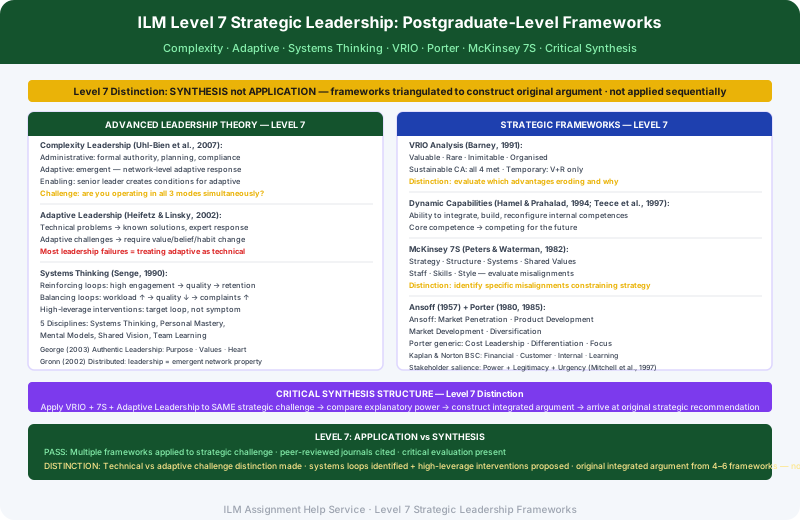
Complexity leadership theory (Uhl-Bien et al., 2007) distinguishes three types of leadership: administrative leadership (formal authority structures, compliance-based management, planning and resource allocation), adaptive leadership (the informal, emergent leadership that arises in response to novel problems, not the positional leader's actions but the network-level adaptive responses of the organisation), and enabling leadership (the formal leader's role in creating the conditions for adaptive leadership to emerge, reducing bureaucratic barriers, creating diverse interaction spaces, protecting informal leadership). The ILM Level 7 application requires the candidate to evaluate which type of leadership is most needed in their specific organisational context, and to critically examine whether their formal leadership role is functioning in all three modes simultaneously, which complexity leadership theory argues is the requirement for effective senior leadership in organisations facing genuine complexity and uncertainty.
Heifetz and Linsky's (2002) adaptive leadership framework distinguishes between technical problems (problems with known solutions, solvable by applying existing expertise) and adaptive challenges (problems that require people to change their values, beliefs, and habits, where the problem and the solution are both unclear). Most senior leadership failures, Heifetz argues, are the result of treating adaptive challenges as technical problems: attempting to apply expert solutions to situations that require value-level change rather than procedural improvement. The ILM Level 7 application requires the candidate to identify specific strategic challenges in their organisation, classify them as technical or adaptive, evaluate whether the organisation's current response is appropriate to the challenge type, and propose a leadership approach, including the candidate's own role, that addresses the adaptive dimensions rather than just the technical ones. Senge's (1990) systems thinking requires the candidate to analyse their organisation as a complex adaptive system characterised by feedback loops, delays, interdependencies, and emergent behaviours, rather than as a complicated but predictable machine that responds linearly to management interventions.
Developing Organisational Strategy: VRIO, Dynamic Capabilities, McKinsey 7S, Ansoff, Porter
ILM Level 7 strategic management units require candidates to demonstrate both strategic analysis competence (applying the frameworks) and strategic evaluation competence (critically assessing which frameworks are most informative for their specific organisational context). The most commonly expected strategic frameworks at Level 7 include VRIO (Valuable, Rare, Imitable, Organised) for resource-based strategy analysis, Hamel and Prahalad's (1994) dynamic capabilities concept, McKinsey 7S for organisational alignment analysis, Ansoff's (1957) growth matrix for strategic direction evaluation, and Porter's (1980) generic competitive strategies. Distinction-level applications require critical triangulation: applying multiple frameworks to the same strategic question and evaluating what each reveals that the others do not, then constructing an analytical argument about the organisation's strategic position that draws on all of them rather than treating each as a separate analytical exercise.
VRIO analysis: identifies the resources and capabilities that provide the organisation with a sustainable competitive advantage. A resource is Valuable if it creates value for customers (reduces costs or improves performance). It is Rare if few competitors possess it. It is Inimitable if it is difficult for competitors to replicate, typically because it is embedded in complex organisational routines, cultural patterns, or tacit knowledge. It is Organised if the organisation is structured and managed to exploit it. Resources that are valuable, rare, inimitable, and well-organised provide sustainable competitive advantage. Resources that are valuable but not rare provide competitive parity. Resources that are valuable and rare but imitable provide only temporary advantage. At Level 7 distinction standard, the VRIO analysis should evaluate the dynamic aspects of competitive advantage: which of the organisation's current competitive advantages are at risk of erosion due to technological change, competitive imitation, or internal capability deterioration, connecting to Teece, Pisano, and Shuen's (1997) dynamic capabilities concept (the ability to integrate, build, and reconfigure internal and external competences to address rapidly changing environments). McKinsey 7S (Peters and Waterman, 1982) (Strategy, Structure, Systems, Shared Values, Staff, Skills, and Style) at Level 7: the analytical value is in evaluating the alignment and consistency across all seven elements, identifying misalignments that constrain strategic execution, and proposing specific interventions to restore alignment.
Leading Complex Multi-Stakeholder Change at Level 7
Change management at Level 7 requires engagement with frameworks that go substantially beyond Kotter and Lewin, not because those frameworks are wrong, but because they were developed for and tested in relatively stable hierarchical organisations where the problem of change is primarily one of managing resistance to a predetermined answer. Heifetz and Linsky's (2002) adaptive leadership framework, complexity leadership theory, and Senge's (1990) systems thinking all challenge the "change as implementation" assumption and propose instead that effective strategic change in complex organisations requires a different kind of leadership: one that tolerates ambiguity, engages with conflict rather than suppressing it, and enables the organisation to develop its own capacity for adaptation rather than managing change as a top-down programme with a predetermined end-state.
Multi-stakeholder change management at Level 7 requires the candidate to demonstrate management of stakeholder complexity beyond Mendelow's matrix: while Mendelow is appropriate at Level 5 for project-level stakeholder management, Level 7 change involving boards of directors, regulators, union representatives, major customers, investors, and community stakeholders requires a more sophisticated analytical framework. Mitchell, Agle, and Wood's (1997) stakeholder salience model, which classifies stakeholders by the combination of power, legitimacy, and urgency they possess, provides the additional analytical granularity that Level 7 strategic change contexts typically demand. Stakeholders who possess all three attributes (power to act, legitimacy of claim, and urgency of need) are "definitive" stakeholders whose concerns the organisation is obligated to address immediately; those with only one attribute have minimal salience. Mapping a complex multi-stakeholder change initiative using the salience model rather than (or in addition to) Mendelow's matrix demonstrates the theoretical sophistication that Level 7 distinction criteria require.
Systems Thinking in ILM Level 7: Interconnected Cause-Effect Analysis
Senge's (1990) systems thinking is one of the most intellectually demanding frameworks in the ILM Level 7 curriculum because it requires the candidate to analyse their organisation as a dynamic system in which cause and effect are often separated in time and space, feedback loops create non-linear and counterintuitive outcomes, and well-intentioned management interventions frequently produce unintended consequences. Senge identifies five component "disciplines" of a learning organisation: Systems Thinking itself, Personal Mastery, Mental Models, Building Shared Vision, and Team Learning. At Level 7, the systems thinking discipline is the most assessed because it provides the analytical lens for understanding why organisational problems persist despite repeated management interventions.
Causal loop diagrams (a key tool of systems thinking analysis) identify the feedback loops that sustain or amplify organisational problems. A reinforcing (positive) feedback loop amplifies change in one direction: high employee engagement drives high customer service quality, which drives higher customer retention, which drives stronger financial performance, which enables greater investment in employee development, which drives higher engagement (a reinforcing growth loop). A balancing (negative) feedback loop counteracts change: as workload increases, quality declines, customer complaints increase, management pressure to improve quality increases, quality temporarily improves but workload remains high, eventually driving further quality decline (a balancing loop that prevents sustained improvement). The distinction-level application at Level 7 requires the candidate to identify specific reinforcing and balancing loops in their organisation, evaluate which loops are most influential in sustaining the strategic problem they are analysing, and propose interventions that target the high-leverage points in the system rather than the most visible symptoms.
What Distinction Looks Like at Level 7: Critical Synthesis vs Application
The ILM Level 7 distinction standard requires critical synthesis: constructing an original analytical argument that integrates insights from multiple theoretical traditions, evaluates their relative explanatory power in a specific strategic context, and arrives at a conclusion that goes beyond what any single framework could produce. This is qualitatively different from Level 5 distinction, which requires critical application: applying a framework with evaluative depth, identifying its limitations, and connecting its insights to real evidence. Level 7 distinction requires the candidate to hold competing theoretical frameworks in productive tension, to recognise that the real explanatory power often lies in the interaction between frameworks rather than in any single one, and to demonstrate that their analytical conclusion is the product of this multi-framework engagement rather than a single-theory conclusion dressed in academic language.
A worked example: a Level 7 assignment analysing strategic leadership challenges in a public sector organisation facing significant resource constraint and external regulatory pressure. A Level 5 pass response applies Kotter's change model and identifies which steps have been successfully implemented. A Level 5 distinction response critically evaluates Kotter's application, identifies limitations of the linear model in the complex public sector context, and proposes adjustments. A Level 7 pass response applies multiple strategic frameworks (McKinsey 7S, Ansoff, systems thinking) and evaluates their findings against each other. A Level 7 distinction response constructs an original argument: that the organisation's strategic challenge is fundamentally an adaptive challenge rather than a technical one (Heifetz and Linsky, 2002), that the complexity of the public sector stakeholder environment requires network-level adaptive leadership to emerge (Uhl-Bien et al., 2007) rather than being managed through top-down strategic planning, that the organisation's own systems dynamics (Senge, 1990), specifically, a reinforcing loop between resource constraint, staff disengagement, and service quality decline, are amplifying the strategic challenge beyond the capacity of conventional change management to address, and that VRIO analysis reveals that the organisation's only sustainable competitive resource (staff expertise and institutional knowledge) is at risk of erosion through continued resource reduction, making people strategy, not service design, the critical strategic priority. That is Level 7 distinction: original, multi-framework, critically synthesised, and connected to a strategic recommendation that emerges from the synthesis rather than from any single framework.
Are you struggling with the critical synthesis requirement: applying multiple strategic frameworks to the same strategic question and constructing an integrated argument?
The transition from Level 5 analytical application to Level 7 critical synthesis is the most demanding intellectual shift in the ILM qualification ladder. Most Level 7 candidates have the theoretical knowledge they need: they have encountered the frameworks and understand them individually. The challenge is holding multiple frameworks in productive tension, recognising where they converge and where they conflict, and constructing an argument that emerges from the interaction rather than sequentially applying each framework before moving to the next. Our Level 7 support provides critical synthesis frameworks specifically designed for the most challenging ILM Level 7 units (strategic leadership, organisational change, strategic development) with worked examples at the distinction standard showing how competing theoretical traditions are integrated into a coherent analytical argument. The support is criterion-specific to the candidate's actual unit specification rather than generic Level 7 academic writing guidance, which does not reliably address the specific assessment criteria that ILM Level 7 units require.
ILM Level 7 vs MBA: How the Qualification and Assessment Compares
The comparison between ILM Level 7 and a traditional MBA is important for candidates choosing between pathways and for employers evaluating the credential. Both are postgraduate-equivalent qualifications in leadership and management. The MBA, delivered through university, combines taught modules with examinations, essays, and a dissertation; it typically requires full-time or intensive part-time attendance, has a higher academic entry requirement, and produces a university degree. ILM Level 7, delivered through approved centres, is entirely work-based: assessed through portfolio evidence and written assignments connected to the candidate's real management practice; attendance requirements vary by centre but are generally lower than MBA programmes. The critical difference in practice: MBA assignments are more theoretically abstract and academically evaluated; ILM Level 7 assignments are more practically grounded but still require the theoretical depth and critical synthesis that postgraduate academic assessment demands. Professionals who have completed ILM Level 7 and subsequently enrol in MBA programmes typically find the analytical writing standards familiar; the theoretical range required for ILM Level 7 is comparable to MBA programme expectations. See also: ILM Level 7 full qualification guide · Level 5 as preparation for Level 7
Strategic Leadership Harvard Referencing at Level 7: Key Sources and Citation Standards
Level 7 distinction assignments should cite peer-reviewed journal articles alongside foundational management texts. Key sources: Heifetz, R.A. and Linsky, M. (2002). Leadership on the Line: Staying Alive Through the Dangers of Leading. Boston: Harvard Business School Press. Senge, P.M. (1990). The Fifth Discipline: The Art and Practice of the Learning Organisation. New York: Doubleday. Uhl-Bien, M., Marion, R. and McKelvey, B. (2007). Complexity Leadership Theory: Shifting leadership from the industrial age to the knowledge era. The Leadership Quarterly, 18(4), pp. 298–318. Hamel, G. and Prahalad, C.K. (1994). Competing for the Future. Boston: Harvard Business School Press. Kaplan, R.S. and Norton, D.P. (1996). The Balanced Scorecard: Translating Strategy into Action. Boston: Harvard Business School Press. Ansoff, I. (1957). Strategies for diversification. Harvard Business Review, 35(5), pp. 113–124. Journal citations require volume number, issue number, and page range. See also: ILM Harvard referencing standards · Comprehensive ILM referencing guide · Level 5 leadership theory application
ILM Level 7 Strategic Leadership Assignment Help: Frequently Asked Questions
What is the minimum number of theoretical frameworks expected in an ILM Level 7 strategic leadership assignment?
There is no prescribed minimum, but ILM Level 7 distinction submissions typically integrate four to six theoretical frameworks in a single strategic analysis, not applied sequentially to different aspects of the same issue, but triangulated against each other to build an integrated analytical argument. The quality test is whether the frameworks are being genuinely synthesised (producing an argument that emerges from their interaction) or merely catalogued (each framework applied separately before moving to the next). Distinction at Level 7 requires synthesis; pass requires application; a distinction submission that functions as sequential application of frameworks without integration will typically be marked at merit or pass standard despite its theoretical breadth.
How many peer-reviewed journal articles should an ILM Level 7 assignment reference?
ILM Level 7 distinction assignments typically include five to ten peer-reviewed journal article citations alongside six to twelve management textbooks. The journal citations should be genuinely integrated, not appended as a reference list item without being cited in the text, and should come from credible journals: Leadership Quarterly, Journal of Management Studies, British Journal of Management, Academy of Management Review, Strategic Management Journal, or Harvard Business Review. The key distinction between a pass and a distinction Level 7 reference list is not length but the presence of peer-reviewed research that goes beyond the foundational textbooks, demonstrating that the candidate has engaged with the current state of management research, not just with its most accessible summaries.
What is the word count for ILM Level 7 strategic leadership assignments?
ILM Level 7 written assignments are typically 3,500–5,000 words per unit, with some units specifying up to 7,000 words for complex strategic analysis submissions. The word count requirement varies by unit specification and by ILM centre; candidates should check their specific unit specification for the required range. At distinction standard, the quality of analytical argument matters far more than the quantity of words: a 3,500-word assignment that demonstrates genuine critical synthesis of competing strategic frameworks will outperform a 5,500-word assignment that applies frameworks sequentially without integrating them into a coherent analytical argument.
Common Questions
Is this service specific to ILM qualifications?
Yes. We specialise exclusively in City & Guilds ILM qualifications. Our writers are selected for their specific knowledge of ILM units, marking criteria, and grade descriptors — not generic academic writing.
Will my assignment be plagiarism free?
Every assignment is written from scratch and run through Turnitin before delivery. You receive a copy of the originality report alongside your completed work.
How quickly can you complete my assignment?
Standard turnaround is 5–7 days. For urgent orders we offer 24-hour and 48-hour expedited delivery at an additional cost. Contact us to confirm availability for your deadline.
What if I'm not happy with the work?
We offer unlimited free revisions within 14 days of delivery. If we cannot meet your requirements after multiple revisions, we offer a full refund — no questions asked.