
Harvard referencing is the academic citation standard required for ILM Level 5 and Level 7 assignments and recommended practice at Level 4, and for many ILM candidates it is the most technically unfamiliar aspect of their programme, particularly for those who studied before formal academic referencing was routine in professional education, or who come from fields where citation conventions differ. The good news is that Harvard referencing follows a consistent logic: in-text citations identify the source within the flow of writing, and a reference list at the end of the assignment provides the full publication details for every source cited. The bad news is that management theory citations have specific formatting conventions: the distinction between a book, a journal article, a government report, and a website produces different reference list formats. Errors in those formats are assessed as academic standards failures that can affect submission marks and, at Level 7, contribute to referral decisions. This guide provides the correct Harvard format for the forty management theories most commonly cited in ILM assignments across all levels, with specific examples for every reference type that candidates encounter, from foundational management textbooks to peer-reviewed journal articles to ILM unit specifications and institutional reports.
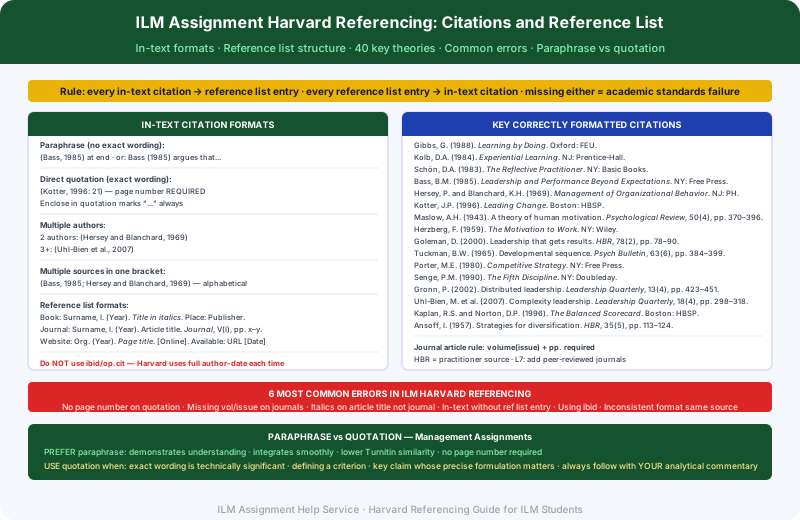
Harvard Basics: In-Text Citations vs Reference List
Harvard referencing consists of two interconnected components that must always be used together: in-text citations (brief author-date references embedded in the writing at the point where the source is used) and a reference list (full publication details for every source cited in-text, presented in a single alphabetically ordered list at the end of the assignment). The rule is absolute: every source cited in-text must have a corresponding full entry in the reference list, and every entry in the reference list must be cited at least once in the assignment text. An in-text citation without a reference list entry leaves the reader unable to locate the source; a reference list entry without an in-text citation is a ghost citation (evidence of padding rather than genuine scholarly engagement), and assessors at Level 5 and Level 7 are trained to identify both errors.
In-text citation formats: paraphrase (no direct quotation): (Surname, Year), e.g., (Bass, 1985) or Bass (1985) argues that... Direct quotation (exact wording from the source): (Surname, Year: page number), e.g., (Kotter, 1996: 21) or as Kotter (1996: 21) states, "..." Secondary citation (citing an author as quoted in another work you have read): (Original Author, Year, cited in Author you read, Year), e.g., (Burns, 1978, cited in Bass, 1985). Secondary citations should be used sparingly: always try to access and cite the original source directly where it is available. Multiple authors: two authors, (Smith and Jones, 2020); three or more authors, (Smith et al., 2020). Multiple sources in one citation: (Bass, 1985; Hersey and Blanchard, 1969), alphabetical order by first author's surname. Multiple works by the same author in the same year: (Bass, 1985a; Bass, 1985b).
Reference list format basics: alphabetical order by first author's surname; hanging indent style (first line flush left, subsequent lines indented); consistent capitalisation and punctuation throughout. Book: Surname, Initials. (Year). Title in italics. Place of publication: Publisher. Journal article: Surname, Initials. (Year). Article title without italics. Journal Title in italics, Volume(Issue), pp. start–end. Website: Surname, Initials. or Organisation Name. (Year). Page title. [Online]. Available at: URL [Accessed date]. ILM centre documents and unit specifications: City and Guilds/ILM. (Year). Document title. London: City and Guilds. Chapter in edited book: Surname, Initials. (Year). Chapter title. In: Editor Surname, Initials. (ed.) Book title. Place of publication: Publisher, pp. start–end.
The 40 Most-Cited Theories Correctly Formatted
Change Management: Kotter, J.P. (1996). Leading Change. Boston: Harvard Business School Press. Lewin, K. (1951). Field Theory in Social Science. New York: Harper and Row. Prosci (2012). ADKAR: A Model for Change in Business, Government and our Community. Fort Collins, CO: Prosci Learning Center Publications. [Note: ADKAR is often attributed to "Hiatt, J.M. (2006)": Hiatt, J.M. (2006). ADKAR: A Model for Change in Business, Government and our Community. Fort Collins, CO: Prosci Learning Center Publications.]
Leadership: Bass, B.M. (1985). Leadership and Performance Beyond Expectations. New York: Free Press. Hersey, P. and Blanchard, K.H. (1969). Management of Organizational Behavior: Utilizing Human Resources. Englewood Cliffs, NJ: Prentice-Hall. Burns, J.M. (1978). Leadership. New York: Harper and Row. Goleman, D. (2000). Leadership that gets results. Harvard Business Review, 78(2), pp. 78–90. Greenleaf, R.K. (1977). Servant Leadership: A Journey into the Nature of Legitimate Power and Greatness. New York: Paulist Press. Kouzes, J.M. and Posner, B.Z. (2017). The Leadership Challenge: How to Make Extraordinary Things Happen in Organizations. 6th edn. Hoboken, NJ: Wiley. Lewin, K., Lippitt, R. and White, R.K. (1939). Patterns of aggressive behavior in experimentally created social climates. Journal of Social Psychology, 10(2), pp. 271–299. Fiedler, F.E. (1967). A Theory of Leadership Effectiveness. New York: McGraw-Hill. Gronn, P. (2002). Distributed leadership as a unit of analysis. The Leadership Quarterly, 13(4), pp. 423–451. George, B. (2003). Authentic Leadership: Rediscovering the Secrets to Creating Lasting Value. San Francisco: Jossey-Bass. Heifetz, R.A. and Linsky, M. (2002). Leadership on the Line: Staying Alive Through the Dangers of Leading. Boston: Harvard Business School Press. Uhl-Bien, M., Marion, R. and McKelvey, B. (2007). Complexity leadership theory: Shifting leadership from the industrial age to the knowledge era. The Leadership Quarterly, 18(4), pp. 298–318.
Motivation: Maslow, A.H. (1943). A theory of human motivation. Psychological Review, 50(4), pp. 370–396. Herzberg, F. (1959). The Motivation to Work. New York: Wiley. McGregor, D. (1960). The Human Side of Enterprise. New York: McGraw-Hill. Vroom, V.H. (1964). Work and Motivation. New York: Wiley. Adams, J.S. (1963). Towards an understanding of inequity. Journal of Abnormal and Social Psychology, 67(5), pp. 422–436. Doran, G.T. (1981). There's a SMART way to write management's goals and objectives. Management Review, 70(11), pp. 35–36. [SMART objectives citation]
Reflective Practice: Gibbs, G. (1988). Learning by Doing: A Guide to Teaching and Learning Methods. Oxford: Further Education Unit. Kolb, D.A. (1984). Experiential Learning: Experience as the Source of Learning and Development. Englewood Cliffs, NJ: Prentice-Hall. Schön, D.A. (1983). The Reflective Practitioner: How Professionals Think in Action. New York: Basic Books. Moon, J.A. (2004). A Handbook of Reflective and Experiential Learning: Theory and Practice. London: RoutledgeFalmer. Honey, P. and Mumford, A. (1986). Using Your Learning Styles. Maidenhead: Peter Honey Publications.
Strategy: Porter, M.E. (1980). Competitive Strategy: Techniques for Analyzing Industries and Competitors. New York: Free Press. Porter, M.E. (1985). Competitive Advantage: Creating and Sustaining Superior Performance. New York: Free Press. Ansoff, I. (1957). Strategies for diversification. Harvard Business Review, 35(5), pp. 113–124. Kaplan, R.S. and Norton, D.P. (1996). The Balanced Scorecard: Translating Strategy into Action. Boston: Harvard Business School Press. Hamel, G. and Prahalad, C.K. (1994). Competing for the Future. Boston: Harvard Business School Press. Senge, P.M. (1990). The Fifth Discipline: The Art and Practice of the Learning Organisation. New York: Doubleday. Peters, T.J. and Waterman, R.H. (1982). In Search of Excellence: Lessons from America's Best-Run Companies. New York: Harper and Row. [McKinsey 7S] Mendelow, A. (1991). Stakeholder mapping. Proceedings of the 2nd International Conference on Information Systems, Cambridge, MA. Tuckman, B.W. (1965). Developmental sequence in small groups. Psychological Bulletin, 63(6), pp. 384–399. Belbin, R.M. (1981). Management Teams: Why They Succeed or Fail. Oxford: Butterworth-Heinemann.
Project Management: APM (Association for Project Management) (2019). APM Body of Knowledge. 7th edn. Princes Risborough: APM. PMI (Project Management Institute) (2021). A Guide to the Project Management Body of Knowledge (PMBOK Guide). 7th edn. Newton Square, PA: PMI.
Referencing ILM Unit Specifications and Centre Documentation
ILM unit specifications are published by City and Guilds and are the primary authoritative sources for the assessment criteria, learning outcomes, and qualification requirements that ILM students work to. When candidates quote or paraphrase from their unit specification in an assignment, for example quoting the exact criterion language or referencing the qualification level descriptor, the specification must be cited. The format for an ILM unit specification reference: City and Guilds/ILM. (Year). Unit title: Unit reference number. [ILM unit specification]. London: City and Guilds. Example: City and Guilds/ILM. (2015). Becoming an Effective Leader: Unit 8600-315. [ILM unit specification]. London: City and Guilds.
Where the exact publication year of the unit specification is uncertain (unit specifications are periodically revised and the version date may not be immediately apparent), candidates can use the ILM centre's guidance materials to identify the version, or note the accessed date: City and Guilds/ILM. (n.d.). Unit title: Unit reference number. [ILM unit specification]. London: City and Guilds. Available at: [URL if accessed online] [Accessed: date]. Centre-specific assessment guidance documents (centre assessment plans, assessment records, programme handbooks) are unpublished institutional documents and follow the format: [Organisation name/Centre name]. (Year). Document title. [Unpublished document]. [City]: [Organisation name]. These are cited when the candidate references specific assessment guidance from their centre's documentation rather than the City and Guilds published specification.
Referencing Journal Articles: HBR, Management Today, and Academic Journals
Journal article referencing is one of the most frequently incorrect citation types in ILM assignments because the format requires more detail than a book citation and the details (volume number, issue number, page range) are not always immediately apparent from an online article. The full format: Surname, Initials. (Year). Article title: no italics, capitalise only the first word and proper nouns. Journal Title in italics, Volume(Issue), pp. start page–end page. Example: Goleman, D. (2000). Leadership that gets results. Harvard Business Review, 78(2), pp. 78–90. The volume and issue numbers are found on the journal's website or in the article's header information. For HBR articles accessed online, the volume and issue are available in the article's full citation information on the HBR website.
Harvard Business Review (HBR) articles are appropriate at Level 5 and Level 7, where they are considered credible practitioner-oriented sources. HBR is not a peer-reviewed academic journal, it is a practitioner management publication, and while it is widely cited in management education, Level 7 distinction submissions should supplement HBR citations with peer-reviewed journal citations from academic journals such as The Leadership Quarterly, Journal of Management Studies, British Journal of Management, Academy of Management Review, and Strategic Management Journal. Peer-reviewed journal citations at Level 7 demonstrate engagement with the research evidence base for management theory, not just its practitioner applications. They carry more academic weight than HBR or Management Today citations in assessments where critical synthesis of research evidence is a distinction criterion. Management Today is a practitioner magazine rather than a journal: it is appropriate as supporting contextual evidence (industry trends, market data, case study examples) rather than as a primary theoretical citation source.
Referencing Websites and Grey Literature
Websites require particular care in Harvard referencing because the information needed for a complete citation (author, publication date, URL) is not always readily available on the web page, and websites can change or be removed after the citation is made (hence the requirement to record the accessed date). Standard website format: Surname, Initials. or Organisation Name. (Year). Page title. [Online]. Available at: full URL [Accessed: day month year]. If no author is identified, begin with the organisation name. If no publication date is available, use (n.d.) for "no date." Example: CIPD (2023). Leadership. [Online]. Available at: https://www.cipd.org/uk/knowledge/factsheets/leadership/ [Accessed: 15 March 2024].
Grey literature (government reports, industry association publications, organisational white papers, consultancy research) follows a similar format: Author/Organisation. (Year). Title. [Report/White paper/Research report]. Place of publication: Publisher. Example: Department for Education. (2023). Further Education Workforce Data 2022/23. [Statistical Release]. London: Department for Education. KPMG (2022). UK CEO Outlook 2022. [Research Report]. London: KPMG. Grey literature is appropriate as contextual evidence at all ILM levels: it provides organisational, sector, and economic context for the management situations being analysed. However, it should not be used as the primary citation for theoretical frameworks, which require academic or practitioner-authoritative sources (published books or journal articles). Candidates who rely heavily on company websites and consultancy reports for theoretical citations risk their referencing being assessed as insufficiently rigorous, particularly at Level 5 and Level 7.
Common Harvard Referencing Errors That Appear in Turnitin
Turnitin does not specifically flag referencing errors, it identifies text similarity, not citation accuracy. However, poor referencing practices correlate with Turnitin issues in specific ways. Direct quotations that are not enclosed in quotation marks and cited with page numbers appear in Turnitin as unacknowledged text matches, which raises similarity scores and may trigger academic integrity concerns even where the candidate had no intention of misrepresenting the source as their own work. The solution is always to enclose direct quotations in quotation marks and cite with the page number: (Bass, 1985: 23). Paraphrased text that is too close to the original wording (changing two or three words without changing the sentence structure) similarly appears as a text match. Genuine paraphrase requires reconstructing the idea in the candidate's own sentence structure, not synonymising the original text word by word.
The most common referencing errors in ILM assignments at Level 5 and Level 7: (1) In-text citations present without corresponding reference list entries: often because the candidate added citations during revision without updating the reference list. (2) Reference list entries without corresponding in-text citations: often leftover entries from earlier drafts. (3) Missing page numbers for direct quotations: required whenever the exact wording of the original source is quoted. (4) Incorrect author format: first name rather than initials, or initials before surname. (5) Missing volume and issue numbers for journal articles: the most common omission in journal article citations. (6) Italics applied to article titles rather than journal titles: book titles and journal titles are italicised; article titles are not. (7) Using "ibid." or "op. cit.": these Latin abbreviations are used in footnote citation styles, not Harvard author-date; each citation in Harvard must give the full author-date reference regardless of how recently the same source was cited. (8) Inconsistent citation of the same source: the same work cited in different formats (Bass (1985), Bass 1985, B. Bass (1985)) within the same document. Full consistency in formatting is required throughout.
When Paraphrasing Beats Quoting in Management Assignments
In management assignments, unlike humanities or social science essays where the exact language of a source sometimes carries analytical weight, paraphrase is almost always preferable to direct quotation, for three reasons. First, paraphrase demonstrates understanding: reconstructing a concept in your own words shows the assessor that you understand what the source says well enough to explain it, rather than recognising the relevant passage and reproducing it. Second, paraphrase integrates more smoothly into analytical writing: a directly quoted sentence from Bass (1985) inserted into a passage of the candidate's own analytical prose often disrupts the argumentative flow, whereas a paraphrase of the same idea fits naturally into the candidate's own writing and requires no adjustment for style, tense, or voice. Third, heavy direct quotation raises Turnitin similarity scores unnecessarily: a passage that could be paraphrased in two sentences of the candidate's own analysis produces no Turnitin flag and demonstrates more competence than the same passage reproduced as a direct quotation.
When direct quotation is appropriate in ILM management assignments: when the exact wording of a source is significant and paraphrase would lose something important: a definition that has a precise technical meaning, a criterion-level statement from a unit specification, or a key theoretical claim that is so specific to its formulation that paraphrase would alter its meaning. A direct quotation from Kotter (1996: 37), "The most general lesson to be learned from the more successful cases is that the change process goes through a series of phases that, in total, usually require a considerable length of time," is appropriate when the candidate is analysing whether Kotter's time emphasis was respected in their own change management experience. The quotation should be followed immediately by the candidate's analysis of what it reveals about their specific situation, not left to stand as the analytical conclusion itself. A quotation that is not followed by analytical commentary is evidence of what the source says, not evidence of the candidate's ability to use the source analytically.
Are you submitting a Level 5 or Level 7 assignment and need to verify that your Harvard referencing is complete and correctly formatted?
Harvard referencing errors are among the most time-efficient improvements to make in any Level 5 or Level 7 assignment because they are identifiable and fixable without requiring additional research or evidence collection. A systematic referencing audit, checking every in-text citation against the reference list, verifying that every reference list entry has the correct volume and issue information, confirming that direct quotations have page numbers, and checking that all format conventions (italics, punctuation, author format) are consistent, takes thirty to sixty minutes for a typical Level 5 assignment and can address multiple referencing issues that, if left in place, would contribute to a referral or a reduced grade. Our referencing support service provides a full referencing audit for ILM assignments at any level, correcting errors to the ILM-standard Harvard format and verifying that in-text citations and reference list entries are fully consistent and correctly formatted. The audit also checks that the theoretical sources cited are appropriate for the level (Level 7 submissions require peer-reviewed journal citations; Level 5 submissions should cite foundational management texts; Level 3 submissions should cite at least the author and year for any theoretical models used).
How Referencing Connects to Academic Integrity in ILM Assignments
Harvard referencing is not merely a formatting convention: it is the mechanism by which academic integrity is maintained in scholarly writing. Citing sources correctly demonstrates that the candidate's analytical conclusions are grounded in established theory and research rather than unsupported assertion, and that they have given appropriate intellectual credit to the authors whose ideas they are using. City and Guilds (ILM) academic integrity policy requires all submitted work to be original and properly referenced: unacknowledged use of others' ideas (whether from published sources or from other students' assignments) constitutes academic misconduct under the policy. Paraphrasing without citation, direct quotation without quotation marks, and using content from online assignment help sources without attribution all fall within the scope of the policy. Turnitin is used by most ILM centres to check similarity; submissions with high similarity to other texts (whether published sources or other submissions) are reviewed, and where the similarity is found to reflect unacknowledged use, academic misconduct proceedings may be initiated. Proper referencing is the most straightforward and complete defence against academic integrity concerns: every source used is acknowledged, every claim is grounded, and every idea that is not the candidate's own is attributed. See also: ILM academic integrity standards · Level 5 referencing requirements · Level 7 postgraduate academic standards · Reflective accounts and theoretical citation · Level 3 citation practice
Reference Management Tools for ILM Students
Reference management software can significantly reduce the time and error rate in Harvard referencing, particularly for Level 5 and Level 7 candidates who are building reference lists of twenty or more sources across multiple units. Free tools: Zotero (a web browser extension and desktop application that captures citation information from web pages and generates Harvard-format reference list entries automatically), Mendeley (an academic reference manager with PDF annotation, particularly useful for Level 7 candidates working with peer-reviewed journal articles), and Microsoft Word's built-in citation manager (Insert → Citation → Harvard format, which adds in-text citations and generates a reference list automatically, though the Harvard output requires manual checking for ILM-specific format conventions). Google Scholar provides citation information for academic articles in multiple formats: clicking "Cite" below a search result provides a Harvard citation that can be pasted directly into a reference list, though the capitalisation and punctuation should be checked against ILM Harvard format conventions. The most important discipline regardless of the tool used: check every generated citation against the original source before submitting. Automated citation tools have known error rates for volume and issue numbers, edition information, and publication place, and these errors must be corrected manually before submission. See also: ILM assignment preparation and submission · Level 7 reference list requirements
ILM Assignment Harvard Referencing Guide: Frequently Asked Questions
Do I need to cite Maslow and Herzberg separately if I reference both in the same sentence?
Yes. Each source requires its own in-text citation. When referencing multiple sources in the same sentence, list them in alphabetical order by first author's surname within a single pair of parentheses, separated by semicolons: (Herzberg, 1959; Maslow, 1943). If one source is cited at a specific point earlier in the sentence, it can be cited there with the others cited at the end: "Maslow (1943) proposes a hierarchical needs structure, while two-factor theory (Herzberg, 1959) distinguishes motivators from hygiene factors." Both must have full entries in the reference list. The same rule applies to all other multiple-source citations: each requires its own author-date citation, not a shared parenthetical.
How do I reference Kotter's eight-step model: is it the 1995 HBR article or the 1996 book?
Both are legitimate sources for Kotter's eight-step change model. The 1996 book is the more commonly cited: Kotter, J.P. (1996). Leading Change. Boston: Harvard Business School Press. The 1995 Harvard Business Review article is: Kotter, J.P. (1995). Leading change: Why transformation efforts fail. Harvard Business Review, 73(2), pp. 59–67. The article has a slightly different framing as an eight-step "why transformation efforts fail" analysis; the book is the full treatment. If you have read and are citing the book, use the 1996 book citation. If you have only accessed the 1995 article, cite that. Do not cite the book if you have not read it. Cite the source you have actually used.
What is the correct Harvard citation for Gibbs' Reflective Cycle?
The correct full Harvard reference for Gibbs' Reflective Cycle is: Gibbs, G. (1988). Learning by Doing: A Guide to Teaching and Learning Methods. Oxford: Further Education Unit. The in-text citation is (Gibbs, 1988) for paraphrase, or (Gibbs, 1988: page number) for direct quotation. Note that the publication is a Further Education Unit report, not a commercial publisher book, which is why "Further Education Unit" appears as the publisher rather than a standard commercial publisher. A common error is citing "Gibbs (1988) Reflective Cycle" without the italicised title: the title must appear in the reference list entry, and the abbreviated in-text version (Gibbs, 1988) should always correspond to the full entry in the reference list.
Common Questions
Is this service specific to ILM qualifications?
Yes. We specialise exclusively in City & Guilds ILM qualifications. Our writers are selected for their specific knowledge of ILM units, marking criteria, and grade descriptors — not generic academic writing.
Will my assignment be plagiarism free?
Every assignment is written from scratch and run through Turnitin before delivery. You receive a copy of the originality report alongside your completed work.
How quickly can you complete my assignment?
Standard turnaround is 5–7 days. For urgent orders we offer 24-hour and 48-hour expedited delivery at an additional cost. Contact us to confirm availability for your deadline.
What if I'm not happy with the work?
We offer unlimited free revisions within 14 days of delivery. If we cannot meet your requirements after multiple revisions, we offer a full refund — no questions asked.