The ILM Level 5 Becoming an Effective Leader unit is consistently rated the most challenging unit in the ILM Level 5 Certificate and Diploma programmes by candidates and assessors alike: not because the theory is inaccessible, but because the unit requires genuine critical self-evaluation of the candidate's own leadership practice rather than the application of theory to a safely abstract organisational context. Candidates must present 360-degree feedback from real rater groups, analyse the patterns across those groups honestly, connect specific leadership behaviours identified in the feedback to named theoretical frameworks, construct a development plan that addresses specific and evidenced development needs, and produce a reflective account using Gibbs or Kolb that demonstrates analytical depth rather than description. The pass standard requires all of this to be present; the distinction standard requires all of this to be critical: evaluating not just what the feedback says but what it reveals about the candidate's assumptions, blind spots, and development trajectory as a leader. Every year, a substantial proportion of Level 5 submissions are referred at this unit because candidates apply the theoretical frameworks correctly but fail to apply them critically to their own practice, producing sophisticated descriptions of leadership theory that never quite engage with what the 360 data actually reveals about them. This guide addresses the criterion-level requirements for the unit with the specificity needed to achieve and exceed the pass standard.
Assessment Criteria Breakdown for ILM Level 5 Becoming an Effective Leader
The ILM Level 5 Becoming an Effective Leader unit (8600-315 or equivalent depending on the cohort's unit catalogue) has four learning outcomes, each with multiple assessment criteria. Learning Outcome 1 requires the candidate to understand the personal and professional skills required to be an effective leader at middle management level: this is the theoretical foundation component, where leadership models (Bass, Hersey and Blanchard, Goleman) are applied to define what effective leadership at the candidate's level requires. Learning Outcome 2 requires the candidate to be able to assess their own leadership behaviour: this is the 360-degree feedback component, where the specific feedback data is presented and analysed, not described. Learning Outcome 3 requires the candidate to be able to construct a personal development plan for leadership: this is the SMART PDP component, where development actions must be specific, measurable, and evidentially connected to the identified development gaps. Learning Outcome 4 requires the candidate to be able to reflect on and evaluate their progress: this is the Gibbs or Kolb reflective component, where the candidate evaluates their own development journey rather than just describing it.
Criterion-level failures are most common at Learning Outcome 2 and Learning Outcome 3. At LO2, the most frequent failure is presenting 360-degree feedback as a descriptive summary ("my manager rated my communication skills as 4/5 and my team rated them as 3.8/5") rather than analysing it analytically ("the gap between my self-assessment of my communication style (3.2/5) and my team's assessment (4.1/5) indicates that I am systematically underestimating the clarity and accessibility of my communication from a team member's perspective, a pattern that Bass (1985) would connect to the individualised consideration dimension of transformational leadership, where leaders who genuinely attend to individual development needs often impact team members more significantly than they are aware"). The analytical requirement in the criterion language, "assess" rather than "describe," is the key marker. At LO3, the most frequent failure is a PDP that contains aspirational development goals ("I want to improve my strategic thinking") without the specificity required to make them assessable: no timeline, no success measure, no specific activity, no connection to the evidence that identified the development gap.
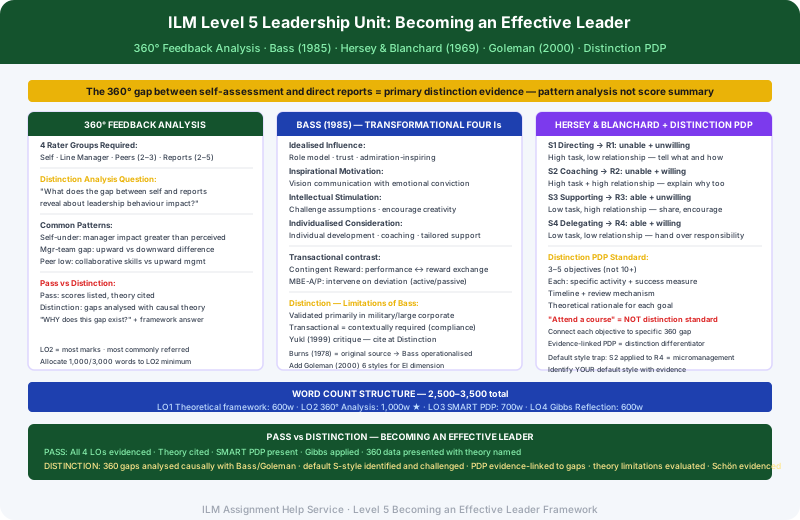
The word count structure for this unit: most centres specify 2,500–3,500 words for the written assignment. A productive allocation is approximately 600 words for LO1 (theoretical framework application), 1,000 words for LO2 (360-degree feedback analysis, this is the most heavily weighted component), 700 words for LO3 (PDP with full SMART criteria), and 600 words for LO4 (reflective account using Gibbs). The 360-degree feedback analysis receives the most assessor attention and should receive the most word count. The PDP should be presented as a structured table or formatted list with SMART criteria explicitly applied to each development objective, not as a prose paragraph that vaguely addresses development intentions.
360-Degree Feedback: Pattern Analysis Across Rater Groups
360-degree feedback works by collecting performance assessments from multiple perspectives simultaneously: the candidate's self-assessment, the line manager's assessment, peer assessments from colleagues at the same level, and upward assessments from direct reports. The value of 360-degree feedback as a leadership development tool, and as an ILM assessment tool, is precisely that the different perspectives reveal patterns that no single perspective could identify. A candidate who rates their own strategic communication skills at 3.5/5 while their line manager rates them at 4.5/5 and their direct reports rate them at 2.8/5 is revealing something analytically important: their communication is perceived very differently across organisational levels, and understanding why that gap exists is more developmentally valuable than knowing the average score.
Pattern analysis across rater groups at Level 5 Distinction standard requires the candidate to identify the three to four most significant patterns in their 360-degree feedback data (not list every score for every competency), explain what each pattern reveals about their leadership behaviour and its impact on different stakeholder groups, connect each pattern to a specific theoretical framework (Bass's transformational dimensions, Hersey and Blanchard's situational leadership, Goleman's emotional intelligence domains), and evaluate the extent to which the pattern is a development priority, a strength to leverage, or a contextual artefact that needs further exploration. The distinction-standard analysis question for any 360-degree feedback gap is always: "What does this gap tell me about my leadership behaviour and its differential impact on different stakeholder groups, and what does the theoretical framework I am applying suggest about why that differential impact exists?"
Common pattern types in Level 5 360-degree feedback and their theoretical connections. Self-overestimation relative to direct reports: often connected to Bass's (1985) finding that transactional leaders tend to overestimate the motivational effectiveness of their directive approach; or to Goleman's (2000) social awareness dimension, where leaders who are technically strong may underestimate the emotional impact of their communication style on team members. Manager-team gap: where the line manager's ratings are significantly higher than the team's, often indicates that the candidate performs differently in upward relationships than in downward relationships: their competencies are visible to the manager but their impact on the team is different from what the manager observes. Same-level peer overestimation: where peers consistently rate the candidate lower than the manager, may indicate that the candidate's collaborative leadership skills are less developed than their upward relationship management, which Kouzes and Posner (2017) would identify as an imbalance between the "Enable Others to Act" and "Model the Way" dimensions of their Five Practices framework.
Bass (1985) Transformational Leadership Applied to Own Practice
Bass's (1985) transformational leadership model identifies four components, the Four Is: Idealised Influence (acting as a role model whose values and behaviours inspire admiration and trust), Inspirational Motivation (communicating a compelling vision with emotional conviction that motivates others to perform beyond expectations), Intellectual Stimulation (challenging assumptions, encouraging creativity, promoting innovative thinking), and Individualised Consideration (treating each team member as an individual with unique development needs and providing tailored support and coaching). Transformational leadership is contrasted with transactional leadership, which operates on an exchange basis (performance in exchange for reward or the avoidance of negative consequences) through contingent reward and management-by-exception (passive and active).
The ILM Level 5 application of Bass requires candidates to do three things that many candidates do only one of. First, understand the model at the level of its specific components: not just "transformational leadership is inspiring others" but the specific Four Is with their precise definitions. Second, apply the model to their own 360-degree feedback data with analytical specificity: not "my 360 feedback suggests I am a transformational leader" but "my 360-degree feedback indicates that my Inspirational Motivation score (4.2/5 from direct reports) is my strongest transformational dimension, consistent with my team's high scores on organisational commitment, while my Intellectual Stimulation score (2.9/5) suggests I may be limiting my team's creative problem-solving capacity by providing solutions rather than creating the conditions for them to develop their own." Third, evaluate the limitations of the transformational model as an analytical frame for their specific situation: Burns (1978), who first theorised transformational leadership before Bass operationalised it, noted that not all leadership contexts call for transformational approaches. Transactional leadership is not a failure but a contextually appropriate tool in operational and compliance-heavy environments.
The pass vs distinction distinction for Bass application: Pass, the candidate describes the Four Is, states which dimensions their 360 feedback indicates are strong or weak, and proposes development actions. Distinction, the candidate analyses the specific 360 evidence through each of the Four Is, evaluates the internal consistency of the feedback (does the Inspirational Motivation score correlate with team engagement data?), compares the transformational and transactional dimensions and evaluates which is appropriate in their specific management context, and acknowledges the limitations of the model (Bass's framework was primarily validated in military and large corporate contexts: how applicable is it to the candidate's specific organisational and cultural context?).
Hersey and Blanchard's Situational Leadership: S1–S4 Matched to R1–R4
Hersey and Blanchard's Situational Leadership model (1969, developed through the 1970s and 1980s) argues that effective leadership requires the leader to adapt their leadership style to the developmental readiness of each individual team member for each specific task. Readiness is defined as a combination of competence (the skill and knowledge to perform the task) and commitment (the willingness and motivation to perform the task), producing four readiness levels: R1 (unable and unwilling or insecure: low competence, low commitment or confidence), R2 (unable but willing or motivated: low competence, high commitment), R3 (able but unwilling or insecure: high competence, low commitment or variable confidence), R4 (able and willing or self-reliant: high competence, high commitment). The four matching leadership styles are: S1 Directing (high task, low relationship: telling the individual specifically what to do and how), S2 Coaching (high task, high relationship: explaining why as well as what, involving the individual in discussion while the leader still directs decisions), S3 Supporting (low task, high relationship: sharing decision-making, providing encouragement and facilitation, not directing), S4 Delegating (low task, low relationship: handing responsibility to the individual, staying available but stepping back).
The ILM Level 5 application of Hersey and Blanchard for the distinction standard requires pattern analysis across the team rather than a single application to a single team member. The candidate should map all team members (anonymised) against the R1–R4 scale for their key tasks, identify which S-style they are currently applying to each, evaluate whether the S-style is appropriate to the R-level, and examine what the pattern reveals about their default leadership style: the style they tend to apply regardless of readiness level. A common pattern is leaders who default to S2 (Coaching: high task, high relationship) because it feels "engaged and supportive," even with R4 team members who need S4 (Delegating) and experience S2 as micromanagement. Another common pattern is leaders who apply S1 (Directing) across the board in operational pressure situations, reverting to a directive default regardless of the team member's actual readiness level, reducing autonomy for R4 individuals and increasing dependency in R2 individuals who need coaching support to develop competence.
Distinction-Level Personal Development Plan: SMART Plus Evidence-Linked
The Personal Development Plan (PDP) required in the ILM Level 5 Becoming an Effective Leader unit must be SMART (Specific, Measurable, Achievable, Relevant, Time-bound) for each development objective. This is the pass standard. The distinction standard requires the PDP to also be evidence-linked: each development objective must trace back to a specific identified gap in the 360-degree feedback analysis, and each planned development activity must include a rationale connecting it to the identified gap rather than being a generic professional development action. "Attend a leadership training course" is not a SMART PDP objective. "Develop my Intellectual Stimulation capability (Bass, 1985) by facilitating three team problem-solving workshops in Q1 2026, using structured brainstorming and devil's advocate questioning techniques, with success measured by a post-workshop team survey on perceived creative autonomy (target: minimum 7/10 average from team members)" is a distinction-standard PDP objective.
PDP structure at Distinction: three to five objectives (more than five disperses developmental focus), each with: a specific development goal connected to a named 360-degree feedback gap; a planned activity that is more specific than "training" (facilitation, coaching, observation, project leadership, action learning, structured reading with application, mentoring from a specific person with named expertise); a success measure that is observable and specific; a timeline with a specific completion date; a review mechanism (how and when progress will be assessed); and a theoretical rationale connecting the development approach to the identified gap. Assessors at Level 5 Distinction standard are looking for a PDP that demonstrates the candidate understands the difference between generic professional development and criterion-specific leadership development, a distinction that reflects the analytical sophistication the full unit demands.
What Separates Analysis from Description in ILM Level 5 Leadership Assignments
The recurring assessor feedback pattern in referred Level 5 leadership assignments is "more analytical depth required." This phrase is typically applied to submissions that describe theoretical frameworks accurately, present 360-degree feedback data clearly, and propose plausible development actions, but that do not critically engage with what the evidence reveals about the candidate's leadership practice. The structural test for analytical depth is straightforward: replace every sentence in the assignment that begins with "Bass argues that..." or "The model shows that..." or "According to Hersey and Blanchard..." with a sentence that begins with "My 360-degree feedback data indicates that I..." or "The pattern across rater groups reveals that my..." or "The gap between my self-assessment and my team's assessment suggests that my leadership approach...". Analytical writing is first-person, specific, evidence-referenced, and evaluative. Descriptive writing is third-person, general, theory-summarising, and neutral.
The distinction between analysis and description is not about vocabulary or academic register. It is about the relationship between the theoretical framework and the candidate's specific evidence. A pass-level submission says: "Bass's (1985) transformational leadership model identifies Individualised Consideration as a key leadership dimension." A distinction-level submission says: "The variance between my direct reports' rating of my Individualised Consideration (2.7/5) and my own self-assessment (3.8/5) is the most significant gap in my 360-degree feedback and indicates that my perception of how consistently I attend to individual development needs differs substantially from my team's experience of it, a finding consistent with Bass's (1985) research showing that managers who identify with transformational values often apply them less consistently in day-to-day practice than in high-visibility leadership moments." The second sentence is analytical because it connects a specific evidential finding to a specific theoretical concept with a specific evaluative judgment about what the combination reveals.
Have you received your 360-degree feedback and do not know how to structure the analysis to meet the distinction criteria?
The 360-degree feedback analysis is the component of the Becoming an Effective Leader unit where the most marks are available and where the most candidates underperform relative to their potential. Receiving 360-degree feedback and writing about it are two different competencies: the first requires honest engagement with what colleagues and reports think about your leadership behaviour; the second requires connecting that feedback data to theoretical frameworks in a way that produces criterion-level analytical evidence. Most candidates can do the first; many struggle with the second because the connection between "my scores" and "what Bass or Hersey and Blanchard say about this" requires both theoretical understanding and critical self-evaluation, applied simultaneously to the same piece of evidence. Our support provides criterion-mapped analysis guidance for the specific unit version the candidate is completing, with worked examples showing how to connect specific 360-degree feedback patterns to the leadership frameworks at the pass, merit, and distinction standards. Both the theoretical application and the analytical structure are provided at the level of the specific assessment criteria, not as general leadership writing guidance.
Connecting Leadership Unit Evidence to Other Level 5 Units
The evidence produced for the Becoming an Effective Leader unit has direct cross-unit relevance in the ILM Level 5 Certificate and Diploma. The 360-degree feedback analysis contributes to criteria in units on performance management and team development. The PDP contributes to criteria in personal development and continuous professional development units. The reflective account provides the analytical framework for any unit that requires reflective practice evidence. When building a Level 5 portfolio, candidates who plan evidence production with cross-unit relevance in mind produce fewer total evidence items with greater criterion coverage per item. This is a planning efficiency that also reduces the risk of criterion gaps. See also: ILM Level 5 full qualification structure · Reflective account writing for Level 5 units · Progression to Level 7 leadership assessment · ILM assignment structure across levels
Goleman's Emotional Intelligence and Kouzes and Posner in Level 5 Leadership Assignments
Goleman's (2000) emotional intelligence framework (Self-Awareness, Self-Management, Social Awareness, and Relationship Management) provides a complementary analytical lens to Bass and Hersey for the 360-degree feedback analysis. Specifically, Goleman's social awareness dimension (empathy, organisational awareness, service orientation) directly addresses the gaps that typically appear between leaders' self-assessments and their direct reports' assessments: leaders with lower social awareness tend to overestimate their interpersonal impact on team members in ways that are measurable in 360-degree feedback data. Kouzes and Posner's (2017) Five Practices of Exemplary Leadership, Model the Way, Inspire a Shared Vision, Challenge the Process, Enable Others to Act, Encourage the Heart, provide an alternative scoring framework for Level 5 assignments where the unit's 360-degree feedback instrument is aligned to the Five Practices rather than to Bass's MLQ. Using both frameworks where the evidence supports both demonstrates the theoretical breadth that distinction criteria at Level 5 require. See also: Level 5 qualification structure · Leadership styles and theories for ILM
ILM Level 5 Leadership Unit Assignment Help: Frequently Asked Questions
How many rater groups does my 360-degree feedback need to include for the Becoming an Effective Leader unit?
ILM Level 5 360-degree feedback should typically include four rater groups: self-assessment, line manager assessment, peer assessments (two to three colleagues at a similar level), and direct report assessments (two to five team members, depending on team size). The analytical value, and the distinction-level criterion requirement, comes specifically from comparing patterns across all four groups, particularly the gap between self-assessment and direct report assessments, which typically reveals the most significant leadership development insights. Submissions with only self-assessment and line manager feedback lack the multi-perspectival evidence that the criterion requires and will typically not fully meet the LO2 assessment standard.
Which leadership theory is most important for the ILM Level 5 Becoming an Effective Leader unit?
Bass's (1985) transformational leadership model and Hersey and Blanchard's (1969) situational leadership model are the two most commonly applied, and most expected, theories for this unit at Level 5. Bass provides the framework for analysing the nature and quality of the candidate's leadership approach (transformational vs transactional dimensions), and Hersey and Blanchard provide the framework for analysing whether the candidate adapts their style to individual team member needs (S1–S4 matched to R1–R4). Using both theories, applied to the same 360-degree feedback data, is the approach most likely to meet distinction criteria. Goleman's (2000) emotional intelligence framework provides a useful third frame, particularly for candidates whose 360 data shows gaps in social awareness or relationship management dimensions.
What does a distinction-level PDP look like for the ILM Level 5 Becoming an Effective Leader unit?
A distinction-level PDP for this unit has three to five objectives, each directly connected to a specific gap identified in the 360-degree feedback analysis (not generic leadership development aspirations), each with a SMART structure (specific activity, measurable success indicator, achievable within a realistic timeline, relevant to the identified gap, time-bound with a completion date), and each with a theoretical rationale explaining why the planned development approach will address the identified gap. Development activities should be specific: not "attend training" but "facilitate three structured problem-solving workshops using the Six Thinking Hats method to develop my Intellectual Stimulation capability (Bass, 1985), measured by post-workshop team creativity ratings in Q2 2026."
Common Questions
Is this service specific to ILM qualifications?
Yes. We specialise exclusively in City & Guilds ILM qualifications. Our writers are selected for their specific knowledge of ILM units, marking criteria, and grade descriptors — not generic academic writing.
Will my assignment be plagiarism free?
Every assignment is written from scratch and run through Turnitin before delivery. You receive a copy of the originality report alongside your completed work.
How quickly can you complete my assignment?
Standard turnaround is 5–7 days. For urgent orders we offer 24-hour and 48-hour expedited delivery at an additional cost. Contact us to confirm availability for your deadline.
What if I'm not happy with the work?
We offer unlimited free revisions within 14 days of delivery. If we cannot meet your requirements after multiple revisions, we offer a full refund — no questions asked.