Leadership theory is the intellectual backbone of ILM assignments at every level, and the ability to apply it correctly, selecting the right theory for the specific unit criterion, applying it with the right analytical depth for the level, and evaluating its limitations rather than just describing its content, is the primary competence that separates referred submissions from passes and passes from distinctions. The landscape of leadership theory spans more than eighty years of management research, from Lewin's (1939) early identification of autocratic, democratic, and laissez-faire styles through to Gronn's (2002) distributed leadership and George's (2003) authentic leadership. ILM assessors at each level have specific expectations about which theories are appropriate, how deeply they should be applied, and what critical evaluation of them looks like. This guide provides a level-by-level application framework for the leadership theories most commonly assessed in ILM units at Levels 3, 5, and 7, with specific guidance on the analytical standard required at each level and the common application errors that lead to referrals across all three.
Which Theory at Which Level: A Quick Reference Framework
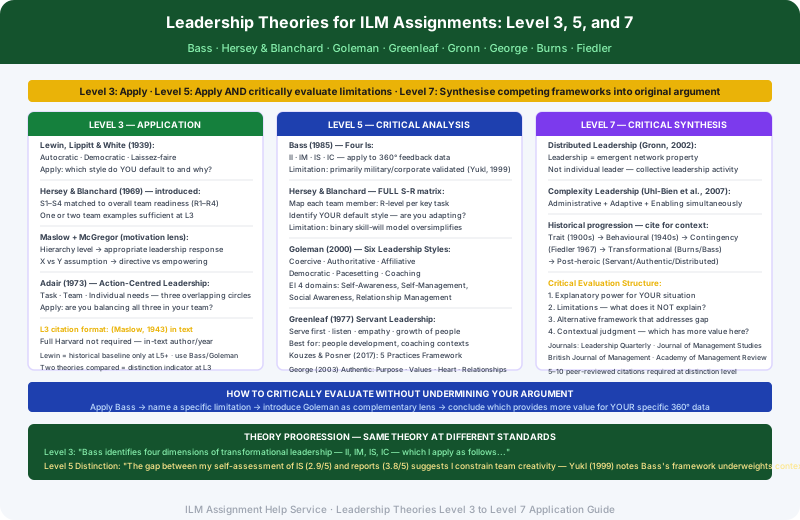
The selection of leadership theory for an ILM assignment is not arbitrary. It should reflect both the assessment criteria of the specific unit and the analytical standard appropriate to the level. At Level 3, the standard requires understanding and application: demonstrating that you understand what a theory means and can connect it to a specific team context with examples. At Level 5, the standard requires critical analysis: applying a theory to real evidence, evaluating its explanatory power, and comparing it to at least one alternative. At Level 7, the standard requires critical synthesis: integrating multiple competing theoretical frameworks into an original argument about strategic leadership challenges, with evaluation of what each framework explains and what it does not.
Level 3 leadership theories, most commonly assessed: Lewin, Lippitt, and White's (1939) three leadership styles (autocratic, democratic, laissez-faire); Blanchard and Hersey's situational leadership (introduced at Level 3, applied at depth at Level 5); Maslow's (1943) Hierarchy of Needs (applied to motivation as the primary outcome of effective leadership); Tuckman's (1965) team development stages as a leadership response framework; and McGregor's (1960) Theory X and Theory Y. Level 5 leadership theories, most commonly assessed: Bass (1985) transformational and transactional leadership; Hersey and Blanchard (1969) situational leadership applied to individual team members across the full S1–S4 and R1–R4 matrix; Goleman (2000) emotional intelligence and its six leadership styles; Greenleaf (1977) servant leadership; and Kouzes and Posner (2017) Five Practices. Level 7 leadership theories, most commonly assessed: Gronn (2002) distributed leadership; Heifetz and Linsky (2002) adaptive leadership; Uhl-Bien et al. (2007) complexity leadership; Senge (1990) systems thinking; and George (2003) authentic leadership. Burns (1978) and Fiedler (1967) are important historical foundations that are cited at Level 5 and Level 7 to provide contextual contrast and to demonstrate awareness of the theoretical development trajectory in leadership studies.
Transformational vs Transactional Leadership: Bass (1985) and Burns (1978)
Burns (1978) first introduced the distinction between transforming and transactional leadership in a political context. Transforming leadership raises both the leader and the follower to higher levels of morality and motivation, engaging followers' higher-order needs and values to pursue shared goals that transcend individual self-interest. Transactional leadership operates through exchange: the leader provides rewards (or the avoidance of punishment) in exchange for followers' compliance and performance. Bass (1985) operationalised and refined Burns' distinction into a measurable model for organisational leadership, adding the concept of laissez-faire leadership (absence of leadership, neither transformational nor transactional) and developing the Multifactor Leadership Questionnaire (MLQ) to measure leadership style empirically. Bass's four transformational components, the Four Is, are: Idealised Influence (role model behaviour inspiring trust and admiration), Inspirational Motivation (vision-based motivation communicated with emotional conviction), Intellectual Stimulation (challenging thinking, encouraging innovation and creative problem-solving), and Individualised Consideration (personalised development support treating each follower as an individual). Transactional components: Contingent Reward (clear performance expectations with specified rewards for achievement) and Management by Exception Active and Passive (intervening either proactively when performance deviates from standards or only reactively after problems have occurred).
Level 5 application standard: applying Bass's Four Is to 360-degree feedback data to identify which transformational dimensions are strongest and which need development, evaluating the evidence for each dimension-specific claim, and identifying the causal mechanisms that explain the pattern in the feedback data. Level 5 distinction: evaluating the limitations of Bass's transformational model for the candidate's specific management context, for example recognising that transformational leadership has been most strongly validated in military and corporate leadership contexts (Yukl, 1999), and that its applicability in bureaucratic public sector or highly regulated environments where transactional mechanisms (compliance, process adherence) are organisationally required may be more limited than the model implies. Burns (1978) should be cited as the original theoretical source; Bass (1985) as the operationalisation; at Level 7, Yukl's (1999) critique of the transformational leadership literature should be engaged with to demonstrate awareness of the research evidence for and against the model's claims.
Situational Leadership: Hersey and Blanchard Applied Across All ILM Levels
Situational leadership (Hersey and Blanchard, 1969) is the most persistently assessed leadership theory across all ILM levels: it is introduced at Level 3, applied analytically at Level 5, and critically evaluated at Level 7. Its central proposition, that effective leadership requires adapting style to the developmental readiness of each individual for each specific task, is both theoretically accessible (the four-quadrant model is visually intuitive) and analytically rich (matching S1–S4 to R1–R4 across a team of several individuals with different development profiles requires genuine analytical work). The model's longevity in management education reflects its practical utility: the S1–S4 range (Directing, Coaching, Supporting, Delegating) maps directly to observable management behaviours, making it one of the few leadership frameworks that candidates can apply to real evidence with the specificity that ILM criteria require.
Level 3 application: identifying the dominant readiness level (R1–R4) of the candidate's team overall, matching it to the appropriate leadership style (S1–S4), and evaluating whether the current approach is appropriate. One to two team examples are sufficient at Level 3. Level 5 application: mapping individual team members (anonymised) across the R1–R4 scale for their key tasks, evaluating whether the S-style applied to each is appropriate to their R-level, identifying the candidate's default style (the style they apply regardless of readiness variation), and evaluating the consequences of any style-readiness mismatches in terms of team performance or development outcomes. Level 5 distinction: evaluating the model's limitations: its binary skill-will framework oversimplifies the complex and contextually variable nature of employee motivation; the model assumes that readiness is a stable individual characteristic rather than a dynamic interaction between the individual, the task, and the organisational context; and its prescriptive S-R matching guidance has limited empirical validation compared to transformational leadership research. Level 7 critical evaluation: Hersey and Blanchard as a contingency theory, comparing it to Fiedler's (1967) earlier contingency model (which assumed leadership style was fixed and argued for matching the situation to the leader) and evaluating the theoretical assumptions about leader flexibility that distinguish the two approaches.
Servant Leadership and Distributed Leadership at Level 5 and Level 7
Greenleaf's (1977) servant leadership model proposes that effective leadership begins with the desire to serve, that the leader's primary orientation is toward the needs of followers and the community, not toward the leader's own power, status, or vision. The servant leader asks: what do my team members need to perform and develop? This is different from asking: what do I need my team members to do? Servant leadership characteristics include: listening (prioritising understanding before responding), empathy (genuinely engaging with others' perspectives and feelings), healing (supporting personal wellbeing and development), awareness (self-awareness and situational awareness), persuasion (influencing through shared values and logical argument rather than authority), conceptualisation (long-term and systems-level thinking), foresight (anticipating consequences of decisions), stewardship (accountability for the organisation's values and resources), commitment to the growth of people (individual development as a primary leadership purpose), and building community (creating authentic connection and shared purpose).
The ILM Level 5 application of servant leadership is most appropriate for candidates in people development, coaching, mentoring, or team leadership roles where the primary leadership challenge is developing individuals rather than directing operational performance. Servant leadership provides an alternative frame to Bass's transformational model: both prioritise the development of followers, but transformational leadership does so in service of the leader's vision, while servant leadership does so as an end in itself. The distinction-level application evaluates when servant leadership is most appropriate versus when it is insufficient: a team requiring S1 Directing (low competence, low confidence) benefits more from clear direction than from servant-leader empathy and growth focus, which Greenleaf himself acknowledged by noting that servant leadership does not mean avoiding the responsibility to lead decisively when decision is required. Gronn's (2002) distributed leadership, the concept that leadership is not a property of the individual senior leader but an emergent phenomenon of collective leadership activity distributed across teams, networks, and communities of practice, is the appropriate Level 7 framework for analysing leadership in organisations where the complexity of the work environment exceeds any single leader's capacity to direct and control. Distributed leadership challenges the "great man" assumptions underlying most earlier leadership theory and provides the conceptual foundation for examining how leadership emerges in self-managing teams, professional communities, and matrix organisations.
Goleman's Emotional Intelligence: Four Domains and Six Leadership Styles
Goleman's (2000) emotional intelligence framework identifies four domains (Self-Awareness, Self-Management, Social Awareness, and Relationship Management) and connects each to observable leadership behaviour. Self-Awareness: knowing one's own emotions, strengths, weaknesses, drives, values, and goals, and understanding their impact on others. Self-Management: controlling or redirecting disruptive emotions and impulses and adapting to changing circumstances. Social Awareness includes empathy (understanding others' emotions and perspective) and organisational awareness (reading the emotional currents, power relationships, and political dynamics of the organisation). Relationship Management: inspiring and influencing others, developing people, managing conflict, and teamwork and collaboration.
The six leadership styles Goleman (2000) identifies are empirically associated with specific EI competency profiles and with specific climatic impacts on team performance: Coercive (demands immediate compliance, negative impact on team climate in most contexts, appropriate only in crisis), Authoritative (mobilises people toward a vision, most strongly positive climate impact), Affiliative (creates emotional bonds and harmony, positive but insufficient alone when performance improvement is required), Democratic (forges consensus through participation, positive but slow-moving), Pacesetting (sets high performance standards and exemplifies them, negative climate impact in most sustained applications because it overwhelms team members), and Coaching (develops people for the future, strongly positive long-term climate impact but requires willingness on the part of the individual being coached). The ILM Level 5 application of Goleman requires the candidate to identify their dominant leadership style from the six (supported by 360-degree feedback or self-assessment evidence), evaluate the climate impact of that style on their specific team, identify the styles they underuse or avoid, and evaluate the development implications. Distinction: critical evaluation of the empirical basis for Goleman's framework, the original research was primarily based on practitioner analysis rather than controlled empirical study, and the causal relationship between leadership style and climate has been critiqued for conflating correlation with causation.
Authentic Leadership: George (2003) at Level 5 and Level 7
George's (2003) authentic leadership model (developed from extensive research with senior leaders including interviews with 125 leaders across multiple sectors) proposes five dimensions of authentic leadership: Purpose (knowing your purpose as a leader and the values that drive your leadership behaviour), Values (acting on your values consistently regardless of external pressures), Heart (leading with compassion, genuinely caring about the development and wellbeing of those you lead), Relationships (building enduring, trust-based relationships that enable collaborative performance), and Self-Discipline (establishing consistent practice and high personal standards that support resilience and sustained performance). Authentic leadership differs from transformational and servant leadership in its emphasis on self-knowledge as the foundation of effective leadership: before a leader can inspire, develop, or serve others, they must understand their own values, motivations, and the consistent principles that guide their leadership behaviour, not as an aspirational ideal but as a lived and tested reality.
The ILM Level 5 application is most appropriate for personal development and leadership reflection units, particularly where the assessment criteria require the candidate to evaluate their own leadership values, their development as a leader across the programme, or the authenticity and consistency of their leadership behaviour across different stakeholder relationships. Distinct from transformational leadership, which tends to be evaluated through the outcomes it produces (team performance, follower motivation), authentic leadership is evaluated through the candidate's own self-knowledge and the consistency between their stated values and their observable behaviour, a distinction that connects directly to the reflective practice requirements of ILM personal development units. At Level 7, authentic leadership is applied in the context of senior leadership identity development: examining how the candidate's leadership purpose, values, and self-knowledge have developed through the programme and how that development connects to their strategic leadership challenges and organisational responsibilities.
How to Critically Evaluate Leadership Theory at Distinction Level
Critical evaluation of a leadership theory (the analytical work that separates distinction from pass at Level 5 and Level 7) requires the candidate to do something specific and intellectually demanding: to identify what the theory cannot explain, what assumptions it rests on that may not hold in the candidate's specific context, and what an alternative framework reveals that the primary theory misses. This is not an invitation to dismiss the theory ("Maslow has been criticised so I will not use it") but an invitation to engage with it more deeply, using its limitations as a productive analytical tool rather than a reason to avoid applying it.
The four-part critical evaluation structure: (1) Explanatory power: what does this theory explain about my situation that other frameworks do not? Specific evidence. (2) Limitations: what does this theory fail to explain, or what assumptions does it make that do not hold in my context? For Bass: the assumption that transformational leadership is universally superior to transactional ignores the evidence that transactional mechanisms are organisationally necessary in compliance-heavy environments (Yukl, 1999). For Hersey and Blanchard: the binary skill-will model of readiness reduces the multidimensional complexity of human motivation to a two-axis diagram. For Maslow: the hierarchical assumption, that lower needs must be substantially satisfied before higher needs become motivating, has limited empirical support (Wahba and Bridwell, 1976). (3) Comparison: which alternative theory addresses the identified limitation? If Bass's transformational model cannot explain my team's performance pattern, does Goleman's (2000) social awareness framework or Greenleaf's (1977) service orientation provide a more complete explanation? (4) Contextual judgment: given the explanatory power and limitations of both frameworks, which provides more value for understanding my specific situation, and why? That four-part structure, applied consistently to each theory cited, produces the critical evaluation standard that ILM Level 5 distinction and Level 7 require.
Are you unsure which leadership theory to use for your specific ILM unit, or do you have the theory but need help applying it at the analytical depth your level requires?
Two different challenges account for most of the leadership theory difficulties ILM candidates face. The first is theory selection: candidates who are unfamiliar with the range of leadership frameworks available and default to the same two or three theories (Maslow, Tuckman, and a vague reference to "transformational leadership") regardless of the unit's specific assessment criteria, often finding that those theories do not map to the criteria precisely enough to fully meet them. The second is analytical depth: candidates who know the relevant theories but apply them descriptively rather than analytically: summarising what Bass says about transformational leadership rather than applying Bass's Four Is to their own 360-degree feedback data with evaluative depth. Our support service addresses both challenges with criterion-specific guidance: for each ILM unit, the frameworks that most directly address the specific assessment criteria, the analytical standard required at the candidate's level, and worked examples of theory-evidence connections at pass and distinction standard. The guidance is unit-specific rather than generic leadership writing advice, which does not reliably address the criterion-level requirements of ILM assessment.
Connecting Leadership Theory to Reflective Accounts and 360-Degree Feedback
The connection between leadership theory, reflective accounts, and 360-degree feedback evidence is the analytical integration that distinguishes distinction-level ILM leadership submissions from pass-level ones. The three evidence types are designed to work together: the 360-degree feedback provides the empirical evidence of the candidate's leadership impact; the theoretical framework provides the analytical lens for understanding why that impact pattern exists; and the reflective account provides the critical self-evaluation that connects the evidence and the theory to the candidate's personal development trajectory. An assignment that uses all three without connecting them, presenting the 360 data, then describing the theory, then providing a reflective account without linking them analytically, is technically complete but not analytically coherent. The connection that assessors are looking for is the argument: what does the 360 evidence reveal, through the lens of Bass or Hersey or Goleman, about the candidate's specific leadership practice, and what does that analysis reveal in the reflective account about the assumptions, patterns, and development priorities that the candidate is taking forward? See also: ILM assignment structure across levels · Level 5 leadership unit detailed guidance · Level 7 strategic leadership frameworks · Coaching models for leadership development · Level 3 leadership theory application
Leadership Theory Historical Progression: From Traits to Complexity
Understanding the historical development of leadership theory helps ILM candidates at Level 5 and Level 7 contextualise the frameworks they apply and demonstrate the theoretical breadth that distinction criteria require. The progression: Trait theories (1900s–1950s): leadership as innate personal characteristics (intelligence, charisma, determination); largely discredited by research showing that no universal trait profile predicts leadership effectiveness across contexts. Behavioural theories (1940s–1960s): leadership as observable behaviour patterns, including Lewin et al.'s (1939) autocratic-democratic-laissez-faire typology and the Ohio State Studies on initiating structure and consideration. Contingency theories (1960s–1970s): leadership effectiveness depends on the fit between leader style and situation, including Fiedler (1967) and Hersey and Blanchard (1969). Transformational/Transactional (1970s–1990s): Burns (1978) and Bass (1985), followed by widespread adoption in management education and research. Post-heroic and relational theories (1990s–2010s): servant leadership, authentic leadership, distributed leadership, complexity leadership, all challenging the assumption that effective leadership is primarily a property of the individual senior leader. Citing this developmental arc at Level 7 demonstrates theoretical literacy beyond the individual frameworks and provides the contextual foundation for the critical synthesis that Level 7 assessment requires. See also: Level 7 complexity and adaptive leadership · Level 5 transformational and situational leadership · Emotional intelligence in ILM leadership assignments
Leadership Styles and Theories for ILM Assignments: Frequently Asked Questions
Can I use the same leadership theory in multiple ILM units?
Yes. Using the same theoretical framework across multiple units within a programme is acceptable and often analytically beneficial, as it demonstrates consistent application and developing understanding of the framework. Bass's (1985) transformational leadership model, for example, is appropriately applied in leadership units, team development units, performance management units, and change management units, each application focuses on a different aspect of the model in a different evidence context. The criterion requirement is that each application is genuine, connected to specific evidence from the candidate's practice in the context of that unit's assessment criteria, rather than being repeated verbatim from a previous assignment. Internal consistency of theoretical perspective across a programme is a sign of analytical coherence, not self-plagiarism.
How do I critically evaluate a leadership theory without undermining my whole argument?
Critical evaluation strengthens rather than undermines an analytical argument because it demonstrates that the candidate has genuinely engaged with the theory rather than just reporting it. The structure: use the theory to explain your evidence, identify a specific limitation of the theory in your context (what it cannot explain), introduce an alternative framework that addresses that limitation, and conclude with a judgment about which framework provides more explanatory value for your specific situation and why. This structure produces an argument that is more intellectually credible than uncritical application because it demonstrates that the candidate has chosen the primary framework deliberately, with awareness of its constraints, rather than defaulting to the most familiar option.
Is Lewin's three leadership styles model still appropriate for ILM Level 5, or is it too basic?
Lewin, Lippitt, and White's (1939) three-style model, Autocratic, Democratic, and Laissez-Faire, is primarily appropriate at Level 3. At Level 5, it can be cited as a historical reference point or as a baseline contrast for more sophisticated frameworks, but using it as the primary analytical lens for a Level 5 leadership assessment will typically not provide sufficient analytical depth to meet the critical analysis criterion. Level 5 assessors expect engagement with post-1970s leadership theory, Bass, Hersey and Blanchard, Goleman, which provides the analytical granularity (specific sub-dimensions, measurable components, evidence-based distinctions) that Lewin's three-style typology lacks. Cite Lewin for context; apply Bass and Goleman for analytical substance at Level 5.
Common Questions
Is this service specific to ILM qualifications?
Yes. We specialise exclusively in City & Guilds ILM qualifications. Our writers are selected for their specific knowledge of ILM units, marking criteria, and grade descriptors — not generic academic writing.
Will my assignment be plagiarism free?
Every assignment is written from scratch and run through Turnitin before delivery. You receive a copy of the originality report alongside your completed work.
How quickly can you complete my assignment?
Standard turnaround is 5–7 days. For urgent orders we offer 24-hour and 48-hour expedited delivery at an additional cost. Contact us to confirm availability for your deadline.
What if I'm not happy with the work?
We offer unlimited free revisions within 14 days of delivery. If we cannot meet your requirements after multiple revisions, we offer a full refund — no questions asked.