ILM Level 4 is the most underrepresented level in ILM qualification discussions despite being structurally important in the leadership and management development pipeline: it sits between the operational first-line management focus of Level 3 and the strategic analytical demands of Level 5, serving candidates who are senior team leaders, section managers, or junior middle managers with cross-functional or departmental management responsibilities. Level 4 candidates manage more complex environments than Level 3 team leaders: they have budget accountability, manage through others (managing team leaders rather than managing direct operational staff), and face more complex stakeholder environments. But they are not yet expected to operate at the strategic organisational level that Level 5 requires. The assessment standard at Level 4 reflects this positioning: more analytical depth than Level 3, less strategic synthesis than Level 5, with a specific focus on the transition from operational to managerial thinking. Understanding what Level 4 assessors are looking for, where it differs from both adjacent levels and why those differences matter for the quality of evidence and analysis required, is the starting point for any Level 4 submission that aims to exceed the pass standard.
What ILM Level 4 Is: How It Differs from Level 3 and Level 5
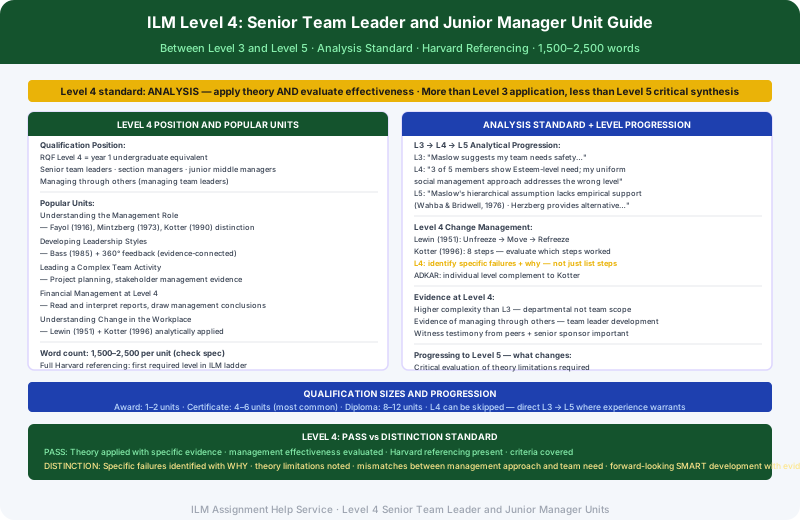
ILM Level 4 is the Senior Team Leader and Junior Manager qualification, sitting at the same RQF (Regulated Qualifications Framework) level as the first year of an undergraduate degree. It is appropriate for candidates who are managing teams of team leaders, running departments within larger operations, taking on their first significant management role after several years in a team leader position, or progressing through an employer-funded management development programme that uses Level 4 as a stepping stone toward Level 5. The distinction between Level 3 and Level 4 is primarily about management scope: Level 3 candidates manage a team directly; Level 4 candidates manage through others, have some degree of strategic influence within their departmental context, and are expected to demonstrate management capability that extends beyond task-level team supervision.
Level 4 vs Level 5: Level 4 requires analysis: applying frameworks to real situations with specific evidence and evaluating the effectiveness of management approaches. Level 5 requires critical analysis: applying frameworks, evaluating their limitations, comparing alternative frameworks, and constructing analytical arguments that go beyond describing what the evidence shows to evaluating what it means for strategic management decisions. At Level 4, a change management assignment might apply Lewin's Force Field Analysis and Kotter's eight-step model to a departmental change initiative, evaluate which steps were implemented effectively and which were not, and propose improvement actions. At Level 5, the same change assignment would require the candidate to evaluate whether Kotter and Lewin are the most appropriate frameworks for the specific change type, compare them to ADKAR and Prosci's change management model, and construct a critical argument about the effectiveness of the change management approach that goes beyond step-by-step evaluation. The word count difference reflects this: Level 4 assignments are typically 1,500–2,500 words; Level 5 assignments typically 2,000–3,500 words. The additional words at Level 5 represent more theory, more critical evaluation, and more sophisticated analytical argument.
Level 4 qualifications are available as Award (one or two units, three to six months), Certificate (four to six units, six to twelve months), and Diploma (eight to twelve units, twelve to eighteen months). Most employer-funded Level 4 programmes are at Certificate level, structured around a core leadership unit, a management unit, and two to three elective units relevant to the candidate's specific management role. The distinction from Level 3 in terms of qualification scope and evidence complexity means that Level 4 Diplomas are substantial programmes that typically provide a comparable development experience to some Level 5 Certificate programmes. The overlap is one of the reasons Level 4 is sometimes treated as equivalent to a short Level 5, though the assessment standards are formally different.
Popular Level 4 Units: Management Role, Leadership Styles, Complex Team Activity, Financial Management
The most commonly studied Level 4 units, and those most frequently requiring additional support, are: Understanding the Management Role (typically 1,500–2,000 words, covering management theories, roles, and responsibilities at middle management level), Developing Leadership Styles (1,500–2,500 words, applying leadership theory to the candidate's own style with 360-degree or self-assessment evidence), Leading a Complex Team Activity (1,500–2,500 words, demonstrating project or task leadership with work-based evidence of a specific initiative), Financial Management at Level 4 (understanding financial statements, variance analysis, and budget management in the context of departmental management), and Understanding Organisational Culture and Ethics (analysis of the candidate's organisation's culture and ethical framework with theory applied). The ILM Level 4 unit specifications for each of these define the specific learning outcomes and assessment criteria; candidates should work from their specific unit specification rather than generic guidance, as unit versions can vary between cohort years and delivery centres.
Understanding the Management Role is typically the first unit studied in a Level 4 programme and sets the analytical standard for subsequent units. It requires candidates to demonstrate understanding of management theories and their application to the management role: Fayol's (1916) functions of management (Planning, Organising, Commanding, Coordinating, Controlling), Mintzberg's (1973) managerial roles (Interpersonal, Informational, Decisional), and the distinction between management and leadership (Kotter, 1990). At Level 4 pass standard, each theory is applied to the candidate's own management role with specific examples. At Level 4 distinction standard, the candidate evaluates which of Mintzberg's role categories they spend most time in, whether that allocation is appropriate for their management context, and what the implications are for their professional development as a manager.
Leadership Theory at Level 4: Stepping Up from Description to Analysis
The leadership theory standard at Level 4 is the critical transition point between Level 3 application and Level 5 critical analysis. Level 3 candidates describe and apply: "Maslow's hierarchy suggests that my team's primary need is safety, which I address through job security assurances." Level 4 candidates analyse: "Applying Maslow's (1943) hierarchy to my team's current motivational pattern, three of the five team members show evidence of Esteem-level need (seeking recognition and development opportunities) while two are operating at Social level (prioritising team inclusion and belonging). This heterogeneity in motivational need suggests that a uniform management approach is insufficient: a finding that aligns with Hersey and Blanchard's (1969) argument that leadership effectiveness requires individual-level adaptation rather than uniform team-level management." Level 5 candidates critically analyse: adding evaluation of the limitations of Maslow's hierarchical assumption, comparison to Herzberg's two-factor theory as an alternative motivational frame, and critical evaluation of whether the S-style adaptation required by situational leadership is consistent with the candidate's current leadership capabilities and organisational context.
The Level 4 leadership theory most commonly assessed and most commonly misapplied is transformational leadership (Bass, 1985). Level 4 candidates often describe transformational leadership accurately, they know the Four Is, they can define Idealised Influence and Inspirational Motivation, but apply it without evidence specificity, producing generic claims ("I am a transformational leader because I inspire my team") rather than evidence-connected analytical statements ("My 360-degree feedback from three direct reports consistently rates my Inspirational Motivation component (4.1/5) as my strongest transformational dimension, consistent with my team's high scores on engagement surveys measuring commitment to team goals"). At Level 4, evidence-connected theory application (connecting theoretical claims to specific workplace evidence) is the pass standard; at Level 5, evaluating those claims critically is the pass standard. The progression is incremental but requires a deliberate change in how the candidate writes: from theory-describing to theory-applying to theory-evaluating.
Work-Based Evidence at Level 4: Higher Complexity Than Level 3, Narrower Scope Than Level 5
Work-based evidence at Level 4 reflects the candidate's management scope: departmental or section management rather than team supervision (Level 3) or organisational or strategic management (Level 5). The evidence types are broadly the same across all levels, meeting records, witness testimony, performance data, project documentation, financial reports, email chains, development plans, but the scope and complexity of each type scales with the management level. A Level 3 team performance record covers a team of five to ten direct reports and shows weekly KPI performance; a Level 4 departmental performance record covers a department of twenty to fifty staff managed through two or three team leaders and shows monthly departmental KPI performance, absence trends, and cost management data. The analytical requirement scales accordingly: Level 4 evidence annotation should demonstrate that the candidate can identify patterns across a larger and more complex evidence set and evaluate their management implications at departmental scale.
Witness testimony at Level 4 is particularly important for evidencing upward and lateral stakeholder management: the candidate's relationships with their line manager, with peers in other departments, and with senior stakeholders above their direct management level. Level 3 witness testimony is primarily from team members and the immediate line manager; Level 4 witness testimony should include evidence from the candidate's management peers and, where possible, a senior sponsor or director who can confirm the candidate's management impact at departmental or cross-functional level. Evidence of managing through others, records of performance conversations between the Level 4 candidate and their team leaders, evidence of the development support provided to team leaders, or outcome data showing team leader development, is specifically valued at Level 4 because it demonstrates the distinctive management competency of the level (managing managers rather than managing workers).
Level 4 Word Count and Assessment Format
ILM Level 4 written assignments are typically 1,500–2,500 words per unit, with some units specifying up to 3,000 words for more complex criteria. The word count is larger than Level 3 (750–1,500 words) to accommodate the analytical depth required, theory applied to evidence with evaluative commentary, but smaller than Level 5 (2,000–3,500 words) because the critical analysis standard, while present, is less extensive. Full Harvard referencing is expected at Level 4 (in-text citations and a reference list), marking the first formal requirement for academic citation in the ILM qualification ladder. Candidates who have not previously used Harvard referencing should familiarise themselves with the author-date format before beginning their Level 4 programme, as referencing errors are a common cause of reduced marks and sometimes referral at this level.
Assignment format at Level 4 is typically unstructured (no required subheadings beyond those implied by the assessment criteria) but candidates who structure their submissions with headings aligned to the learning outcomes find that assessor navigation is easier and criterion coverage is more reliably complete. A Level 4 assignment structure that opens with a brief context statement (the candidate's role and organisation), moves through each learning outcome in sequence (each with theory applied to evidence with evaluation), and concludes with a development reflection and SMART action plan, is a reliable structure for meeting assessment criteria systematically. Work-based evidence appendices should be labelled with criterion references and brief annotations. Even at Level 4, where evidence annotation is less formally required than at Level 5 and Level 7, annotating evidence against criteria prevents the assessor from having to infer the relevance of each appendix item.
Progressing from Level 4 to Level 5: What Changes
The transition from Level 4 to Level 5 is the most significant analytical step in the ILM qualification ladder below Level 7. At Level 4, the standard is analysis: applying theory to evidence and evaluating the effectiveness of management approaches. At Level 5, the standard is critical analysis: evaluating the limitations of the frameworks applied, comparing alternative frameworks, and constructing analytical arguments that integrate multiple theoretical perspectives into a coherent assessment of the candidate's management practice. The word count increase (from 1,500–2,500 words to 2,000–3,500 words) reflects this: more theory, applied more critically, to more complex evidence from a broader management scope.
Practical preparation for Level 5 after Level 4: candidates who develop strong Harvard referencing habits at Level 4 will find the expanded referencing requirements at Level 5 manageable. Candidates who develop the habit of evaluating the limitations of the theories they apply, even informally, at the end of each theoretical application section, are building the critical evaluation muscle that Level 5 assessment requires. Candidates who approach Level 4 evidence with criterion-by-criterion planning, rather than narrative-first drafting, develop the systematic evidence coverage approach that prevents the criterion gaps that cause most Level 5 referrals. The single most impactful preparation activity for Level 5 transition is reading and analysing two or three distinction-level Level 5 submissions (available from some ILM centres as anonymised exemplar materials) to develop a concrete understanding of what the critical analysis standard looks like in practice rather than in the abstract. See also: ILM qualification structure across all levels · ILM Level 3 overview and comparison · ILM Level 5 full qualification guide · Work-based evidence standards across levels · Level 3 team leader unit guidance
Are you a Level 4 candidate finding that Level 5 study guidance online does not quite address your level's specific requirements?
One of the most common challenges for Level 4 candidates is that the online guidance available for ILM assignments is predominantly aimed at Level 5 and Level 7, the most commonly studied levels, and either overshoots the analytical standard required at Level 4 or undershoots it by treating Level 4 as equivalent to Level 3. The Level 4 assessment standard has a specific analytical character (more than application, less than critical synthesis) that generic management assignment guidance does not reliably address. Our support service provides criterion-specific guidance for ILM Level 4 units, calibrated to the Level 4 assessment standard rather than transposed from Level 5 guidance. Theory selection, evidence annotation, Harvard referencing format, and analytical depth guidance are all provided at the Level 4 standard, with criterion-mapped review of draft submissions that identifies specific gaps in analysis or evidence coverage before submission rather than after referral.
Level 4 Change Management and Organisational Units
Change management units at Level 4 (typically "Understanding Change in the Workplace" or equivalent) require candidates to apply change management frameworks to a specific change initiative they have been involved in or have led. The most appropriate frameworks at Level 4 are Lewin's (1951) Force Field Analysis (Unfreeze-Move-Refreeze) and Kotter's (1996) eight-step model, applied analytically (which steps were implemented effectively, which were not, and why) rather than descriptively (listing the steps and confirming they were followed). At Level 4, identifying the specific change management failures, where the initiative deviated from the model's guidance and what the consequences were, and evaluating the lessons learned is the analytical standard that the assessment requires. ADKAR (Hiatt, 2006) is a useful additional framework at Level 4 because its individual-level change focus (Awareness, Desire, Knowledge, Ability, Reinforcement) provides a person-centred analytical complement to Kotter's organisational process model. See also: Level 5 management frameworks in depth · Level 5 change management analytical standard
Financial Management at Level 4: Reading and Interpreting Financial Reports
Financial management at Level 4 requires the candidate to demonstrate that they can read and interpret financial reports relevant to their management role, P&L statements, budget reports, cost reports, variance analyses, and make management recommendations based on that analysis. The Level 4 standard does not require the causal depth expected at Level 5 (where variance analysis must identify specific causal drivers of budget deviations), but does require the candidate to move beyond describing the numbers to drawing management conclusions from them. A Level 4 financial management submission that identifies that labour costs are 8% above budget, notes that the primary driver is overtime expenditure, and recommends a specific management response (reviewing shift scheduling, addressing attendance issues, evaluating staffing level adequacy) has met the Level 4 analytical standard. Candidates who do not have direct budget responsibility should discuss alternative financial evidence with their centre before beginning this unit; options include analysis of cost data relevant to their operational area, shadow budget management for a specific project or initiative, or engagement with financial planning processes as a contributing stakeholder. See also: Level 5 financial management in depth · Financial evidence types and anonymisation
ILM Level 4 Assignment Help: Frequently Asked Questions
Is ILM Level 4 harder than Level 3?
Yes. ILM Level 4 has a higher analytical standard than Level 3. At Level 3, the primary requirement is applying theory to your team context with specific examples (application standard). At Level 4, the requirement is applying theory and evaluating the effectiveness of management approaches, not just "I applied Kotter's model" but "Kotter's step 3 was the weakest element of my change management approach because..." (analysis standard). Level 4 also introduces full Harvard referencing as a requirement, which Level 3 does not. The word count is typically 1,500–2,500 words rather than 750–1,500 words, reflecting the additional analytical depth expected. Candidates progressing from Level 3 to Level 4 should expect a noticeable increase in both the volume and the analytical quality of writing required.
Which management theories are most commonly required at ILM Level 4?
The most commonly required management theories at Level 4 are: Fayol's (1916) functions of management and Mintzberg's (1973) managerial roles (management role units); Bass (1985) transformational leadership and Hersey and Blanchard (1969) situational leadership (leadership style units); Lewin (1951) Force Field Analysis and Kotter (1996) eight-step model (change management units); Maslow (1943), Herzberg (1959), and McGregor (1960) (motivation and people management units); and Porter (1980) Five Forces and PESTLE analysis (business environment units). Full Harvard referencing, in-text citations and a reference list, is required for all theoretical citations at Level 4.
Can I skip Level 4 and go directly from Level 3 to Level 5?
Yes. There is no mandatory requirement to complete Level 4 before studying Level 5. Many candidates progress directly from Level 3 to Level 5, particularly when their current management role has progressed to middle management level and they have the practical management experience that Level 5 work-based evidence requires. Level 4 is most valuable as a bridging qualification for candidates whose management experience and analytical development are not yet at the Level 5 standard, particularly in terms of Harvard referencing, evidence complexity, and analytical depth. If a candidate is an experienced middle manager who can readily provide Level 5 standard evidence and has strong academic writing ability, Level 4 may add limited developmental value compared to progressing directly to Level 5.
Common Questions
Is this service specific to ILM qualifications?
Yes. We specialise exclusively in City & Guilds ILM qualifications. Our writers are selected for their specific knowledge of ILM units, marking criteria, and grade descriptors — not generic academic writing.
Will my assignment be plagiarism free?
Every assignment is written from scratch and run through Turnitin before delivery. You receive a copy of the originality report alongside your completed work.
How quickly can you complete my assignment?
Standard turnaround is 5–7 days. For urgent orders we offer 24-hour and 48-hour expedited delivery at an additional cost. Contact us to confirm availability for your deadline.
What if I'm not happy with the work?
We offer unlimited free revisions within 14 days of delivery. If we cannot meet your requirements after multiple revisions, we offer a full refund — no questions asked.