ILM Level 3 is the entry point for leadership and management qualifications and the most widely studied ILM level in the UK, taken predominantly by team leaders, first-line supervisors, shift managers, and emerging managers who are managing a team for the first time or formalising management practice they have already developed through experience. The assessment standard at Level 3 is introductory by design: candidates are not expected to produce the critical analysis required at Level 5, nor the strategic synthesis demanded at Level 7. They are expected to demonstrate that they understand the relevant management and leadership concepts, can apply them to their own team and workplace context with specific examples, and have identified specific learning and development actions that connect directly to the evidence they have presented. The most common reason for Level 3 referral is descriptive writing: candidates who describe their team, their organisation, and their management activities at length without connecting any of it to the theoretical frameworks or assessment criteria that the unit requires. This guide provides criterion-level support for the most commonly studied Level 3 units, with specific guidance on applying theory to first-line management practice at the pass standard and beyond.
Level 3 Qualification Structure: Award, Certificate, and Diploma
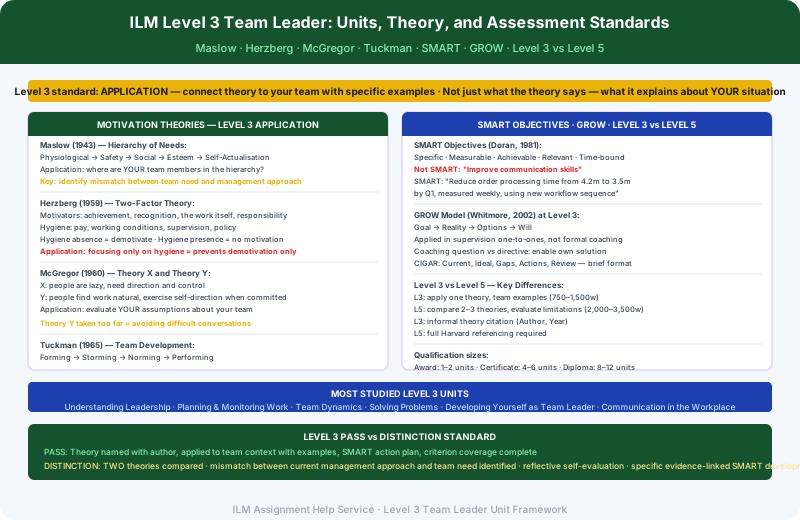
The ILM Level 3 qualification is available in three sizes: Award (the smallest, covering one or two units and typically completed in three to six months), Certificate (covering four to six units, typically completed in six to twelve months), and Diploma (covering eight to twelve units, typically completed in twelve to eighteen months). Most employer-funded ILM Level 3 programmes are at Certificate level, combining mandatory units with a selection of elective units chosen to match the candidate's management role and development needs. The most commonly studied units at Level 3 are: Understanding Leadership (3461-302 or 8600-300), Planning and Monitoring Work (8600-309), Understanding Team Dynamics (3461-305 or 8600-307), Solving Problems and Making Decisions (8600-304), and Developing Yourself as a Team Leader (8600-308). Most units are assessed through a single written assignment of 750–1,500 words, with the specific word count and format stated in the unit specification. Level 3 does not require formal Harvard referencing in most units, but any theoretical models cited should be referenced by author and year in parentheses to demonstrate awareness of the academic context for the ideas used.
The Award is typically taken by candidates who need to demonstrate specific management competency in one or two areas, often chosen by the employer to address a specific development need. The Certificate is the standard delivery model for team leader development programmes and provides sufficient breadth to develop rounded first-line management capability. The Diploma is appropriate for team leaders who are developing a more comprehensive management foundation, often as preparation for progression to ILM Level 4 or Level 5. Candidates studying the Diploma should be aware that the later units often build on evidence and analytical capability developed in the earlier units: criterion mapping and evidence planning from the start of the programme, rather than unit by unit, reduces duplication and improves coverage across the full qualification.
Planning and Monitoring Work: SMART Objectives and Team Performance Evidence
The Planning and Monitoring Work unit (8600-309) is one of the most practically grounded units in the Level 3 programme: it requires candidates to demonstrate that they can plan work for their team, allocate tasks and resources, set objectives, monitor performance against those objectives, and take corrective action when performance deviates from plan. The assessment criteria specifically require evidence of SMART objective setting (Doran, 1981), objectives that are Specific, Measurable, Achievable, Relevant, and Time-bound, applied to real team tasks or individual team member development needs.
SMART objectives at Level 3 pass standard: the candidate presents one or more objectives they have set for their team (or for themselves as a team leader), demonstrates that each objective meets all five SMART criteria, and provides evidence of how progress against the objectives is being monitored. The most common error at Level 3 is objectives that are specific but not measurable ("improve customer service quality"), measurable but not time-bound ("complete the induction programme"), or time-bound but not specific enough to be actionable ("reduce team absence by March"). A fully SMART Level 3 objective: "Reduce the team's average order processing time from 4.2 minutes to 3.5 minutes per order by the end of Q1, measured by the weekly order processing time report, by introducing the new workflow sequencing process agreed with the operations manager in January." The evidence for monitoring typically takes the form of performance data (KPI reports, attendance records, quality scores), meeting records showing progress reviews, or annotated work plans showing actual vs planned completion. Work-based evidence for this unit should include real planning documents, rota plans, task allocation sheets, project plans, not just a written description of planning activities.
Performance monitoring at Level 3: the unit requires candidates to demonstrate that they monitor team performance systematically, identify deviations from plan, and take appropriate corrective action. Corrective action does not mean management-by-exception in the negative sense, punishing underperformance. It means identifying the cause of the deviation (was the objective unrealistic? was the team member under-supported? were the resources insufficient?) and addressing the cause rather than just the symptom. The analytical requirement at Level 3 is limited but present: candidates must show that they understand why performance deviated from plan, not just that it did.
Motivation Theory at Level 3: Maslow, Herzberg, and McGregor Applied to Teams
The three most commonly applied motivation theories at Level 3 are Maslow's Hierarchy of Needs (1943), Herzberg's Two-Factor Theory (1959), and McGregor's Theory X and Theory Y (1960). Understanding how to apply each to a specific team context, rather than just describing what each theory says, is the difference between a pass and a strong submission at Level 3.
Maslow's (1943) Hierarchy of Needs proposes that human motivation is driven by a progressive hierarchy of needs: Physiological (food, shelter, rest; met in a work context by adequate pay and working conditions), Safety (security, stability; met by job security, safe working environment, fair procedures), Social/Belonging (connection, relationships; met by positive team culture, social interaction, belonging to a valued group), Esteem (recognition, achievement, respect; met by feedback, praise, promotion, responsibility), and Self-Actualisation (realising full potential; met by challenging work, development opportunities, creative autonomy). The Level 3 application: the candidate identifies where their current team members' motivational needs are primarily located in the hierarchy, with specific examples, and evaluates whether their management approach is addressing those needs. A team of new starters will have predominantly Safety and Social needs; an experienced team of specialists who have been in role for several years may have predominantly Esteem and Self-Actualisation needs. A team leader who provides primarily social management support (team-building, social events) to a team whose primary unmet need is Esteem (recognition, development, progression) is addressing the wrong need level, and Maslow provides the analytical frame to identify and explain that mismatch.
Herzberg's (1959) Two-Factor Theory distinguishes motivators (factors that positively motivate: achievement, recognition, the work itself, responsibility, advancement) from hygiene factors (factors whose absence demotivates but whose presence does not actively motivate: company policy, supervision quality, working conditions, pay, interpersonal relationships). The Level 3 application: the candidate identifies specific motivators and hygiene factors relevant to their team and evaluates whether their management approach is addressing both. A team leader who focuses exclusively on improving working conditions (hygiene factors) but fails to create opportunities for recognition and meaningful achievement (motivators) will prevent demotivation but will not generate positive motivation. This is exactly the distinction Herzberg's research identified. McGregor's (1960) Theory X and Theory Y: Theory X managers assume that people are fundamentally lazy, motivated primarily by financial reward or the avoidance of punishment, and require close supervision and direction. Theory Y managers assume that people find work naturally motivating when the conditions are right, will exercise self-direction when committed to organisational goals, and can be developed to take on greater responsibility. The Level 3 application requires the candidate to evaluate whether their own management approach leans toward Theory X or Theory Y assumptions, with specific evidence from their management practice, and to consider whether that orientation is appropriate for their specific team context.
Communication Unit: Stakeholder Communication Evidence at Level 3
The communication unit at Level 3 (Understanding the Communication Process in the Workplace or equivalent) requires candidates to demonstrate that they understand the communication process, can select appropriate communication methods for different purposes and audiences, and can evaluate the effectiveness of their own communication practice. The assessment criteria typically require evidence of communication with internal stakeholders (team members, line manager, other managers) and, where relevant, external stakeholders (customers, suppliers, regulatory contacts).
Communication evidence at Level 3: the most useful evidence types are email chains demonstrating professional written communication (annotated to identify the communication purpose, audience, and approach), meeting records showing team briefings or one-to-one conversations, examples of written plans or instructions provided to team members, and witness testimony from the line manager or team members confirming the quality and effectiveness of the candidate's communication. The analytical requirement at Level 3 is limited but specific: the candidate must evaluate the effectiveness of their communication, not just describe it, and identify any instances where the communication approach could have been more effective and what they would do differently. Communication barriers, categorised as physical (noise, distance), psychological (assumptions, emotional state, defensiveness), linguistic (jargon, vocabulary mismatch), or cultural (different communication norms and expectations), should be identified from the candidate's own experience and connected to specific communication evidence. At Level 3, citing a communication theory such as Shannon and Weaver's (1949) transmission model or Mehrabian's (1971) work on non-verbal communication demonstrates theoretical awareness and contributes to the analytical depth assessors look for in stronger submissions.
GROW Model in Level 3 Supervision Contexts
The GROW coaching model (Whitmore, 2002: Goal, Reality, Options, Will) is introduced at Level 3 in the context of team leader supervision and one-to-one management conversations rather than as a formal coaching programme. At Level 3, GROW is most commonly applied in the context of performance conversations, development discussions, and problem-solving support with team members, brief coaching conversations (10–20 minutes) within the natural flow of a management one-to-one rather than dedicated coaching sessions. The assessment criterion is typically about understanding and applying a coaching or mentoring approach in a team leader context, not about demonstrating formal coaching practice as an ILM Coaching and Mentoring candidate would need to.
GROW at Level 3: the candidate describes a specific instance of applying a coaching approach with a team member, identifies the GROW framework used (even if it was applied informally rather than with explicit reference to the model), and evaluates the effectiveness of the approach: what questions were used, what the team member's response was, what they committed to doing, and whether the coaching conversation led to a better outcome than a directive approach would have. The key Level 3 application principle for GROW is the distinction between a coaching approach (asking questions that help the team member identify their own solution) and a directive management approach (telling the team member what to do). A team leader who can demonstrate that they applied GROW to a specific team member situation, with specific questions used at each stage, and that the team member generated a specific action commitment as a result, has met the Level 3 criterion for coaching and mentoring approaches. CIGAR (Current, Ideal, Gaps, Actions, Review) is an alternative that works particularly well for brief supervision conversations because its explicit Gaps stage makes the connection between current performance and desired performance concrete and visible for both parties.
How Level 3 Differs from Level 5: What Changes in Expectations
Understanding the difference between Level 3 and Level 5 assessment expectations matters both for Level 3 candidates who intend to progress to Level 5 and for candidates who are uncertain whether they are studying at the right level for their current role and experience. At Level 3, the analytical requirement is application: demonstrating that you can take a theoretical framework and apply it to your own team context with specific examples. At Level 5, the analytical requirement is critical analysis: demonstrating that you can apply a framework, evaluate the limitations of that application, and compare the framework's explanatory power to alternative frameworks for the same situation. At Level 3, one motivation theory applied to one team context is sufficient to meet a criterion. At Level 5, the same criterion requires the candidate to compare two or three theories, evaluate which is most applicable to their specific management context and why, and identify what each theory does not explain about their situation.
Word count and depth: Level 3 assignments are typically 750–1,500 words per unit; Level 5 assignments are typically 2,000–3,500 words. The additional word count at Level 5 reflects not more descriptive content but greater analytical depth: more theory applied more critically to more complex evidence. The evidence complexity also changes: Level 3 evidence reflects first-line management practice (team management, task planning, individual development); Level 5 evidence reflects middle management practice (financial management, cross-functional projects, organisational change, senior stakeholder management). Tuckman's (1965) model of team development (Forming, Storming, Norming, Performing) is assessed at Level 3 in the context of understanding team dynamics; at Level 5, the same model is applied with critical evaluation of its limitations (linear progression, contextual sensitivity, the impact of leadership style on stage progression) and compared with alternative models such as Belbin (1981) and Hackman (2002). The theoretical content overlaps; the analytical standard differs fundamentally.
Word Count and Format Expectations at Level 3
ILM Level 3 word counts vary by unit and by ILM centre delivery, but the typical range is 750–1,500 words per written assignment, with some units specifying up to 2,000 words for more complex criteria. Candidates should always work from the specific unit specification for their cohort, as word count requirements can vary between ILM centre and cohort delivery versions of the same unit. As a general rule, Level 3 word counts are sufficient for one or two well-developed theoretical applications with specific workplace examples, not for a comprehensive academic literature review or an extended discussion of multiple competing theories. The most effective Level 3 assignment structure allocates approximately one third of the word count to each of: (1) the theoretical framework applied, with citations and specific workplace examples; (2) the candidate's self-evaluation of their current practice against the framework; and (3) the development actions identified, with specific plans and timelines. Harvard referencing is not formally required at Level 3 in most units, but citing theoretical models by author and year in the text (Maslow, 1943; Herzberg, 1959) demonstrates academic awareness and strengthens the analytical credibility of the submission. Candidates planning to progress to Level 5 should develop Harvard referencing habits at Level 3 to ease the transition.
Is your Level 3 assignment being referred because it is too descriptive, or because you are not sure how to connect your workplace experience to the theoretical frameworks?
The most common Level 3 challenge is the gap between having relevant workplace experience and knowing how to present it in the theoretical terms that the assessment criteria require. Most Level 3 candidates are doing exactly what the theory describes: they are applying Maslow-aligned approaches to team motivation, or Tuckman-aligned strategies to team development, without knowing that what they are doing has a theoretical name and a body of research behind it. The job of a Level 3 assignment is to make that connection explicit: to name the theory, cite the author, and show that your specific management practice aligns with (or usefully departs from) what the theory describes. Our support service helps Level 3 candidates identify which theoretical frameworks apply to their specific management evidence, structure their assignments to connect experience to theory at the criterion level, and develop the specific SMART action plans that assessors need to see in the conclusions. Support is provided for all Level 3 units across Award, Certificate, and Diploma programmes.
Tuckman's Team Development Model and Belbin's Team Roles at Level 3
Tuckman's (1965) four-stage team development model, Forming (team assembles, uncertainty, polite behaviour), Storming (conflict emerges as roles and processes are challenged, team members establish themselves), Norming (team establishes norms and working relationships, collaborative patterns develop), and Performing (team functions effectively, high trust, shared goals), is the most commonly applied team dynamics framework at Level 3. Belbin's (1981) team roles model, identifying nine functional team roles including Plant (creative problem-solver), Resource Investigator, Co-ordinator, Shaper, Monitor Evaluator, Teamworker, Implementer, Completer Finisher, and Specialist, is frequently applied alongside Tuckman to identify which team roles are represented and which are missing in the candidate's current team. At Level 3, applying one or both models to a specific team situation with evidence of the team's current developmental stage or role balance demonstrates exactly the theoretical application standard the assessment expects. See also: ILM assignment structure and theory application · Level 3 qualification overview · Progression to Level 5 · ILM coaching skills for team leaders · Reflective account writing for Level 3
Self-Development at Level 3: Learning Styles and CPD Planning
Several Level 3 units include self-development criteria, requiring candidates to assess their own strengths and development needs as a team leader, identify their preferred learning style, and construct a personal development plan. Honey and Mumford's (1986) learning styles, Activist, Reflector, Theorist, and Pragmatist (developed from Kolb's 1984 experiential learning cycle), provide the most commonly used framework for learning style self-assessment at Level 3. A Level 3 self-development assignment that identifies the candidate's dominant learning style with a specific example of how that style manifests in their approach to management development (an Activist who prefers learning by doing new tasks over reading management theory, for instance), evaluates whether that style is serving their development needs, and proposes specific CPD activities that extend beyond their comfort style, demonstrates exactly the self-analytical awareness that the criterion requires. The personal development plan should be SMART, the same standard as team performance objectives, and should be connected directly to the development needs identified in the self-assessment rather than being a generic list of management training aspirations. See also: Reflective account writing for Level 3 · Level 3 unit requirements
ILM Level 3 Team Leader Assignment Help: Frequently Asked Questions
How much theory do I need to cite in an ILM Level 3 assignment?
ILM Level 3 assignments typically require one to three theoretical frameworks per unit assignment: enough to demonstrate that the candidate can connect management practice to established theory, but not the breadth of theoretical engagement that Level 5 and Level 7 require. For a motivation unit, applying Maslow (1943) and Herzberg (1959) with specific team examples is sufficient to meet the pass standard; adding McGregor (1960) with a self-evaluation of your management style moves toward distinction. The key requirement is application: showing how each theory explains or connects to something specific in your team context, rather than description of what each theory says without connecting it to your evidence.
What evidence do I need for the ILM Level 3 Planning and Monitoring Work unit?
The Planning and Monitoring Work unit requires evidence of real planning activity in your management role: a rota, work schedule, project plan, or task allocation document showing planned resources and timelines; SMART objectives set for yourself or your team members, with evidence of how progress is monitored (KPI data, performance records, meeting notes with progress review discussion); and evidence of corrective action taken when performance deviated from plan, a meeting note showing a performance conversation, or an updated plan showing how you adjusted resource allocation in response to an issue. All evidence should be annotated to map it to the specific assessment criterion it evidences and to explain what management decision or approach it demonstrates.
Does ILM Level 3 require Harvard referencing?
Most ILM Level 3 unit specifications do not formally require full Harvard referencing; you are not typically required to produce a formatted reference list at the end of your assignment. However, any theoretical models you cite should be referenced in the text using the author-date format: (Maslow, 1943) or (Tuckman, 1965). Citing theories without author attribution ("according to the hierarchy of needs model...") is weaker than citing them with the author and year, which demonstrates awareness of the theoretical source. Candidates who plan to progress to Level 5 should develop consistent in-text citation habits at Level 3, as full Harvard referencing is required at Level 5 and Level 7.
Common Questions
Is this service specific to ILM qualifications?
Yes. We specialise exclusively in City & Guilds ILM qualifications. Our writers are selected for their specific knowledge of ILM units, marking criteria, and grade descriptors — not generic academic writing.
Will my assignment be plagiarism free?
Every assignment is written from scratch and run through Turnitin before delivery. You receive a copy of the originality report alongside your completed work.
How quickly can you complete my assignment?
Standard turnaround is 5–7 days. For urgent orders we offer 24-hour and 48-hour expedited delivery at an additional cost. Contact us to confirm availability for your deadline.
What if I'm not happy with the work?
We offer unlimited free revisions within 14 days of delivery. If we cannot meet your requirements after multiple revisions, we offer a full refund — no questions asked.