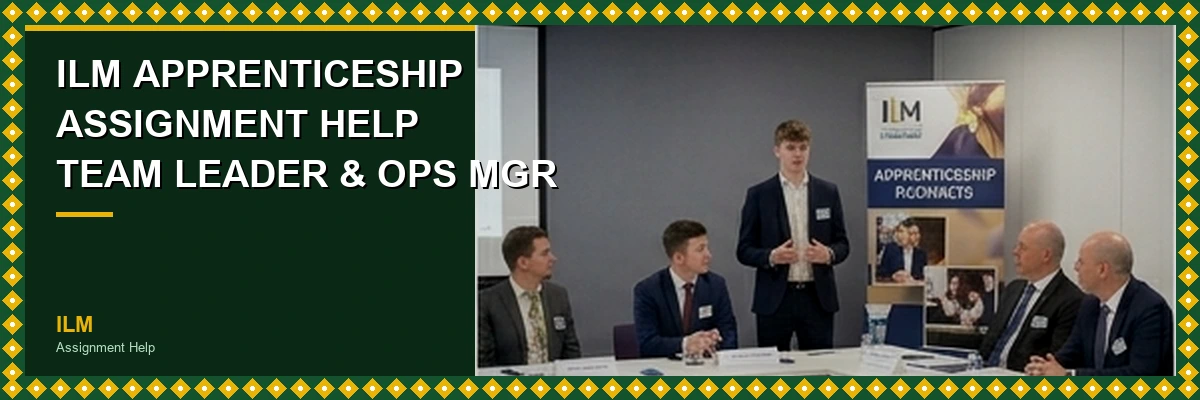
How ILM Qualifications Fit Within Management Apprenticeship Standards
Management apprenticeship standards in England are structured around three components: on-the-job learning (at least 80% of the apprentice's time), off-the-job training (at least 20% of the apprentice's time, formally documented), and End Point Assessment (EPA), an independent assessment of whether the apprentice has met the full apprenticeship standard. An ILM qualification is frequently embedded within the apprenticeship as the off-the-job learning and academic component. Completing the ILM qualification provides the knowledge and skills evidence base for EPA, but the ILM qualification itself is not the apprenticeship outcome. The apprenticeship is completed through EPA, not through ILM certificate or diploma award.
Three management apprenticeship standards are most commonly associated with ILM qualifications. The Team Leader/Supervisor Standard (Level 3 Apprenticeship) typically incorporates an ILM Level 3 Certificate or Diploma as the academic component. The Operations/Departmental Manager Standard (Level 5 Apprenticeship) typically incorporates an ILM Level 5 Certificate or Diploma. The Senior Leader Standard (Level 7 Apprenticeship) typically incorporates an ILM Level 7 Diploma. In each case, the ILM qualification runs alongside the apprenticeship's on-the-job learning and evidence of work-based practice, with the full qualification and portfolio submitted as gateway evidence before EPA.
Apprenticeship-route ILM candidates face a more complex evidence requirement than standalone ILM students: their written submissions must satisfy both ILM unit assessment criteria and the Knowledge, Skills, and Behaviours (KSBs) specified in the apprenticeship standard. Dual mapping, structuring evidence to address ILM criteria and apprenticeship KSBs simultaneously, is the defining challenge of apprenticeship-route ILM assignment work.
Team Leader/Supervisor Apprenticeship (Level 3): ILM Portfolio Requirements
The Team Leader/Supervisor Level 3 Apprenticeship Standard specifies the KSBs that the apprentice must demonstrate across their programme. The Knowledge component includes understanding management techniques, organisational governance, project management fundamentals, and change management principles. The Skills component includes managing people and developing relationships, building trust, communicating purpose and direction, and inclusive decision-making. The Behaviours component includes taking responsibility, being inclusive, agile, and professional. ILM Level 3 assignment units must be mapped to these KSBs so that the portfolio demonstrates both ILM criterion coverage and apprenticeship standard evidence.
A single Level 3 ILM assignment, for example a reflective account on Managing Workplace Projects, may simultaneously provide evidence for the ILM unit assessment criteria (describing the project management approach used, applying a theoretical framework, evaluating outcomes) and for specific apprenticeship KSBs (Skills: manages projects, Knowledge: project management). Annotating portfolio submissions with both ILM criterion references and KSB references is essential for gateway preparation: the external verifier and the EPA organisation both need to see this mapping clearly documented.
The 20% off-the-job training requirement also affects Level 3 apprentices. Every ILM study activity (attending taught sessions, researching theory, writing assignments, receiving mentoring from the training provider) must be recorded and evidenced as off-the-job training. The employer and training provider jointly track this and confirm it has been met at gateway. Apprentices who do not maintain their off-the-job training records consistently throughout the programme frequently discover a gateway gap that delays EPA. Maintaining this documentation from day one is critical.
Operations/Departmental Manager Apprenticeship (Level 5): ILM Portfolio Requirements
The Operations/Departmental Manager Level 5 Apprenticeship Standard requires evidence of operational management competence at department or function level. KSBs at Level 5 cover a broader scope than Level 3: operational and project management, financial management, leading people and managing change, building relationships, and communication. The ILM Level 5 assignment units must simultaneously meet ILM assessment criteria (critical analysis of management theory applied to own organisational context) and provide portfolio evidence for these KSBs.
Level 5 dual mapping is more demanding than Level 3 because both the ILM criteria and the KSBs are more complex. An ILM Level 5 assignment on Leading Innovation and Change, requiring critical analysis of Kotter's 8-step model applied to a real change initiative, may evidence multiple KSBs simultaneously: Knowledge (change management), Skills (leads and manages change), and Behaviours (takes responsibility, acts as a role model). The ILM submission must be substantive enough to meet Level 5 critical analysis requirements while also providing the granular KSB evidence that the EPA assessor will examine.
Harvard referencing is mandatory in Level 5 ILM assignments. At apprenticeship Level 5, the expectation is that the candidate demonstrates the ability to engage with academic management literature: this is assessed as part of the Knowledge component of the standard (understanding management theory and research) as well as by the ILM assessor. Management textbooks and peer-reviewed journals should be correctly cited throughout Level 5 apprenticeship portfolio submissions.
Dual Mapping: Writing Evidence for Both ILM Criteria and Apprenticeship KSBs
Dual mapping is the practice of structuring ILM assignment submissions so that each piece of evidence simultaneously addresses ILM unit assessment criteria and specific apprenticeship KSBs. Without deliberate dual mapping, apprentices often find themselves completing ILM assignments that meet ILM criteria but lack the specific KSB-referenced evidence the EPA organisation needs, or producing separate KSB evidence logs that duplicate work already in the ILM portfolio. Integrated dual mapping eliminates this duplication and ensures the portfolio is as efficiently evidenced as possible.
The practical technique: before writing each ILM assignment, identify the ILM assessment criteria the unit requires and list the specific apprenticeship KSBs that the assignment content can address. Structure the assignment to explicitly reference both, for example a reflective account on managing a team change can include a section on how the candidate's approach demonstrated the Leadership KSB (leading and managing change) as well as addressing the ILM criterion (critically analyse own change management approach using a theoretical framework). Annotate the submitted portfolio with a mapping table that cross-references every section of evidence to both ILM criteria and KSB references. This mapping table is what the EPA assessor and external verifier will use to verify gateway readiness.
Gateway Requirements: What Must Be in Place Before Your EPA
Gateway is the formal milestone that marks the end of the apprenticeship learning period and the point at which the apprentice is confirmed as ready for EPA. EPA cannot proceed until all gateway requirements have been met. Gateway is the responsibility of the employer, training provider, and apprentice jointly. Missing any gateway requirement delays EPA and can cause significant disruption to the apprentice's programme timeline.
Gateway requirements for management apprenticeship standards include: completion of all ILM qualification units (the full qualification must be achieved before gateway); employer confirmation that the apprentice has demonstrated the KSBs in their workplace role (the employer signs a confirmation statement); training provider confirmation of programme completion including the 20% off-the-job training requirement; achievement of English and Maths qualifications at Level 2 (GCSE Grade 4 or equivalent) where the apprentice did not hold these prior to starting the apprenticeship; and portfolio compilation and sign-off confirming the evidence is complete, current, and mapped to the apprenticeship standard.
The ILM qualification completion is often the rate-limiting step at gateway: apprentices who fall behind on ILM assignments may be ready in their workplace practice but unable to proceed to EPA because their qualification is incomplete. Keeping ILM assignments on track throughout the programme, rather than completing them in a rush at the end, is the most effective gateway preparation strategy.
End Point Assessment (EPA): What to Expect and How to Prepare
The EPA is conducted by an independent End Point Assessor: not the employer, not the training provider, and not the ILM assessor. The assessor is appointed by the EPA organisation (in many cases ILM itself as the EPA organisation, or another approved provider) and their role is to make an independent judgement about whether the apprentice meets the full apprenticeship standard.
For the Team Leader/Supervisor and Operations/Departmental Manager standards, EPA typically comprises a structured professional discussion (a 60 to 90 minute interview in which the assessor draws on portfolio evidence and asks the apprentice to explain, justify, and reflect on their management practice) and a work-based project report (for some standards). The professional discussion is not a test of theoretical knowledge in isolation: it is a structured conversation about the apprentice's actual management activities, evidenced by their portfolio, which demonstrates whether those activities meet the apprenticeship standard.
Preparation for EPA should focus on: knowing your portfolio deeply (being able to speak fluently about every portfolio entry and the management decisions it reflects); being able to connect portfolio evidence to specific KSBs (so you can respond when the assessor asks "how does this piece of evidence demonstrate the Leadership KSB?"); practising articulating critical self-reflection (evaluating what worked, what you would do differently, and what you have learned from management experience, not just describing outcomes); and demonstrating awareness of the broader organisational context of your management practice. For more detailed EPA preparation guidance, see ILM end point assessment (EPA) help.
Standalone ILM vs Apprenticeship-Route ILM: Key Differences
Standalone ILM candidates complete the qualification without the apprenticeship funding framework, KSB requirements, gateway milestone, or EPA. Their obligation is to meet ILM unit assessment criteria in their portfolio evidence. Apprenticeship-route candidates must simultaneously meet ILM criteria, evidence apprenticeship KSBs, document 20% off-the-job training, meet gateway requirements, and prepare for independent EPA. The ILM assignment work is substantively the same (the same units, the same criteria, the same academic standard), but the additional mapping, documentation, and EPA preparation requirements make the overall programme management more demanding. This is why targeted apprenticeship assignment support, which addresses both ILM criteria and KSB mapping, is more specific than standard ILM Level 3 or Level 5 assignment guidance.
Using the Apprenticeship Levy for ILM Qualifications
Employers in England with a payroll over £3 million pay the apprenticeship levy (0.5% of payroll) into a digital account administered by HMRC, which can only be used to fund apprenticeship training through approved providers. Management apprenticeship standards (Team Leader at Level 3, Operations Manager at Level 5, Senior Leader at Level 7) are eligible for levy-funded delivery. Employers who use the levy to fund these programmes effectively receive management qualification and development investment (including the embedded ILM qualification) at no direct cash cost to the training budget, since funding is drawn from the levy account. For small employers (below the levy threshold), the government co-invests 95% of apprenticeship training costs. Understanding this funding model helps managers and HR teams access ILM qualification delivery that might otherwise be deprioritised due to training budget constraints. See also: ILM Level 3 assignment help · ILM Level 5 assignment help.
Common Questions
Is this service specific to ILM qualifications?
Yes. We specialise exclusively in City & Guilds ILM qualifications. Our writers are selected for their specific knowledge of ILM units, marking criteria, and grade descriptors — not generic academic writing.
Will my assignment be plagiarism free?
Every assignment is written from scratch and run through Turnitin before delivery. You receive a copy of the originality report alongside your completed work.
How quickly can you complete my assignment?
Standard turnaround is 5–7 days. For urgent orders we offer 24-hour and 48-hour expedited delivery at an additional cost. Contact us to confirm availability for your deadline.
What if I'm not happy with the work?
We offer unlimited free revisions within 14 days of delivery. If we cannot meet your requirements after multiple revisions, we offer a full refund — no questions asked.